November 16,2023
Enterprise Name
The sealant has very strong adhesion and performs well even on glass and aluminum. After curing, it remains flexible and shows no cracking. Perfect for our facade projects.
Jul 3, 2026
Your project needs determine whether to use acrylic or silicone sealants. Each is "better" under certain situations. Acrylic Sealant Waterproof Grade is great for door frames, window perimeters, and trim work where aesthetics matter because to its paintability and internal adaptability. Superior flexibility and water immersion resistance make silicone the preferred material in high-movement joints and persistent wet zones. The selection depends on substrate type, movement capability, moisture exposure, and if your construction or restoration project needs post-application painting.
The chemical structure and curing methods distinguish these sealants. Aquatic acrylic sealants form plasto-elastic seals by moisture evaporation. Contemporary waterproof caulks use hydrophobic modifiers and silane coupling agents to improve water resistance. Silicone sealants, on the other hand, are polymer-based compounds that cure by chemical cross-linking to generate totally elastic connections with high movement tolerance.
Acrylic polymer emulsions in water, plasticizers, fillers, and additives make up acrylic formulations. Curing creates a flexible yet solid seal when water evaporates inward. Sealant usually needs 12–24 hours to withstand rain. Silicone sealants convert siloxane polymers into silicone rubber with atmospheric moisture, attaining rain resistance in 30 minutes and full cure in 24-48 hours independent of joint depth.
Know industry testing requirements to understand waterproof ratings. ASTM C834 defines sealants by type and grade, with acrylics as Type OP. After seven days of water immersion, ASTM C794 adhesion-in-peel samples must sustain over 90% cohesive failure without bond delamination to be waterproof. ISO 9047 classifies movement capabilities, with premium acrylic sealants commonly certified at ±12.5% joint movement. Professional-grade Acrylic Sealant Waterproof Grades are certified, unlike gap fillers unsuitable for moisture.
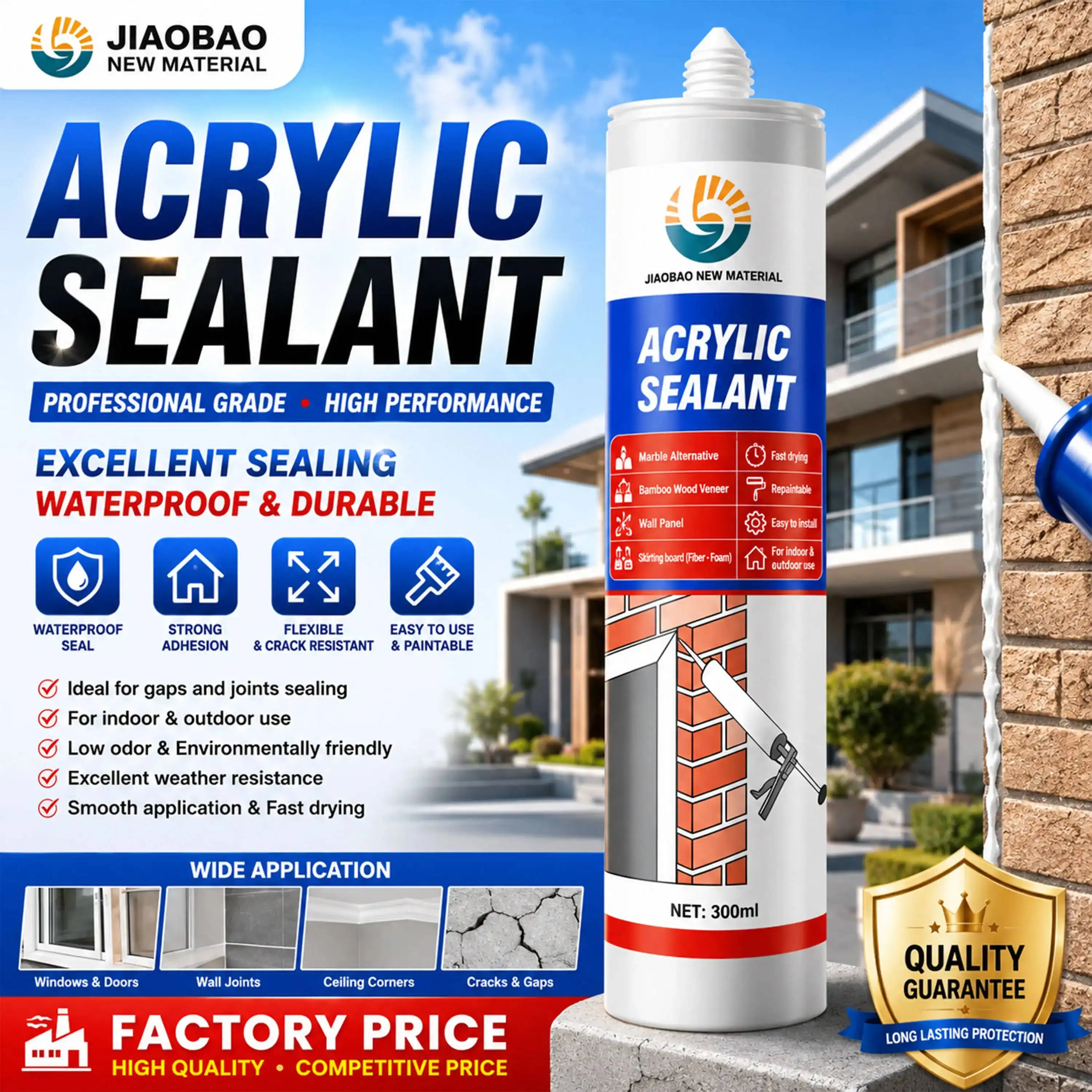
Professional Acrylic Sealant Waterproof Grades are designed for moisture resistance and visual diversity. Shandong Jiaobao's one-component RTV acrylic sealer is waterproof after thorough testing in real-world situations. The product exceeds standards with 0% sag in vertical applications, 0.5-hour skin-dry time, and 0.64 MPa tensile strength at 23°C.
When buying Acrylic Sealant Waterproof Grades, procurement experts should consider many key criteria. Elongation at break must reach 200% to withstand thermal expansion without cohesive breakdown. High solid content (75–85%) reduces curing shrinkage, a major failure point in poorer goods. Due to its thixotropic consistency and 163 ml/min extrusion rate, our formulation applies efficiently without droop or rundown on vertical joints. Primers are not needed on concrete, ceramic, plasterboard, wood, aluminum, and glass since the substance sticks well.
The Acrylic Sealant Waterproof Grade addresses industry issues. Managers installing curtain walls require sealants that won't wash off if rain comes within hours. Hydrophobic modifiers in our Acrylic Sealant Waterproof Grade recipe prevent early cure re-emulsification. Door and window perimeter seals on building facades exposed to weather are protected. Bathroom baseboards, kitchen backsplash edges, and drywall corner joints resist splash water and high humidity without degrading.
Both sealant kinds are vital in construction, although their performance suits various applications. Understanding these distinctions minimizes specification mistakes that cause seal failure and costly repair.
Silicone sealants are very elastic and may withstand joint movement of ±50% without losing adherence. They are necessary for structural glass, parking structure expansion joints, and other thermally cycling connections. Acrylic Sealant Waterproof Grades provide ±12.5% to ±15% movement capacity, suitable for low-movement connections like window frames or partition walls in stable climates. Silicone's movement tolerance is needed for aluminum curtain walls in harsh temperature zones, whereas acrylic works well for temperate home window installations.
Acrylic formulas excel in painted tasks. The non-porous silicone surface rejects paint, leaving seal lines that detract from architecture. Installing ornate trim, crown molding, or baseboards requires sealants that vanish beneath latex or acrylic paints. Our Acrylic Sealant Waterproof Grade may be painted after curing, allowing flawless color matching. This feature is essential for high-end residential, hotel, and commercial buildings that require visual consistency. When selected during procurement, custom color options—white, black, grey, or RAL-matched shades—allow aesthetic integration without painting.
Initial material costs favor acrylic sealants, which cost 30-40% less than silicone. Water-based cleaning saves solvents and application time, increasing labor efficiency. Painting over acrylic seals in 2-4 hours speeds up projects and cuts labor expenses. For certain applications, silicone's longer service life in high-movement applications may justify higher upfront expenditure. Acrylic's 10-15 year durability at a reduced cost makes interior office partition seals reliable, while silicone's 20-25 year longevity benefits distribution center loading dock expansion joints.
Sealant selection involves methodical study of environmental conditions, substrate kinds, and performance requirements to match product capabilities to project needs. Overlooking compatibility criteria or misinterpreting certification requirements causes specification errors.
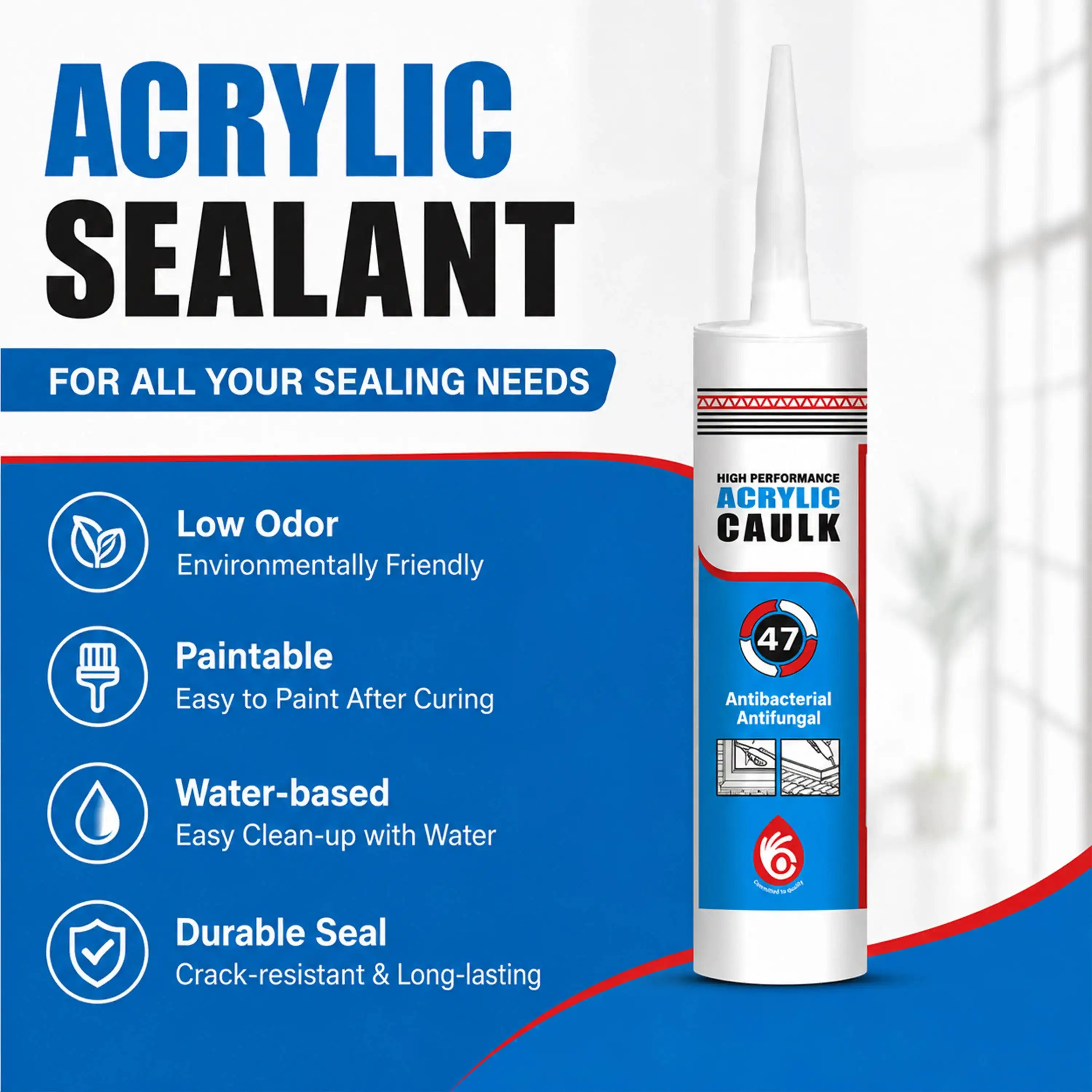
Home building jobs with door frames, windows, and interior trim work suit Acrylic Sealant Waterproof Grade. Paintable, low-odor, and easy to apply, the material suits inhabited environments with minimum interruption. Acrylic's moisture resistance benefits HVAC ducting penetrations and condensation-prone regions, while curtain wall structural joints need silicone or polyurethane. Industrial establishments should use acrylic for equipment mounting seals and modest wall penetrations and higher-performance chemistry for thermal stress or chemical-exposed process equipment.
Adhesion between sealant and substrate is key to sealing. Mechanical interlocking and chemical adhesion make our Acrylic Sealant Waterproof Grade composition strong on porous substrates including concrete, brick, and gypsum board. The formula's silane coupling agents connect non-porous materials like glass, metal, and painted surfaces. Purchase managers should seek adhesion test data for their project substrates—ASTM C794 peel adhesion after water immersion is the most accurate performance indicator.
Prioritize quality-system-certified manufacturers while sourcing. Shandong Jiaobao offers CE-marked items that fulfill international regulations and is ISO-certified. We have mature production procedures and consistent batch-to-batch quality after 13 years of manufacture. Request technical data sheets with test results, not simply specs, when assessing providers. Check shelf life guarantees—our 12-month stability ensures factory-to-jobsite product performance. Before bulk purchase, established manufacturers provide sample testing programs for on-site validation.
Misapplication destroys even the best sealer. Proper surface preparation, ambient conditions, and application methods affect seal durability and waterproofness. These standards safeguard investments and prevent failure.
Adhesion requires clean, dry, and contaminant-free joints. Remove loose masonry, dust, paint flakes, and old sealant with wire brushes or motorized cleaners. Oil, grease, and curing chemical contamination required isopropyl alcohol cleaning and drying. Porous substrates like concrete benefit from mild dampening to decrease sealant water extraction during cure, but standing water must be absent. Application temperatures should be 5°C to 40°C and humidity below 80% for optimum curing. Conditioning frozen or sun-exposed surfaces before sealant application is necessary.
Correct bead sizing eliminates typical failures. Joint width should be twice predicted mobility and depth should equal breadth for efficient load distribution. Closed-cell backer rod controls depth and prevents three-sided adhesion, which inhibits movement and tears cohesively. Keep extrusion pressure constant by cutting cartridge nozzles at 45 degrees to meet joint width. To optimize contact, use moistened spatulas or shaping tools to push sealant on both joint sides immediately after application. Our formulation's 163 ml/min extrusion rate allows large-scale application without fatigue or equipment stress.
Systematic inspections are needed for large projects to find application flaws before waterproofing. Joint filling without voids, substrate adherence, and smooth tooled surfaces without air bubbles should be visually checked. After skinning, pull sealant edges to assess adhesion—proper application resists separation and rips cohesively rather than delaminating. Many field failures are caused by temperature and humidity changes, therefore record them. Seals should be inspected 30 and 90 days after application for cracking, shrinkage, or adhesion loss, which may indicate specification or application issues.
Acrylic Sealant Waterproof Grade excels in low-to-moderate movement joints for paintability, minimal odor, and moisture resistance. It is favored for door and window perimeters, interior trim, and facade weather sealing due to its cost-effectiveness, aesthetic variety, and simplicity of application. Choosing between acrylic and silicone sealants requires project-specific analysis, not conventional wisdom. High-movement structural joints and constant water immersion require silicone. When procurement personnel match sealant skills to project needs, performance and budget improve.
Can outdoor Acrylic Sealant Waterproof Grades be used? Weatherproof acrylic sealants work well in outdoor applications exposed to rain, UV radiation, and temperature cycling. Avoiding yellowing and chalking, they adapt to seasonal fluctuations. These are not ideal for constant water immersion like pools or pond margins. Exterior door frames, window perimeters, and facade weather sealing are appropriate exterior applications for decades of service.
Impact of Acrylic Sealant Waterproof Grade on sealant lifespan? Compared to acrylic fillers, Acrylic Sealant Waterproof Grade formulations with improved polymer systems and hydrophobic additives last longer. In correctly specified applications, these changes avoid moisture-induced deterioration and retain adhesion and flexibility for 10-15 years. Standard non-waterproof acrylics can degrade in 2-3 years if exposed to moisture, thus grade matters.
Acrylic sealants are suitable for aesthetic and interior projects due to their paintability, low cost, and ease of cleanup. Silicone is better at movement, severe temperatures, and continuous water immersion. Acrylic should be used for low-movement joints that need painted surfaces and silicone for structural connections, moist regions, or high-performance applications where elasticity justifies the cost premium.
Shandong Jiaobao New Material Co., Ltd. makes quality acrylic sealants for B2B construction, industrial, and architectural applications. Since 2013, we have supplied Acrylic Sealant Waterproof Grade with high quality and flexible customization. Our ISO and CE-certified products function consistently with full technical assistance. Wholesale prices, 1-2 week production lead times, OEM/ODM services, and RAL color matching are available. Our compositions fulfill ASTM and international standards and come in 300ml and 600ml cartridges or sausages. For technical specifications, sample requests, and project-specific sealing quotes, email dorashen@cnjiaobao.com.
1. American Society for Testing and Materials. "ASTM C834-22: Standard Specification for Latex Sealing Compounds." ASTM International, 2022.
2. International Organization for Standardization. "ISO 9047:2021 Building Construction—Jointing Products—Determination of Adhesion/Cohesion Properties of Sealants at Variable Temperatures." ISO Standards Catalogue, 2021.
3. Building Research Establishment. "Sealant Selection and Specification for Building Facades: Technical Guidance for Procurement Professionals." BRE Publications, 2020.
4. National Institute of Building Sciences. "Waterproofing Integrity: Comparative Analysis of Acrylic and Silicone Sealant Performance in Commercial Construction." NIBS Technical Reports, 2019.
5. Society of Architectural and Engineering Technicians. "Field Performance Evaluation of Water-Based Sealants in Climate-Diverse Applications." SAET Research Journal, Volume 28, 2021.
6. Construction Specifications Institute. "Sealants and Waterproofing Materials: Best Practices for Material Selection and Quality Assurance in B2B Procurement." CSI Practice Guides, 2023.
November 16,2023
Enterprise Name
The sealant has very strong adhesion and performs well even on glass and aluminum. After curing, it remains flexible and shows no cracking. Perfect for our facade projects.
November 16,2023
Enterprise Name
Stable quality across batches. Our customers especially like the smooth application and consistent extrusion. It helps reduce installation time on site.
November 16,2023
Enterprise Name
I used it for bathroom sealing. Excellent waterproof performance and no mold issues so far. It's been holding up very well in humid conditions.
November 16,2023
Enterprise Name
The neutral silicone works well on sensitive materials without corrosion. Very suitable for industrial applications requiring stable performance.
_1779347426672.webp)