November 16,2023
Enterprise Name
The sealant has very strong adhesion and performs well even on glass and aluminum. After curing, it remains flexible and shows no cracking. Perfect for our facade projects.
Oct 1, 2026
When it comes to structural bonding in automotive glass assembly, selecting the right PU auto glass sealant high strength product is not a minor procurement decision — it directly affects vehicle safety, production line continuity, and regulatory compliance. Whether you are bonding windshields on an OEM assembly line or managing aftermarket glass replacements at scale, the adhesive you choose must meet precise mechanical and chemical benchmarks. This guide walks through what defines a high-strength polyurethane sealant, how to evaluate your options, and how to source reliably for professional automotive applications.
Tensile strength and elongation at break are the main ways to rate high-strength automotive glass sealants. A good structural-grade recipe has a tensile strength of at least 2.2 MPa and a stretch at break of 400% or more. These numbers are not made up; they show how hard the bond line is pushed mechanically during car accidents, roof crush situations, and airbag release events that follow FMVSS 212 rules.
Polyurethane based on isocyanates or silane-modified polyether (SMP) chemistry are used in most professional-grade formulas. One-component moisture-curing systems are most common on production lines because they don't need to be mixed and dry reliably in controlled humidity. The silane-modified polyether variant achieves almost no sagging, great adhesion to ceramic frits on glass, and compatibility with electrophoretic painted metal flanges—all of which are important contact surfaces for installing a windshield.
When it comes to OEM, the difference between a high-modulus (HM) adhesive and a standard-modulus product is very important. High-modulus formulations are stiffer, giving the vehicle body measurable torsional rigidity, and they work better with the ADAS sensors and antenna systems that are built into modern windshields. Standard modulus goods are better at handling slow thermal cycles, but they don't add as much to the structure of the frame.
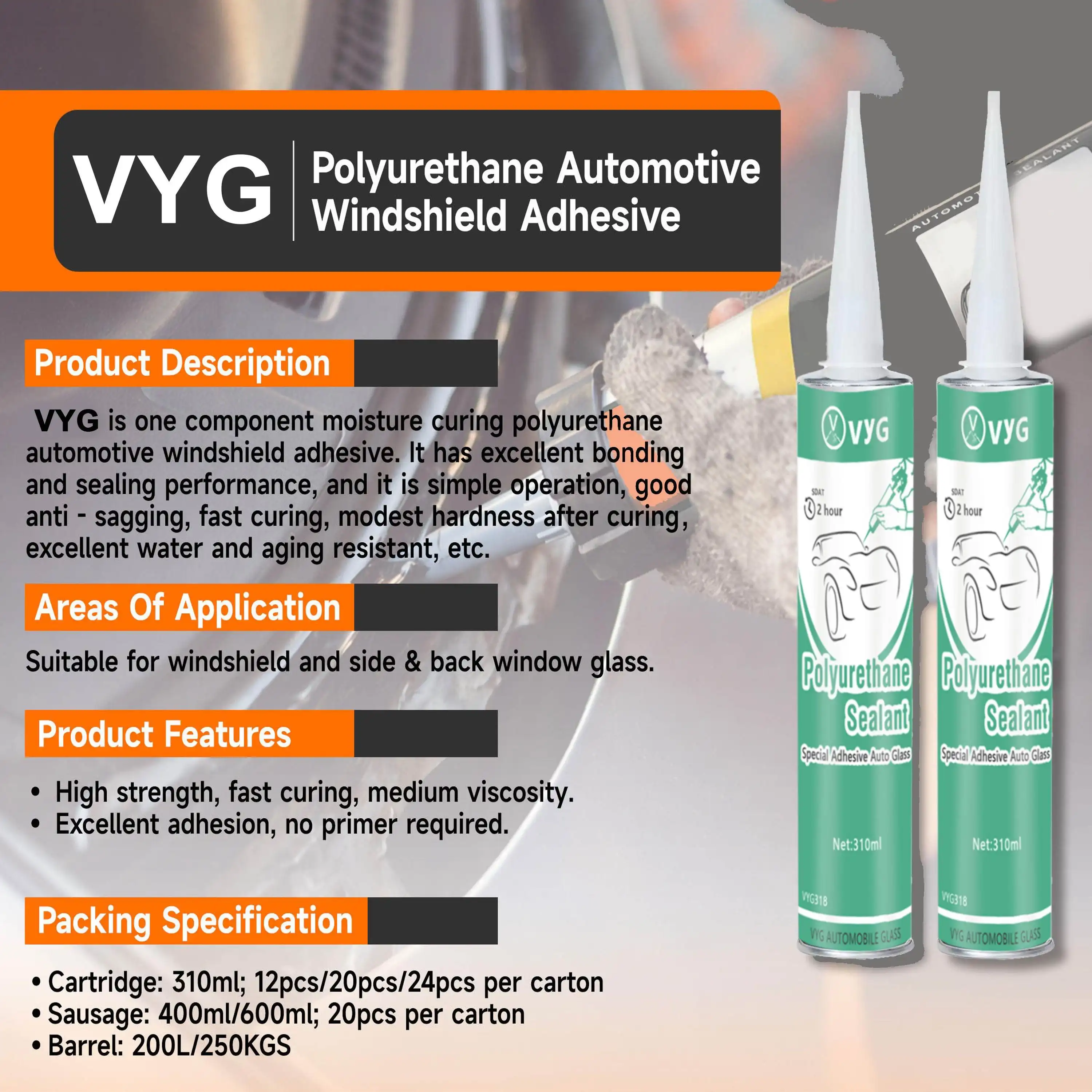
Professional automotive sealants must be able to withstand UV damage, thermal expansion cycles from -40°C to over 90°C, and constant vibration from the road without losing their stickiness. In structural applications, PU auto glass sealant high strength polyurethane and silane-modified polyether adhesives work better than standard silicone sealants because they keep their shear resistance under dynamic load. Silicone, on the other hand, can't do this reliably in bonded glass assemblies because it has a lower modulus.
A substance with a Shore A hardness of about 45 and a solid content of about 99% stays the same size after curing. This means that the shape of the beads on automatic filling lines stays the same. Tack-free times of 15 to 40 minutes, based on the temperature of the room, let assembly lines keep going without having to wait for too long, and the structure still fully cures.
On the U.S. and European markets, sealant formulas need to meet VOC emission limits set by EPA rules and EU REACH rules. As part of their inbound inspection procedures, professional buyers who do PPAP paperwork checks and IATF 16949 supplier audits will need full Safety Data Sheets (SDS) and compliance statements. Quality engineering teams have a lot less work to do when suppliers give them all the technical information they need, like TDS, SDS, and batch test reports.
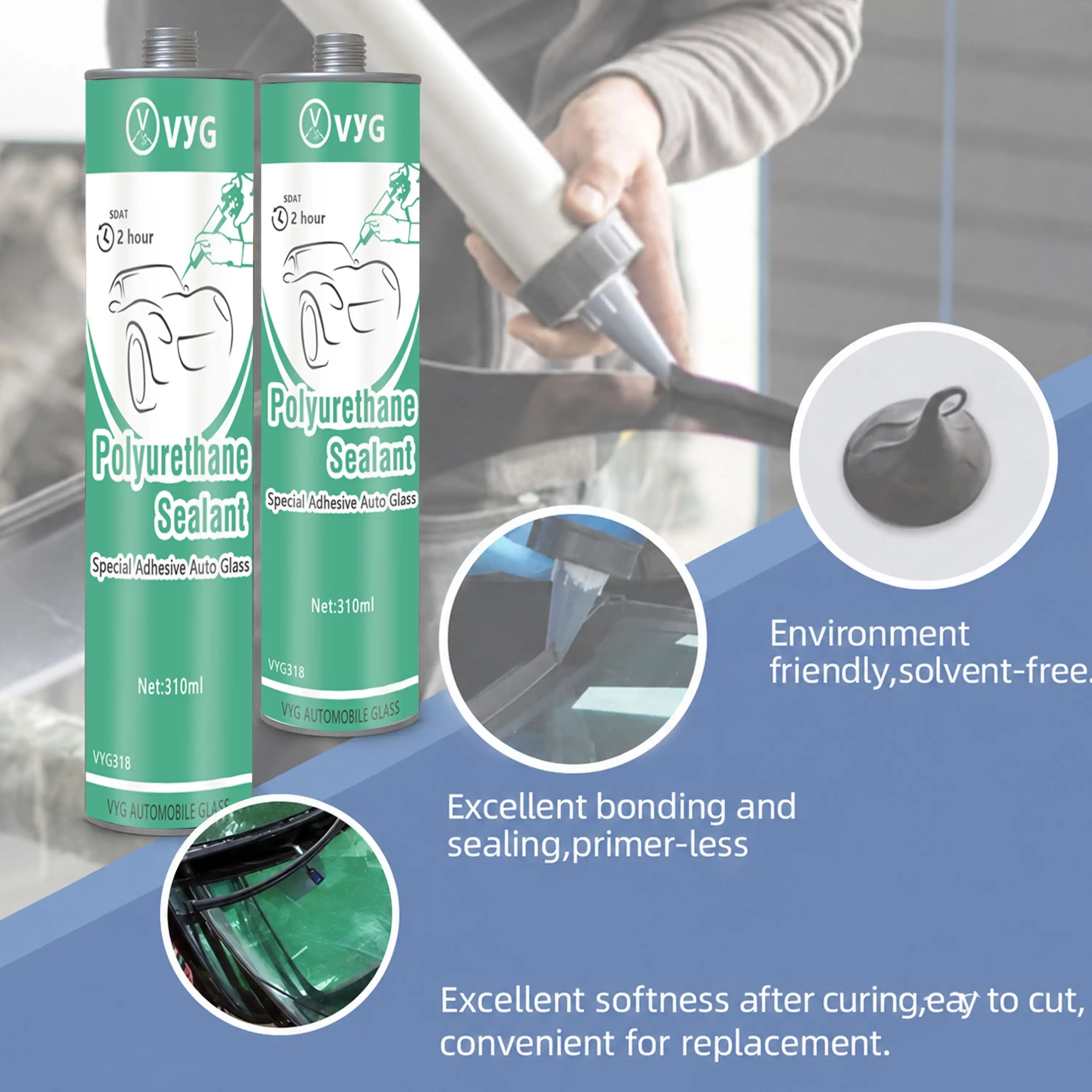
It's not necessary to have the same personality for every job, and procurement managers should compare several suppliers before deciding on one. Here are the main types of stuff that should be looked at:
These differences have direct effects on money. If you choose a product that is too small, you could end up with warranty claims, line stops, and safety responsibility. When you choose a product that is too specific, the cost of materials goes up for no reason. Verified technical data, such as whether a PU auto glass sealant high strength rating is actually required for your joint design, and the shape of your application will help you make the right choice.
After looking at these choices, most procurement teams for windshield assembly lines choose SMP or high-modulus PU formulations because they offer the best balance between structural reliability and ease of use.
Substrates that are clean and dry must be used. Before you put on primer or activator, make sure the glass ceramic frits are dry and free of oil, dust, and water. Scuff and clean metal pinchweld plates with the right fluid. On automated lines, robotic dispensing equipment should be set up to keep the bead sizes the same. A triangle-shaped bead profile should be used so that it contacts both the glass and flange surfaces at the same time for full wet-out.
When the temperature and humidity are normal, the speed at which silane-modified formulations cure is about 3.5 mm per day. Within 15 to 40 minutes, the surface will be free of tack. How long it takes for the structure to fully cure before the vehicle can be used again depends on the environment and the formulation. Instead of just using public data files, quality engineers should test each batch individually to make sure that Safe Drive-Away Time (SDAT) claims are true.
People who work with sealants that haven't fully set should wear rubber gloves and safety glasses. Enough air flow keeps isocyanate or residual solvent vapors from building up in closed workstations. If you store it correctly, between 5°C and 25°C, out of direct sunlight and away from moisture, it will last for 12 months and keep the same viscosity from batch to batch.
Finding structural automotive sealants takes more than just comparing prices. For supply chains that are in line with IATF 16949, the buyer audit method includes checking the supplier's ability to produce a PU auto glass sealant high strength product consistently, check quality control paperwork, and make PPAP submissions. As important as product specifications are, delivery timeliness is just as important. For example, car production lines work on takt time, and a late shipment can cost thousands of dollars an hour to stop the line.
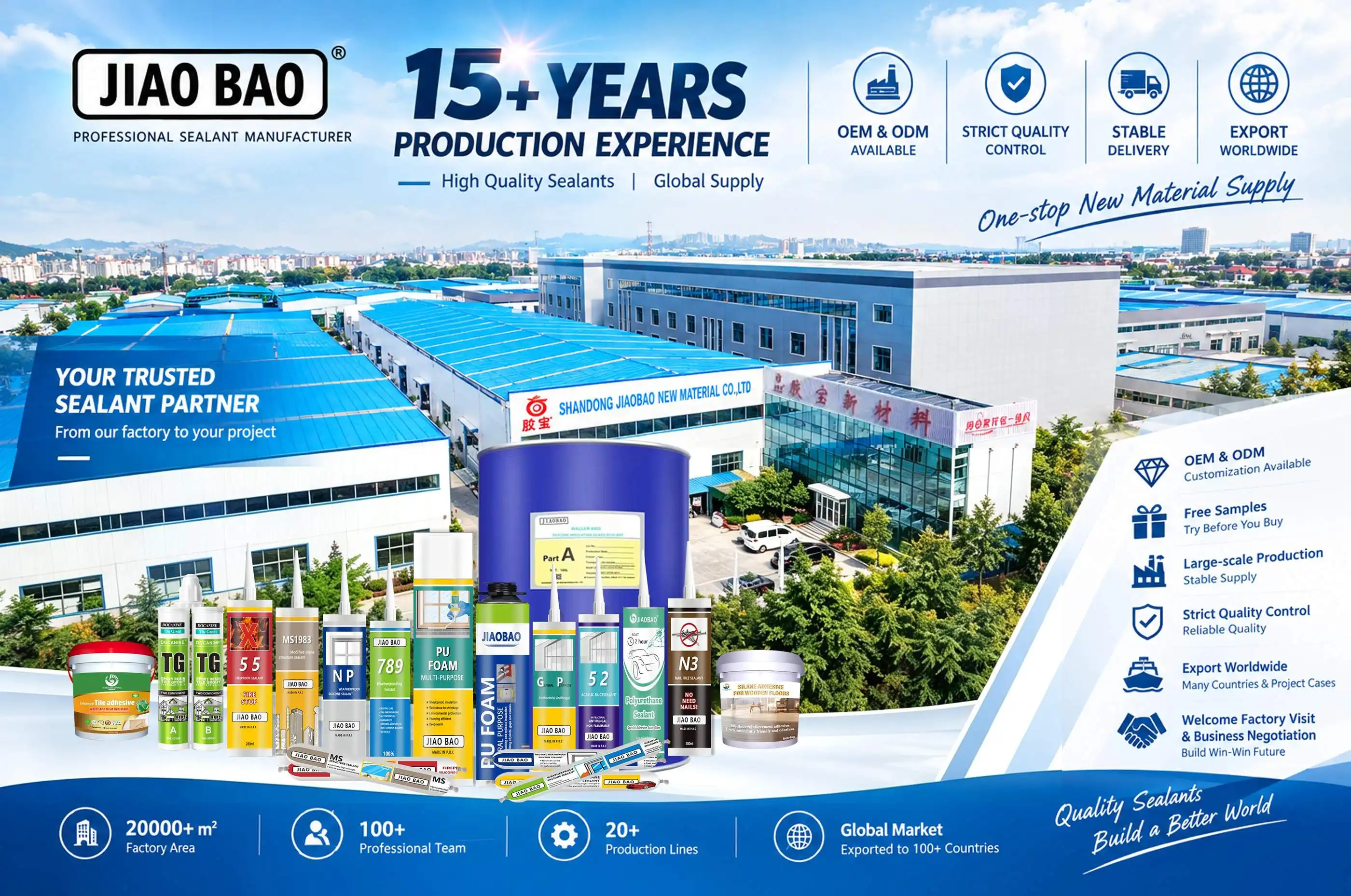
Since 2013, Jiaobao has been making professional-grade sealants. The company has ISO and CE certifications that show that the quality of their products is always high. The company has production wait times of one to two weeks and offers flexible choices for both sea and land freight. This is helpful for producers who manage just-in-time inventory. OEM and ODM customization is possible for specific needs in terms of viscosity, color, packaging format, and volume. You can choose from 300 ml cartridges and 600 ml sausage packs, and the colors can be white, black, gray, or something else you want.
When purchasing teams are looking for a PU auto glass sealant high strength supplier, Jiaobao offers full technical documentation, such as SDS and test data, and guaranties quality with a policy that lets customers return or get a replacement product at any time during the product's shelf life. This level of commitment after the sale lowers the risk of procurement, especially during the initial periods when suppliers are being qualified.
For structural car glass sealing, you need sealants that can handle crash loads, heat stress, and the speed of a production line all at the same time. For installing windshields, bonding panels, and sealing gaps, you need a silane-modified polyether or a PU auto glass sealant high strength adhesive that has a tensile strength of at least 2.2 MPa and an elongation at break of close to 400%. Three important things to keep in mind when choosing a seller are matching the product's chemistry to the needs of the application, making sure that each batch is consistent through incoming inspection, and working with a supplier who gives full technical paperwork.
Silicone sealants don't have the shear modulus that is needed to keep a windshield in place during a crash or when airbags deploy. PU auto glass sealant high strength and SMP formulations give vehicle bodies their torsional stiffness through structural rigidity in a way that silicone can't.
A silane-modified polyether sealant cures at a rate of about 3.5 mm per day in normal conditions (23°C, 50% relative humidity). Depending on the temperature, a tack-free surface forms in 15 to 40 minutes.
Ask for quality management certifications like ISO 9001 or IATF 16949, CE marking paperwork, full SDS, technical data sheets, and batch test reports that can be used with PPAP. For automotive Tier 1 and Tier 2 supplier qualification checks, these papers are required by law.
Yes. Silane-modified polyether formulations can be used with most factory-applied automobile paints and can be painted over after they have fully dried. This means they can be used for bonding body panels and trimming without damaging the outside surface of the car.
Jiaobao sells professional, qualified sealants that are made for uses like putting together autoglass and gluing structures together. With over 13 years of experience making PU auto glass sealant high strength, we are a reliable manufacturer that can help you with your buying process by giving you full technical documentation, OEM customization, and lead times of 1 to 2 weeks. You can email our team at dorashen@cnjiaobao.com or go to shandongjiaobao.com to ask for samples or talk about terms for bulk purchases.
1. Adhesives & Sealants Industry Magazine — "Structural Bonding in Automotive Glazing Applications," 2022.
2. SAE International Journal of Materials and Manufacturing — "High-Modulus Polyurethane Adhesives and Windshield Retention Performance," 2021.
3. Journal of Applied Polymer Science — "Silane-Modified Polyether Sealants: Mechanical Properties and Automotive Applications," 2020.
4. National Highway Traffic Safety Administration (NHTSA) — "FMVSS 212: Windshield Mounting Standard Technical Review," 2019.
5. ISO/IEC Standards Publication — "ISO 8510: Adhesives — Peel Test for a Flexible-Bonded-to-Rigid Test Specimen Assembly," 2006, reaffirmed 2020.
6. Construction and Building Materials Journal — "Elongation and Tensile Performance of One-Component Moisture-Curing Sealants Under Cyclic Loading," 2023.
November 16,2023
Enterprise Name
The sealant has very strong adhesion and performs well even on glass and aluminum. After curing, it remains flexible and shows no cracking. Perfect for our facade projects.
November 16,2023
Enterprise Name
Stable quality across batches. Our customers especially like the smooth application and consistent extrusion. It helps reduce installation time on site.
November 16,2023
Enterprise Name
I used it for bathroom sealing. Excellent waterproof performance and no mold issues so far. It's been holding up very well in humid conditions.
November 16,2023
Enterprise Name
The neutral silicone works well on sensitive materials without corrosion. Very suitable for industrial applications requiring stable performance.
_1779347426672.webp)