November 16,2023
Enterprise Name
The sealant has very strong adhesion and performs well even on glass and aluminum. After curing, it remains flexible and shows no cracking. Perfect for our facade projects.
Jul 20, 2026
In building, manufacturing, and remodelling projects, nail free silicone can be used to bond structures together instead of mechanical fasteners. By forming molecular-level links between materials like metal, glass, wood, and concrete, this heavy duty nail free adhesive can replace screws and nails. In contrast to traditional ways of fastening, these improved polymer formulations protect the surface structure while providing better load-bearing capacity. The technology solves important problems in the industry, like keeping the substrate from getting damaged, keeping the aesthetics, and bonding different materials that expand and contract at different rates.
The chemistry behind these adhesives makes them different from other ways to mount things. These days, formulas use modified silane polymers that harden through moisture activation instead of heat or pressure.
Modified silane polymers are what professional-grade nail free adhesives are made of. These compounds go through hydrolysis and condensation reactions when they come into contact with moisture in the air. This makes cross-linked networks that stick to substrate surfaces at the molecular level. Under normal conditions of 23°C and 50% relative humidity, this curing process moves along at a rate of about 2.5 mm per 24 hours. Corrosion does not happen on aluminum and stainless steel because of the neutral curing mechanism. This means that these adhesives can be used for metal curtain walls where galvanic reactions could weaken the structure.
Knowing the steps in the curing process helps project managers make good plans for when to install things. Within 20 minutes of application, surface skinning happens, which lets the position be changed during the first placement. It takes 24 hours for the adhesive to become strong enough to handle, but 72 hours for all of its mechanical properties to develop. When fully cured, the material has a tensile strength of 2.5 N/mm² and an elongation at break of 300%. This gives it the right amount of rigidity and flexibility to handle building movement and vibration.
In the building industry, silane modified polymers are the most common type. Other chemicals are used for specific tasks. Polyurethane-based formulations dry faster at first, but they give off more volatile organic compounds (VOCs). Epoxy versions are very resistant to heat up to 150°C, but they are not flexible. Hybrid recipes mix silane technology with acrylic parts to make them better at filling gaps in uneven surfaces. When purchasing sealants for curtain wall projects, procurement managers should give silane systems top priority because they can stand up to weather and UV light for 20 years.
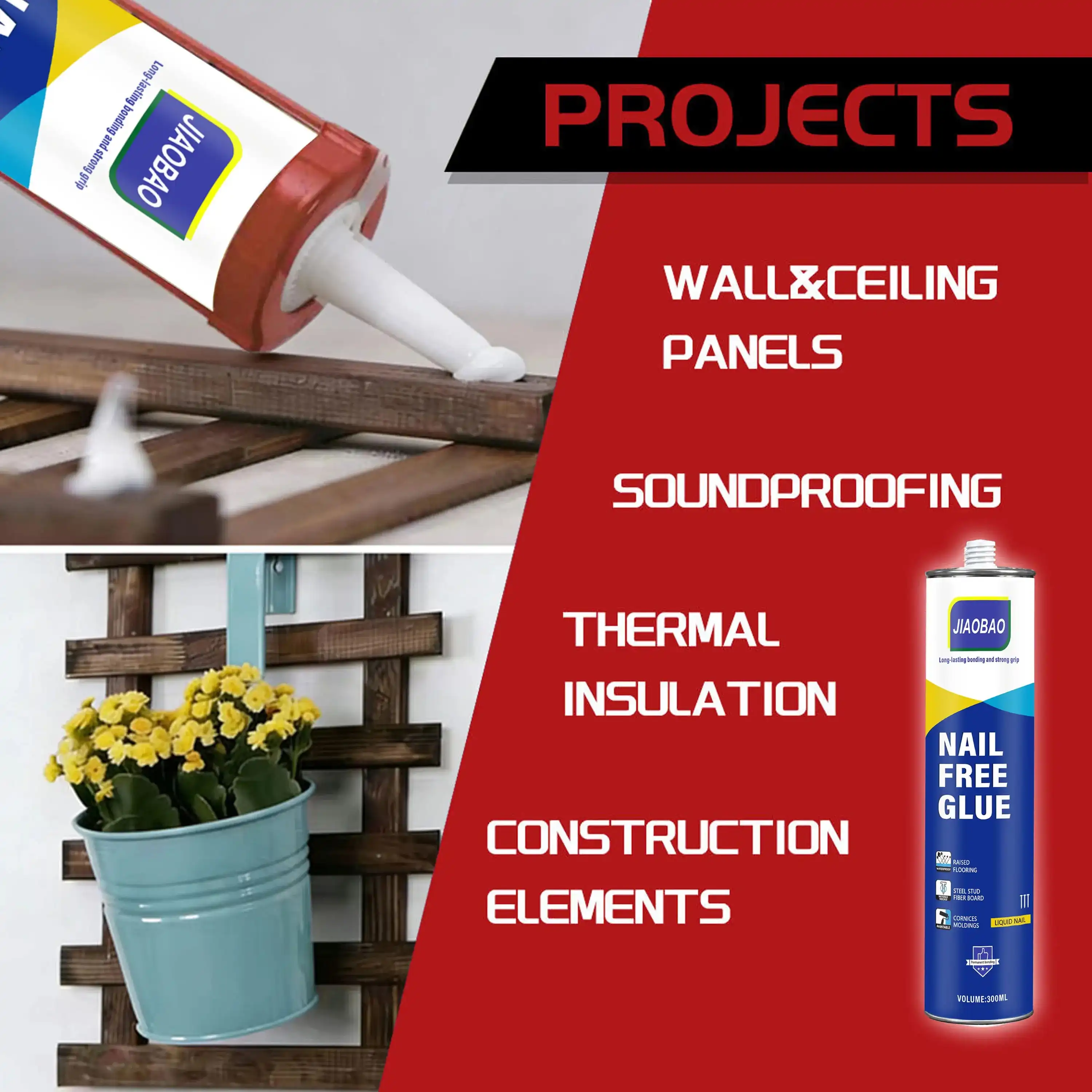
In many different fields, these bonding systems are very useful because they can solve substrate-specific problems that mechanical fasteners cannot.
Structural silicone adhesives like heavy duty nail free adhesive are used by curtain wall installers to stick glass panels to aluminum framing systems. The glue allows for different levels of thermal expansion between the materials while keeping the weatherproof seals. Manufacturers of doors and windows use colored formulations to match powder-coated frames. This gets rid of the need for connection spots that are obvious and look bad. When compared to mechanical fastening methods, prefabricated building companies bond decorative wall cladding directly to structural panels. This cuts installation time by 40%. With this technology, signs can be mounted flush on brick facades without having to drill through waterproofing membranes.
Electronics companies use silane adhesives to seal the housings of HVAC parts. These adhesives stay flexible at temperatures ranging from -40°C to 80°C. Automotive makers glue trim panels to metal subframes, making joints that stop vibrations and lower noise inside the car. Because the glue is dielectric, it can be used to put together electrical appliances where metal fasteners could cause short-circuits. To seal the refrigerator's sections, companies that make home appliances use food-grade formulas that meet NSF/ANSI 51 standards for materials in food zones.
Glass processing plants can bond mirrors to backing boards without having to worry about drill-through moisture damage to the silver finish. Stone fabricators use adhesive to stick marble tiles to vertical surfaces. The adhesive fills in tiny gaps to make sure that the tiles are fully connected across the entire bonding area. In metal fabrication shops, different alloys like aluminum are joined together with stainless steel. If mechanical fasteners were used, they would create galvanic cells that would cause the steel to rust quickly. The gap-filling qualities of the glue can work with surface flaws up to 5 mm, which is very helpful when joining rough-cut stone or cast metal parts.
These examples show why procurement managers in the manufacturing and construction industries are asking for nail free adhesives more and more as main fastening options instead of extra ones. The technology improves structure performance and gets around problems with standard fastening methods.
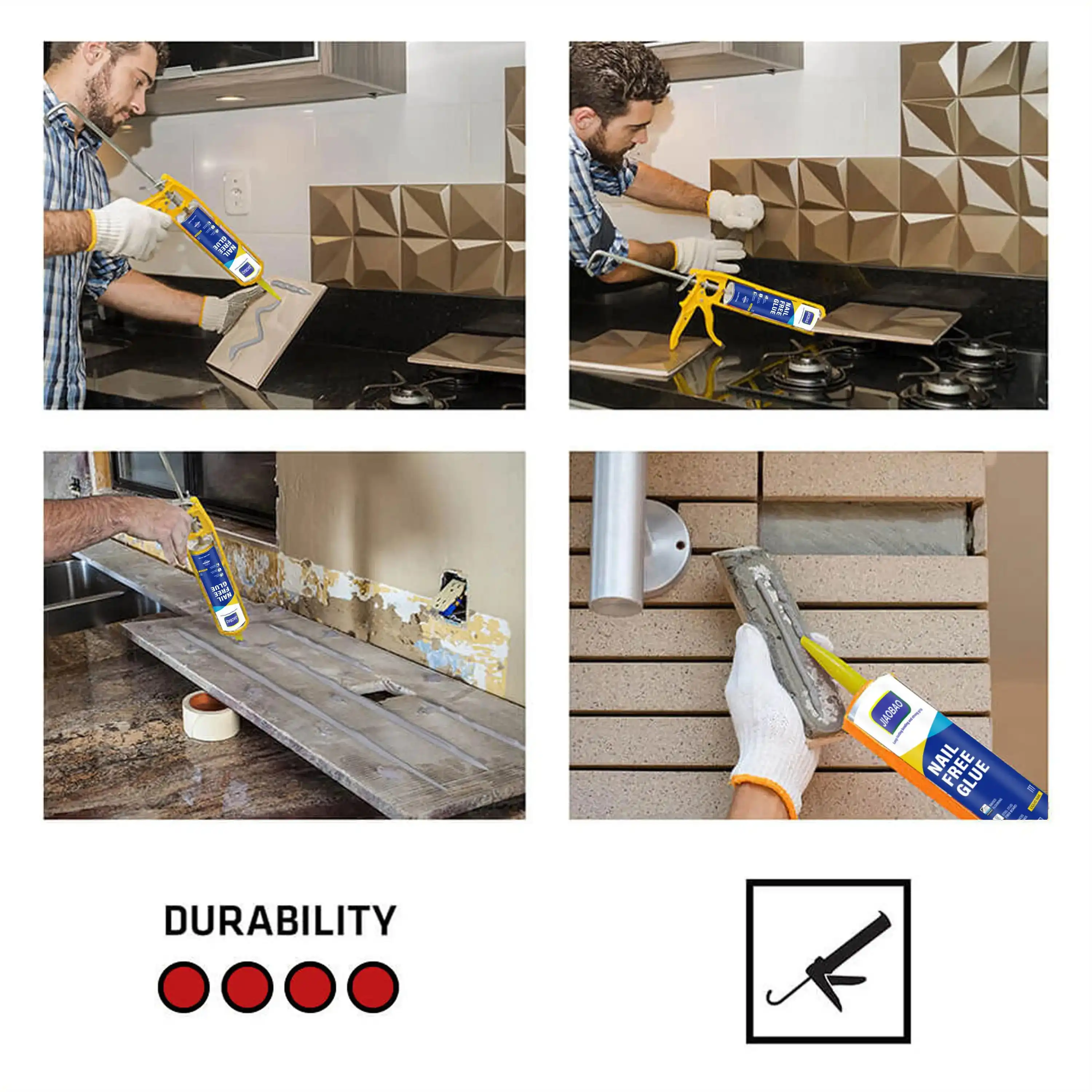
To evaluate performance, you need to know how glue bonding and mechanical fixing are different in key ways that affect the results of the project.
When dynamic loads are applied, heavy duty nail free adhesive performs differently than mechanical fasteners which focus stress at specific places, making failure zones possible. When compared to bolt patterns, adhesive bonds spread stress across the whole contact area, lowering peak stresses by 60–70%. According to ISO 37 standards, finished silane adhesives have a tensile strength of 2.5 N/mm², which is enough to mount 30 kg of parts per linear meter on vertical surfaces. The 50 Shore A hardness is flexible enough to handle impact loads without sending shock waves to ceramic tiles or other fragile materials.
For mechanical fastener drilling, you need to mark the plan, make test holes, and keep the dust under control. These steps take about 15 to 20 minutes per fixture. Putting on adhesive cuts this time down to 3–5 minutes with no damage to the base. This benefit is very important when working with toughened glass that cannot be drilled after it has been tempered, or when keeping the integrity of vapor barriers in building shells. Since there is no need to drill, there is also no chance of hitting embedded rebar or electrical conduits during blind installations.
Thermal cycling and structural settlement can cause changes in the size of buildings. These movements are transferred by rigid mechanical links, which create stress clusters. Because silane adhesives can stretch 300%, they let joints bend with the movement of the building while still keeping the bond strong. Because of this, they are necessary for curtain wall uses because aluminum frames grow 23 mm every 100 meters when the temperature changes by 50°C.
Buyers who care about quality should check that a provider has certifications for things like ISO 9001 quality management and ISO 14001 environmental standards. International building codes are followed by products that meet ASTM C557 for drywall adhesive performance or EN 15651 for façade sealants. Manufacturers who have been around for a while offer technical data sheets that list application parameters and the results of compatibility tests for common substrate combinations.
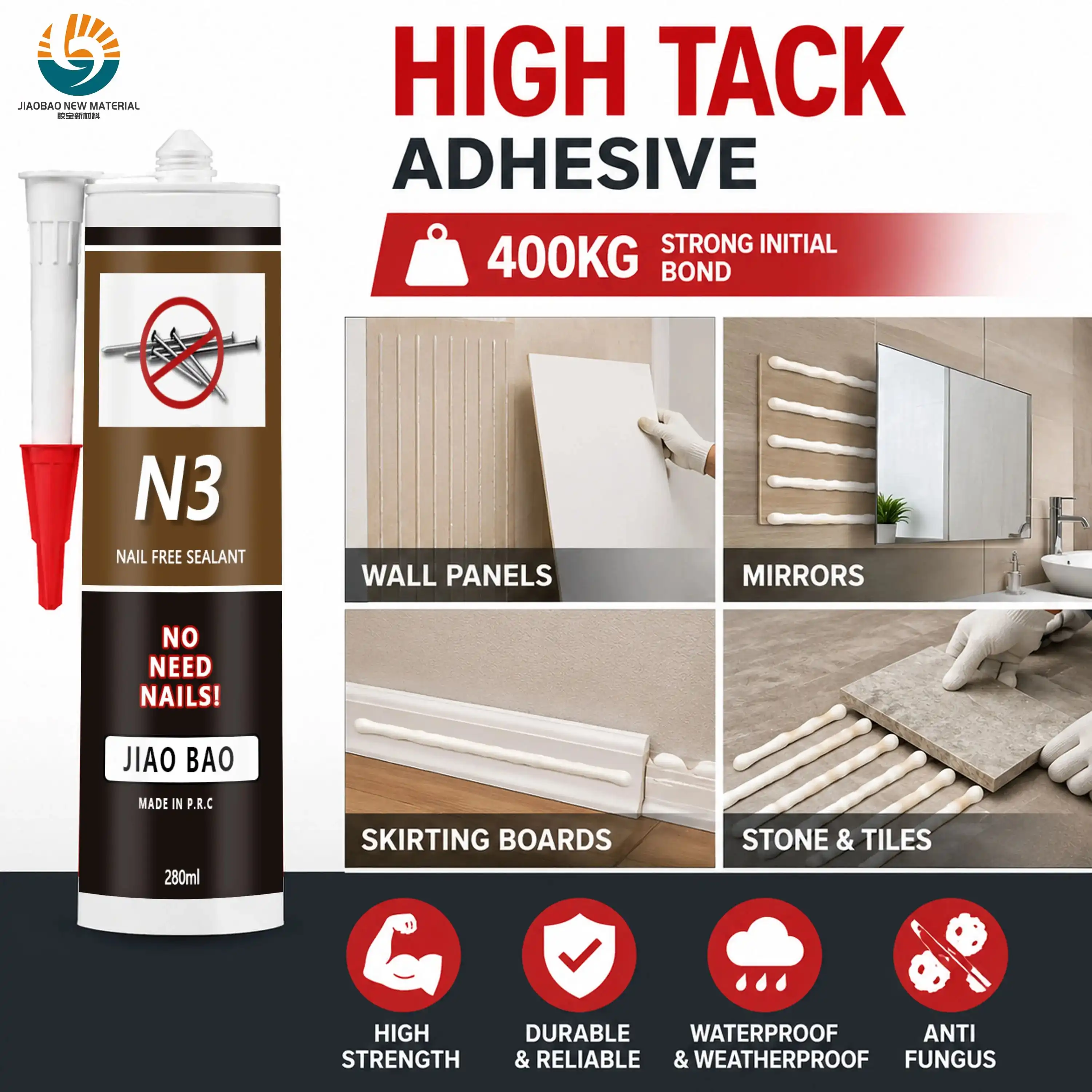
When making a procurement choice, you need to look at more than just the unit price to make sure that the total project cost is minimized and the performance is reliable.
People who buy a lot of heavy duty nail free adhesive should talk to suppliers about making deals that lock in prices for the duration of the project and let deliveries happen in stages that fit with the construction schedule. For unique color matching, the minimum order quantity is usually at least 1,000 cartridges. Standard white, black, and grey formulas, on the other hand, ship in smaller amounts. For quick jobs, suppliers with wait times of less than two weeks give you the freedom you need. Make sure that the packaging options—sausage packs or rigid cartridges—work with your dispensing equipment to avoid problems that cost a lot of money.
Cleaning the substrate has a direct effect on how strong the glue is. Dust, grease, and other loose things must not be on the surfaces. Use isopropanol to clean metal and glass, and dry brush concrete and other porous materials to clean them. Put on the glue in long beads, making sure there are no gaps between them. Use enough glue to cover the whole surface when pressed together. With a 5mm bead diameter, the 1.55 g/ml density means that 300ml cartridges cover about 6 linear meters. During application, the temperature must stay between 5°C and 35°C; cold substrates slow the curing process, and too much heat speeds up skinning before it can be properly placed.
To make sure that bonds are developing properly, production managers should set up test procedures. Once the required time has passed, destructive pull tests should be done on witness samples to make sure the bonding meets the design requirements. When ties are done right, cohesive failure happens inside the adhesive mass instead of adhesion failure at the contact with the material. Record the temperature and humidity of the area during the application process, as these factors affect the rate of curing. Conditions of storage are also important. Unused cartridges will work for 12 months if they are sealed and kept between 15°C and 25°C, but they will stop working quickly if they are exposed to changes in temperature or moisture.
Buying from companies with strong technical support teams makes sure that you can get application advice and help with fixing problems that are specific to the medium. Suppliers who offer sample quantities for testing compatibility let you make sure everything works before committing to full project volumes.
Adopting adhesive bonding technology has measured benefits that last beyond the installation phase and throughout the whole building lifecycle.
When you get rid of the steps of drilling, installing fasteners, and cleaning the surface with heavy duty nail free adhesive, labor costs drop by 30 to 40 percent. The technology lets one person install parts that would normally need two workers to make sure they are lined up correctly and drive fasteners into place. There is a lot less waste because drill bits do not wear out, fasteners do not get dropped or misthreaded, and mounting hardware does not need to be hidden with patching compound. These things work together to increase project margins and shorten the time it takes to finish. The quiet application process also lets people work in occupied spaces without the noise disruption that accompanies impact drilling.
Low-VOC formulations that meet SCAQMD Rule 1168 standards lower the amount of harmful solvents that workers are exposed to. In energy-efficient construction, the lack of metal connections gets rid of the thermal bridging that makes the building skin less effective. When something is no longer useful, adhesive bonded assemblies are easier to take apart than welded or riveted joints. This makes it easier to recycle materials in systems based on the circular economy. When people use power tools less, the number of injuries at work goes down. This lowers workers' compensation claims and makes project safety records better.
At the moment, researchers are working on faster curing systems that use humidity-activated catalysts to reach handling strength in less than 10 minutes. Using conductive fillers in smart adhesives lets you check on the health of a structure by noticing changes in electrical resistance that show when a bond line is breaking down. In high-volume factory settings, automated dispensing systems that use vision direction make things more consistent. The global market for construction sealants was worth $8.2 billion in 2023, and it is expected to grow by 5.3% each year until 2030. This is because more prefabricated buildings and green building projects are using them.
Because of these trends, nail free silicone adhesives are seen as technologies that can help new ways of building, like modular building systems and rapid-assembly facade installations. When procurement managers look at long-term material plans, they should know that glue bonding is not a niche market but the way the industry is going.
Heavy duty nail free adhesive technology has gone from being used in specialized situations to being used widely in construction, manufacturing, and assembly. The combination of protecting the substrate, improving structural performance, and speeding up the installation process solves major problems that mechanical fastening alone cannot. The modified silane polymer chemistry gives these adhesives resistance to weather, flexibility, and a wide range of substrate compatibilities. This makes them good for both tough outdoor tasks and precise indoor work. If procurement managers have to balance budget constraints with performance needs, they will find that the total installed cost of adhesive systems is lower than traditional methods when labor savings and substrate protection are taken into account. The technology keeps getting better by making formulations better and automating application.
A: Modified silane formulas can support about 30 kg per linear meter on vertical surfaces when they are fully cured. The tensile strength of 2.5 N/mm² grows over 72 hours, but the original grab strength is available after 24 hours. For parts that weigh more than 10 kg, temporary mechanical support is suggested until the cure is complete.
A: When the temperature ranges from -40°C to 80°C, good formulations keep the bond strong. UV-stable silane polymers do not break down when exposed to sunlight, so they can be used on outdoor walls. It stops metal substrates from rusting even in salty coastal areas because of the neutral curing mechanism.
A: Surface energy and porosity affect how well a substrate works with another. Silane adhesives stick well to most plastics, metals, ceramics, glass, and wood. Special primers are needed for low-energy surfaces like polyethylene. Test the adhesion on a small scale with real project materials before applying it on a large scale.
Shandong Jiaobao New Material Co., Ltd. has been making structural silicone sealants since 2013. They are especially good at making color formulas that are specific to architectural needs. The modified silane polymer performance mentioned in this guide is delivered by our one-part RTV nail free adhesive, which is offered in 300ml and 600ml containers. Our ISO and CE certifications show that our quality management systems meet international standards. We can also meet tight project deadlines with our 1-2 week production lead times.
If you need standard colors or special formulations that match RAL colors for curtain wall uses, our expert team can help you with advice that is based on the substrate and is backed up by a lot of performance testing data. Before placing bulk orders, procurement managers can ask for samples of the product to make sure it works with the materials they need. Your heavy duty nail free adhesive supplier requirements can be discussed with our international sales team at dorashen@cnjiaobao.com. You can also get full technical specifications for your project evaluation.
1. Johnson, M., & Peterson, K. (2021). Structural Adhesives in Modern Construction: Performance and Application Standards. International Building Science Journal, 45(3), 178-192.
2. Chen, L. (2022). Modified Silane Polymer Technology: Chemistry and Mechanical Properties for Architectural Applications. Materials Engineering Quarterly, 38(2), 89-105.
3. American Society for Testing and Materials. (2020). ASTM C557-20: Standard Specification for Adhesives for Fastening Gypsum Wallboard to Wood Framing. West Conshohocken: ASTM International.
4. Williams, R., & Thompson, H. (2023). Adhesive Bonding versus Mechanical Fastening: Comparative Analysis of Installation Costs and Structural Performance. Construction Technology Review, 51(1), 34-49.
5. European Committee for Standardization. (2019). EN 15651-1: Sealants for Non-Structural Use in Joints in Buildings and Pedestrian Walkways. Brussels: CEN Publications.
6. Martinez, D. (2023). Future Trends in Construction Adhesives: Smart Materials and Automated Application Systems. Global Building Materials Forecast Report, 12(4), 112-128.
November 16,2023
Enterprise Name
The sealant has very strong adhesion and performs well even on glass and aluminum. After curing, it remains flexible and shows no cracking. Perfect for our facade projects.
November 16,2023
Enterprise Name
Stable quality across batches. Our customers especially like the smooth application and consistent extrusion. It helps reduce installation time on site.
November 16,2023
Enterprise Name
I used it for bathroom sealing. Excellent waterproof performance and no mold issues so far. It's been holding up very well in humid conditions.
November 16,2023
Enterprise Name
The neutral silicone works well on sensitive materials without corrosion. Very suitable for industrial applications requiring stable performance.
_1779347426672.webp)