November 16,2023
Enterprise Name
The sealant has very strong adhesion and performs well even on glass and aluminum. After curing, it remains flexible and shows no cracking. Perfect for our facade projects.
Aug 4, 2026
Nail free glue heavy duty has transformed how commercial spaces are designed and assembled. This adhesive technology eliminates the need for drilling, reducing installation time while preserving surface integrity. For procurement managers overseeing exhibition spaces, retail interiors, and office renovations, these advanced bonding solutions address critical challenges: tight deadlines, zero-damage requirements, and multi-substrate compatibility. Modified silane polymer formulations deliver immediate grab strength and long-term durability, making them indispensable for projects where aesthetic precision and structural reliability are non-negotiable. Understanding how these adhesives perform across different applications enables smarter purchasing decisions and better project outcomes.
Nail Free Glue Heavy Duty represents a big step forward in the technology used to connect things together in building. Instead of standard mechanical fasteners that go through surfaces, these versions use molecular adhesion that happens when they are wet. These versions are usually made of modified silane polymers, which react with humidity to make links that are both flexible and strong. This curing process makes a flexible joint that can handle vibrations, temperature changes, and load stress without breaking or delaminating.
Standard adhesives can't handle the unique stresses that come up in commercial interior projects. Because contractors have limited time to do their work, they need products that cure quickly without losing their strength. Decorative panels, polished stone, and glass walls can't have drill holes or fastener marks on them because they are finished. These issues can be solved by Nail Free Glue Heavy Duty, which gives immediate positioning stability and can often hold up to 30 kg/cm² after full cure, while still keeping clean lines and professional finishes.
Industrial-grade products are different from consumer options because they have different performance specifications. Professional formulations show tensile strengths above 2.0 MPa, which means they will hold up under constant load. The elongation at break percentage, which is usually between 150% and 350%, lets bonded joints bend as the building moves without breaking. With a temperature range of -40°C to 80°C, it works the same way in all climate zones and during all four seasons. These factors have a direct effect on purchasing choices because they show whether an adhesive can meet the specific structure needs of a project.
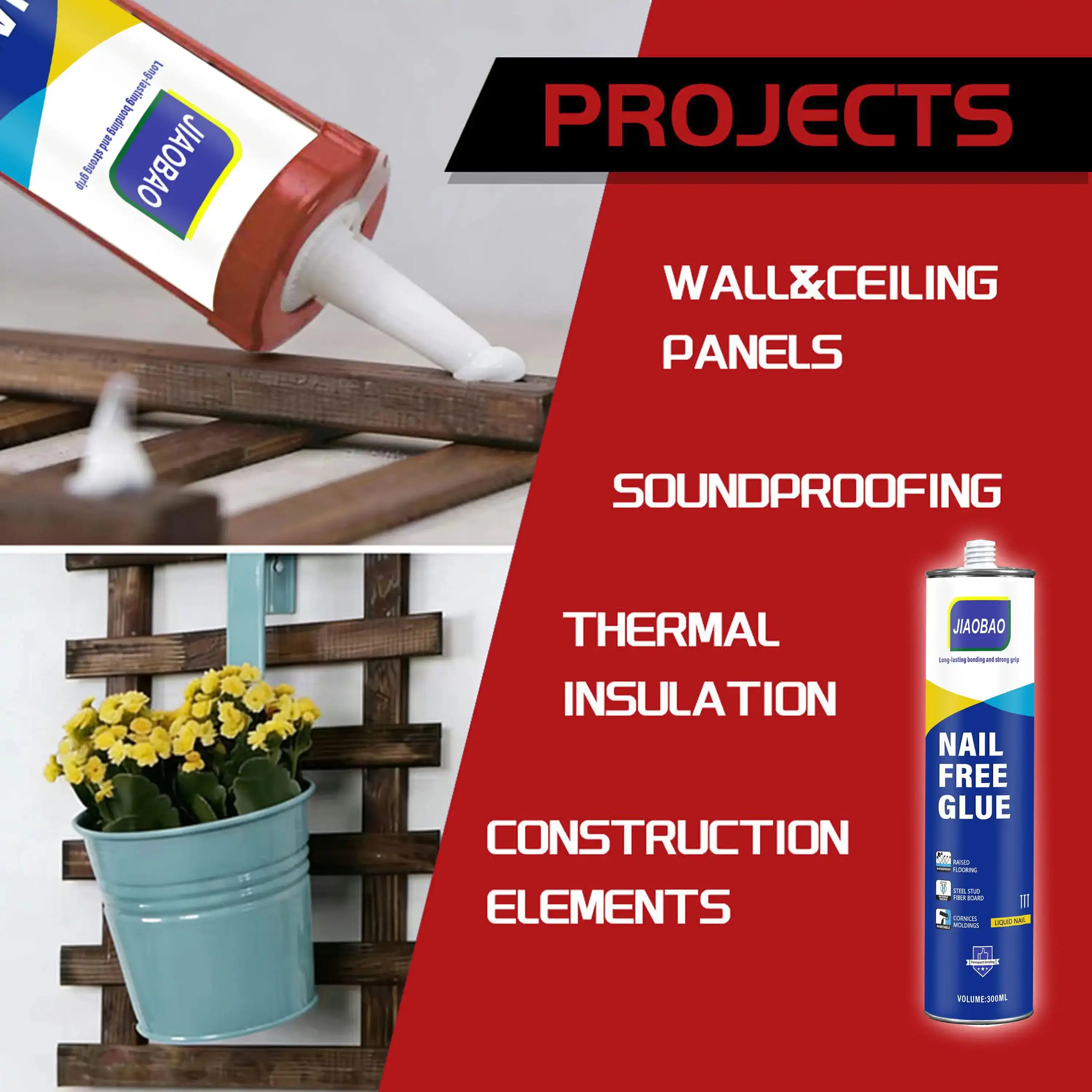
A lot of changes need to be made to retail spaces and showrooms without damaging rented or owned property. Installers can put up illuminated signs, display shelves, and product stands on glass, tile, or painted walls using Nail Free Glue Heavy Duty. The bonding strength holds the weight of the goods in place while still letting them be easily removed during remodelling. Exhibition contractors really like how quiet the installation process is, so it doesn't bother businesses nearby while it's being set up. Products made with a lot of thixotropy don't sag on vertical surfaces, so fixings stay level while they cure.
Adhesive-only placement works well for architectural treatments like metal tiles, wood veneers, and composite panels. If you drill through artistic materials, they could chip, crack, or lose their guarantees. Using continuous beads or dot designs to apply Nail Free Glue Heavy Duty spreads stress evenly across the back of the panel, stopping weak spots from forming. This method also gets rid of fastener points that can be seen, making smooth visual lines that improve the design purpose. Because business projects often use a mix of materials, procurement teams should ask for adhesives that have been shown to stick to both porous and non-porous surfaces.
Safety rules and standards for good looks make installing glass especially hard. Nail Free Glue Heavy Duty made for fixing mirrors dry without giving off corrosive results that could hurt surfaces that reflect light. The flexible cured bond can handle the different rates of temperature expansion between the glass and the base, which keeps stress cracks from happening. Compared to mechanical clips or frames, installation speed is much faster, and labour costs are lower. When purchasing managers look at different suppliers, they should make sure the product meets safety standards by asking for load-bearing test data that is specific to glass substrates.
A lot of work hours are spent on finishing carpentry in commercial fit-outs. Baseboards that are stuck on with adhesive don't have nail holes that need to be filled and painted over. This method works especially well with MDF and PVC trim, which tend to split when nailed close to the edges. When there is no noise from the compressor or other trash during installation, work can be done in buildings that are already occupied with little damage. When installers use products with an extended open time (the time before skinning), they can make changes to the alignment before the bond sets.
More and more, office systems furniture and store fixtures use adhesive joinery instead of mechanical fasteners. This method lowers the weight of the parts, which cuts down on shipping costs and makes assembly easier on-site. Nail Free Glue Heavy Duty holds edge bands in place without clamps, glue laminates to particleboard cores, and connect metal brackets to wooden frames. The cured joint spreads stress across the whole bond surface instead of just at the fastener points, which makes the structure stronger overall. The specs for the purchase should make sure that it works with powder-coated metals and thermoplastic surfaces that are popular in office furniture.
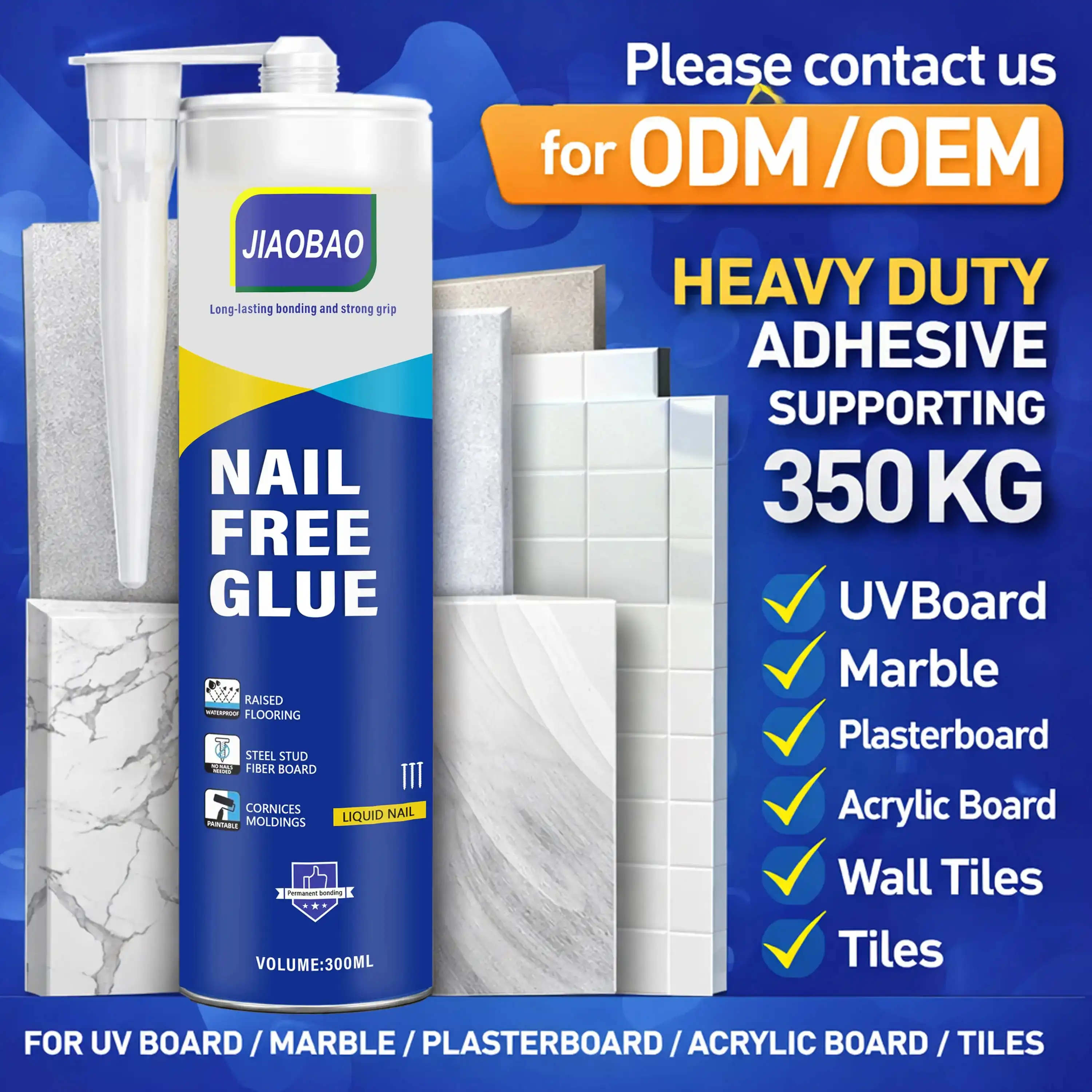
To get the required bond strength, the material must be properly prepared. The surfaces need to be dry, clean, and free of things like dust, grease, or release agents. When you wipe something with isopropyl alcohol, you get rid of residues that stop molecules from sticking together. Porous materials, like wood that hasn't been sealed, may need primer coats to keep the Nail Free Glue Heavy Duty from soaking in too much and starving the joint. Light abrasion can help non-porous substrates get more surface area for mechanical interlocking. The rate of curing depends on the temperature during the coating process. For consistent results, work should be done between 5°C and 35°C.
For professional use, the design spacing and bead geometry must be constant. Standard caulking guns and cartridge-based systems for controlled extrusion work well for high-volume projects, while pneumatic containers and sausage packing work well for smaller jobs. Continuous beads along the sides of the panels and winding designs across the field spread the Nail Free Glue Heavy Duty evenly and without too much. Coverage rates are usually between 5 and 12 linear meters per 300ml cylinder, but this depends on the size of the beads. Depending on the size of the project, procurement teams should look at different packaging options. For example, for large installations, bulk sausage formats lower the cost per unit.
As moisture moves into the bead, moisture-curing bonds get stronger over time. In normal conditions, surface skinning happens in 20 minutes, which lets the object be moved during the open time window. Full depth cure happens at a rate of about 2.5 mm per 24 hours, which means that thick treatments need longer handling times. After 24 hours, light loads can often be put on it, but it takes a few days for it to reach its full strength. By planning installation sequences around cure times, you can keep bonds from being stressed too soon. In dry climates, ambient humidity below 30% may make cure times longer, so projects may need to be changed.
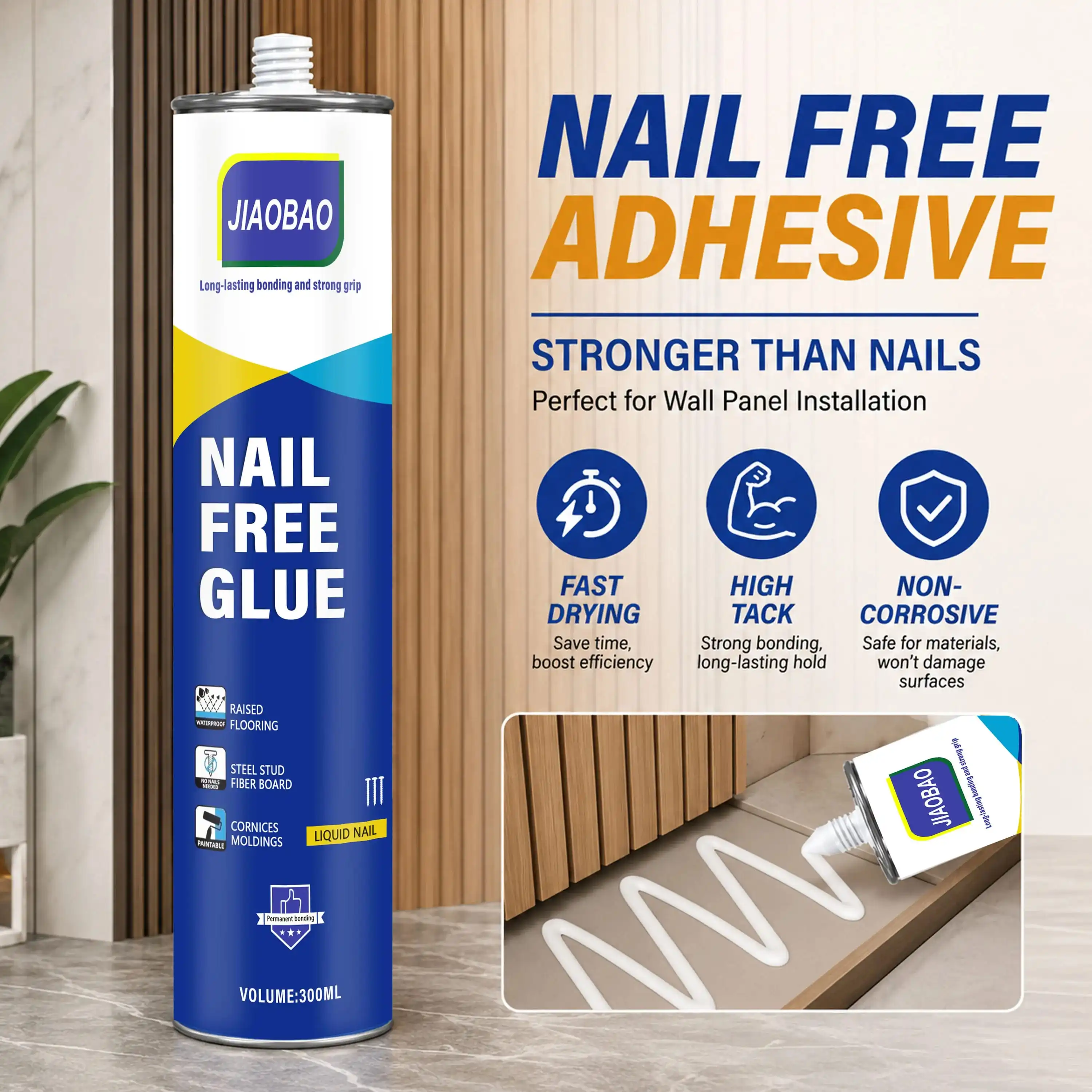
With mechanical fasteners, point loads are concentrated at each screw or nail head. Nail Free Glue Heavy Duty, on the other hand, spreads stress evenly across the bound area. This basic difference affects how joints fail: joined pieces tend to tear or pull through materials, while adhesive joints break through cohesive splitting or substrate delamination. Similar measurements can be found in testing standards like ASTM D1002 for tension shear strength. Quality products are as strong as or stronger than nails at keeping things together. They also have damping qualities that lower noise and sound transfer.
Studies of time show that when compared to mechanical fastening, adhesive installation cuts work hours by 30% to 50%. Getting rid of pilot holes, countersinking, and fastener insertion speeds up work processes by a lot. The quiet operation lets you work in places with a lot of noise, like busy stores or offices with a lot of people. Clean setups that don't make dust cut down on the amount of cleanup that needs to be done and protect the finishes around them. When doing a procurement analysis, the real economic benefit of adhesive systems can be seen when the total installed cost is calculated instead of just the material cost.
Fastener-free surfaces don't show any hardware, which makes design application easier and improves the perceived quality. Unlike screws, which can come loose with shaking or changes in temperature, bonded parts don't need to be tightened all the time. The cured, flexible Nail Free Glue Heavy Duty lets the building move without making the noises that come from hard mechanical links. When choosing the right formulation for the expected service life and remodelling cycle, it's easy to take things off and put them back on during repairs. These things help lower lifecycle costs after the initial installation savings.
Performance data should be more important than marketing claims when making procurement choices. As per ISO 37, the highest tensile strength, the elongation percentage that shows how flexible the material is, and the Shore A hardness that shows when the Nail Free Glue Heavy Duty is fully cured are the most important measures. The temperature range must be able to handle the conditions of the project, especially when it comes to uses near HVAC equipment or outside walls. Lists of substrate suitability should clearly include all materials that are part of the project. Products that meet ASTM C557 for plasterboard adhesives or ISO 11600 for building sealants show that they meet quality standards that are known to be reliable.
For reliable sourcing, you need to check out producers' quality control and output methods. ISO certification shows that process controls have been set up, and third-party testing confirms that the product works as advertised. Since the provider has been making Nail Free Glue Heavy Duty for at least ten years, it's likely that they've solved formulation and growth problems. Ask about protocols for batch testing and ask for certificates of analysis that show the tests met the requirements. Suppliers who give expert support can help with finding solutions to problems in an application and choosing the right product for odd substrates or circumstances.
Buying in bulk depends on how stable the shelves are and how long the project needs to be finished. Items that can be kept for 12 months without going bad can be added to an inventory without worrying about spoiling. Minimum order amounts and price tiers for large orders affect budget planning. For smaller orders, building relationships with distributors may offer better terms than buying directly from the factory. Standard goods usually have lead times of one to two weeks. Custom colours or recipes, on the other hand, need more time to be scheduled for production. Shipping options that are flexible, such as sea freight for international orders and fast land transport for urgent needs, make sure that construction schedules are met by materials that are available when they are needed.
Nail Free Glue Heavy Duty technology has grown up and is now the main way that commercial interior construction is held together. The mix of good structural performance, easy installation, and good looks solves some of the most important problems that procurement managers in the business fit-out and exhibition sectors face. Using modified silane polymers in products gives them the dependability needed for tough jobs without the surface damage that comes with mechanical fixings. For execution to go well, the adhesive's specs must match the type of substrate, the surroundings, and the load needs. As business areas become more flexible and change their layout more often, adhesive-based methods of assembly will continue to become more popular. Strategic relationships with qualified manufacturers make sure that you can always get high-quality products and technical help for difficult projects.
Once they are fully hardened, modified silane polymer formulations are very resistant to water. The system that makes Nail Free Glue Heavy Duty strong actually needs humidity to work, so they can naturally be used in damp situations. When exposed to condensation, cleaning moisture, or high-humidity environments, cured bonds keep their strength. This waterproofing is useful for projects that will be built near the coast or in places where the weather changes a lot. For uses that will come into direct or frequent contact with water, make sure that the product specifications clearly state that the material is waterproof or water-resistant.
To get rid of Nail Free Glue Heavy Duty, you need to separate the layers mechanically instead of chemically. You can slowly separate the joint by working thin, flexible putty knives or piano wire between the two sides that are stuck together. Using a heat gun to heat the bond area weakens some formulations, making them easier to remove. Surfaces can be scraped or sanded to remove leftover material, but porous substrates may still let some penetrate. Future repairs will be easier if you plan for the removal to happen during the initial installation. For example, using release films on historic surfaces makes this easier. Picking the right adhesive for the job and how long you want it to last will make removal easier.
Enough air flow keeps vapours from building up during application, but current formulations give off much less volatile organic compounds (VOCs) than solvent-based options. As standard safety gear, safety glasses and nitrile gloves keep hands from touching the material. Cartridges should be kept in climate-controlled areas, away from places with high temperatures that could change the nature of the product. Follow the rules in your area for getting rid of construction waste when you have empty containers. Material safety data sheets give thorough instructions on how to handle things and what to do in an emergency. Monitoring the air quality may be needed for big projects to make sure that exposure limits for workers are met.
Since 2013, Shandong Jiaobao New Materials Co., Ltd. has been making high-performance Nail Free Glue Heavy Duty systems for commercial contractors and purchasing managers all over the world. Our heavy-duty formula has a modified silane polymer chemistry that gives it a tensile strength of 2.5 N/mm² and an elongation of 300%. It was designed to meet the needs of challenging display and store uses. We have been in business for over 13 years and have ISO approval. We have strict quality control measures in place to make sure that every batch performs the same. Our goods can be made in 300ml and 600ml cartridge or sausage shapes and come in white, black, grey or custom-matched colours to meet the needs of any project. We can make OEM/ODM changes to meet local standards and specific application needs.
Our production lead time of one to two weeks works with tight project plans, and our flexible shipping choices by sea and land save you money on logistics. As part of the quality guarantee, any defects found during the shelf life will be replaced or refunded. This lowers the risk of buying the product. Email our technical team at dorashen@cnjiaobao.com to talk about your specific bonding problems and get product suggestions that are made just for you. As a well-known company that makes Nail Free Glue Heavy Duty, we offer competitive bulk pricing and quick technical support to help you get better installation results while keeping project costs low.
1. Anderson, J.M. (2021). Adhesive Bonding in Modern Construction: Technology and Applications. Construction Materials Press.
2. Chen, L., & Wang, H. (2020). "Performance Evaluation of Modified Silane Polymer Adhesives in Commercial Interior Applications." Journal of Building Materials Science, 34(4), 287-303.
3. European Adhesives Association (2022). Technical Guidelines for Structural Adhesive Selection in Commercial Environments. Brussels: EAA Publications.
4. Martinez, R. (2019). "Comparative Analysis of Mechanical Fastening Versus Adhesive Bonding Systems in Retail Fixture Installation." Commercial Construction Quarterly, 15(2), 112-128.
5. Thompson, K.D., & Liu, S. (2023). Modern Adhesive Chemistry: Formulations for Heavy-Duty Industrial Applications. Industrial Materials Publishing.
6. Zhang, Y., Park, J., & Schmidt, W. (2022). "Moisture-Curing Adhesive Systems: Performance Standards and Quality Control Methods for B2B Procurement." International Journal of Construction Technology, 41(3), 456-471.
November 16,2023
Enterprise Name
The sealant has very strong adhesion and performs well even on glass and aluminum. After curing, it remains flexible and shows no cracking. Perfect for our facade projects.
November 16,2023
Enterprise Name
Stable quality across batches. Our customers especially like the smooth application and consistent extrusion. It helps reduce installation time on site.
November 16,2023
Enterprise Name
I used it for bathroom sealing. Excellent waterproof performance and no mold issues so far. It's been holding up very well in humid conditions.
November 16,2023
Enterprise Name
The neutral silicone works well on sensitive materials without corrosion. Very suitable for industrial applications requiring stable performance.
_1779347426672.webp)