November 16,2023
Enterprise Name
The sealant has very strong adhesion and performs well even on glass and aluminum. After curing, it remains flexible and shows no cracking. Perfect for our facade projects.
Sep 14, 2026
When evaluating bonding solutions for cabinetry, furniture frames, or metal cladding, the choice between nail free glue for wood & metal and traditional metal screws carries real operational weight. Modern construction adhesives—particularly those built on modified silane polymer chemistry—deliver tensile strength of up to 2.5 N/mm² with 300% elongation at break, meaning they flex rather than fracture under dynamic stress. Metal screws offer immediate mechanical grip but introduce drilling damage, corrosion risk, and visible surface penetration. Understanding where each method excels helps procurement managers and engineers make decisions that protect both product quality and project timelines.
Screws, nails, and bolts have been used to hold wood-to-metal assemblies together in manufacturing for more than one hundred years. They work by applying a compression clamping force, need test holes to be made ahead of time, and transfer load instantly. But when making a lot of cabinets or putting together metal frames, each made hole is a possible surface crack, a place where water can get in, and an extra step that needs to be done.
As an option that should be taken seriously, nail free glue for wood & metal came into this space. They are all good, but MS Polymer (Modified Silane) formulas stand out. While SBS rubber-based grab adhesives dry in dry conditions, MS Polymer products stay flexible after fully curing and stick to a huge variety of surfaces, including solid wood, MDF, aluminum, stainless steel, PVC, ceramic tile, stone, and glass, most of which don't need starters.
For procurement professionals who buy a lot of materials, knowing how these adhesives work chemically is not just for school. It has a direct impact on whether a product can withstand changes in temperature on an external metal frame or keep its clean look on a high-end piece of furniture where screw heads are not acceptable.
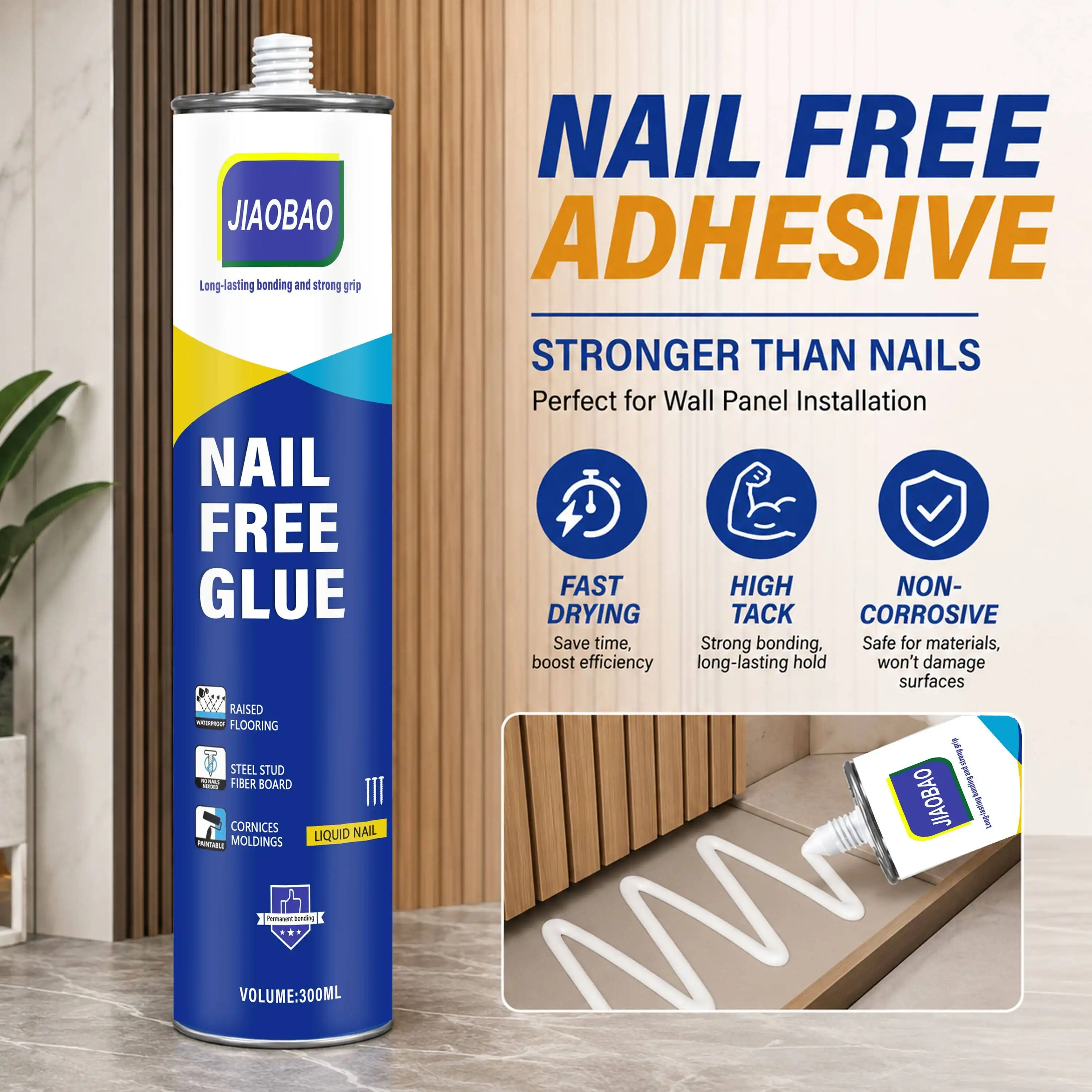
B2B decisions should be based on performance data, not guesses. When it comes to the most important factors in industrial assembly, these are how the two methods compare:
The following comparison looks at the things that procurement managers and process engineers usually look at when they review specifications.
These four factors show that neither method is always better; the best choice relies on the shape of the assembly, the substrate pairing, and the performance need. When it comes to looks, protecting the material, and being able to handle different temperatures, adhesives are definitely the best choice.
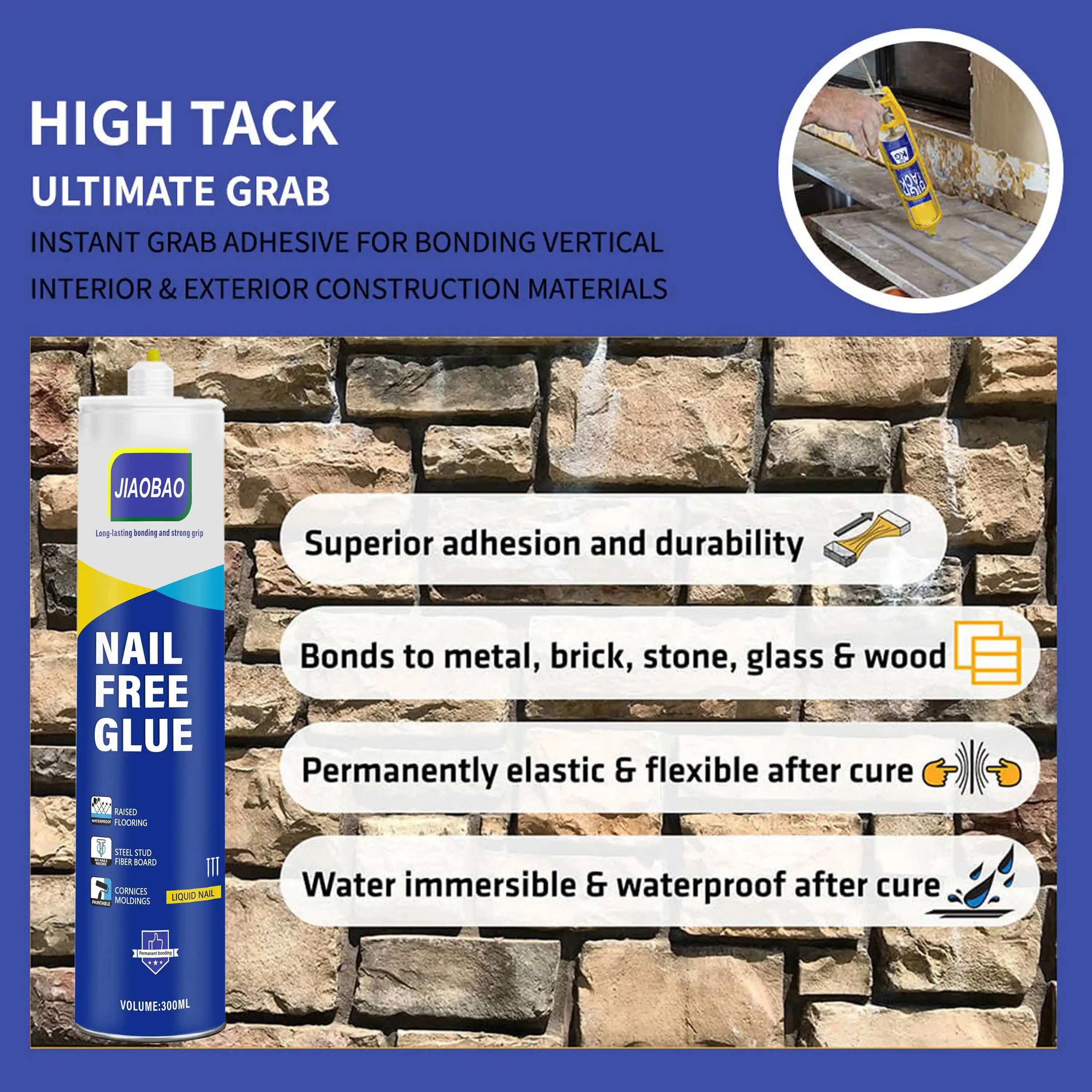
Surfaces that are clean, dry, and free of dust are the most important thing for the strength of a glue bond. At the micro level, lightly abrading metal surfaces that aren't porous makes mechanical interlocking better. If you use the nail free glue for wood & metal in a bead or spiral design, it will take about 20 minutes for the surface to dry at 23°C/50% R.H. lets installers move the window, which screws can't do once they're tightened.
MS Polymer bonds dry at a rate of about 2.5 mm per 24 hours when they come into contact with wetness in the air. For assembly lines that work quickly, this needs to be clamped or supported temporarily during the initial cure. Screw installation, on the other hand, gives you immediate mechanical engagement. As a trade-off, assembly is more difficult because drilling, countersinking, and driving hardware require more tool changes and work steps than applying nail free glue for wood & metal, which only needs one.
Mineral spirits can be used to clean uncured nail free glue for wood & metal, but heat or mechanical scraping is needed to take apart cured binds. Metal screws make it possible to take things apart without damaging them, which is very helpful for movable furniture or equipment that needs to be serviced in the field. OEM clients who are making products that are meant to be serviceable should take this difference into account when they are making their specifications.
The right way to make choices about nail free glue for wood & metal purchases is to look at the total cost of ownership, not the unit price. A packet of building glue replaces not only the cost of fastener materials, but also the cost of drilling, the cost of tool wear, and the rate of repair due to damage to the surface.
When you buy MS Polymer adhesives in bulk from the maker, the unit cost is usually much lower than when you buy the same amount of hardware from a dealer. For OEM and branded label customers, being able to choose from sausage packs or cartridges in 300ml or 600ml sizes, as well as color choices like white, black, gray, or custom-matched, gives the supply chain more freedom than standard screws can offer.
Reliability of the supplier is also very important. Buying from a manufacturer with ISO and CE certification, a documented quality control system, and a production lead time of one to two weeks lowers the risk of buying significantly compared to buying from distributors who haven't been checked out. A shelf life of 12 months also lets you store a lot of items at once without worrying about them going out of style.
Once the application parameters are set, the decision matrix is easy to understand. When the substrate can't be drilled (thin aluminum sheet, glazed ceramic tile, tempered glass), when different materials need to be able to move thermally, or when the finished surface needs to be flawless, adhesive bonding is the better option.
When full mechanical removal is needed, when there are very high point loads (like when fixing a structural hinge), or when load transfer must happen right away without any curing time, metal screws are still the best choice.
The move toward sticky options is being supported by market trends. According to Grand View Research (2024), the global construction adhesive market was worth about USD 12.5 billion in 2023 and is expected to grow at a compound annual growth rate (CAGR) of around 5.2% until 2030. This is because people want damage-free ways to install things in home renovations and when making modular furniture. Sustainability standards, such as low VOC, less waste from drilling debris, and lighter parts, are speeding up this acceptance curve.
Both of these ways of joining are valid ways to put together metal and wood. Adhesive bonding provides spread strength, substrate safety, and thermal flexibility, while mechanical screws provide instant grip and reversibility. MS Polymer nail free glue for wood & metal construction adhesives are a good technical and business choice for most non-structural gluing tasks for companies that make cabinets, customize whole homes, and help OEM clients build their own product lines. The most important thing is to make sure that the product specification matches the actual performance need and to work with a manufacturer that can back up that decision with verified data.
For most cabinet carcass and panel bonding jobs, a tensile strength of 2.5 N/mm² over a large bond area is enough to keep the structure together. But hinge mounting points and heavy drawer slide hardware usually work better with preserved mechanical binding to handle loads that move around a lot.
At 23°C and 50% relative humidity, the surface takes about 20 minutes to dry. Every 24 hours, 2.5 mm of full cure depth is added. At the very least, don't put the full working load on until 24 hours have passed.
Yes. With a working temperature range of -40°C to 80°C, moisture-cure chemistry, and a flexible cured state, MS Polymer adhesives are perfect for outdoor building uses where temperature changes and weather exposure happen all the time.
There are sausage packs and cartridges in both 300ml and 600ml sizes, and they have a shelf life of 12 months. Those who buy branded labels can get custom colors and OEM packages.
Jiaobao adds more than 13 years of experience making things to every batch. Our MS Polymer nail free glue for wood & metal is fully customizable and ships within one to two weeks. It also complies with ISO and CE standards. We offer verified performance data, quick technical help, and reliable after-sales coverage, whether you need a large quantity of adhesive for production lines or a branded building adhesive product for your market. To get examples and details, email our team at dorashen@cnjiaobao.com right now.
1. Grand View Research. Construction Adhesives Market Size, Share & Trends Analysis Report. 2024.
2. Brockmann, W., Geiß, P. L., Klingen, J., & Schröder, K. B. Adhesive Bonding: Materials, Applications and Technology. Wiley-VCH, 2009.
3. Adams, R. D. (Ed.). Adhesive Bonding: Science, Technology and Applications. Woodhead Publishing, 2005.
4. European Committee for Standardization. EN 204: Classification of Thermoplastic Wood Adhesives for Non-Structural Applications. 2001.
5. ASTM International. ASTM C557: Standard Specification for Adhesives for Fastening Gypsum Wallboard to Wood Framing. 2003 (Reapproved 2019).
6. ISO. ISO 37: Rubber, Vulcanized or Thermoplastic — Determination of Tensile Stress-Strain Properties. 2017.
November 16,2023
Enterprise Name
The sealant has very strong adhesion and performs well even on glass and aluminum. After curing, it remains flexible and shows no cracking. Perfect for our facade projects.
November 16,2023
Enterprise Name
Stable quality across batches. Our customers especially like the smooth application and consistent extrusion. It helps reduce installation time on site.
November 16,2023
Enterprise Name
I used it for bathroom sealing. Excellent waterproof performance and no mold issues so far. It's been holding up very well in humid conditions.
November 16,2023
Enterprise Name
The neutral silicone works well on sensitive materials without corrosion. Very suitable for industrial applications requiring stable performance.
_1779347426672.webp)