November 16,2023
Enterprise Name
The sealant has very strong adhesion and performs well even on glass and aluminum. After curing, it remains flexible and shows no cracking. Perfect for our facade projects.
Aug 6, 2026
Yes, Nail Free Glue for Wall Mounting is suitable for heavy wall decorations when properly selected and applied. Modern formulations, particularly those based on modified silane polymers (MS Polymer), deliver exceptional tensile strength up to 2.5 N/mm² and can support static loads ranging from medium-weight mirrors to substantial shelving units. The key lies in understanding substrate compatibility, curing requirements, and load distribution principles. Professional-grade adhesives eliminate drilling risks while providing reliable bonding across diverse wall surfaces, making them an increasingly popular choice for installation service providers seeking damage-free mounting solutions.
Nail Free Glue for Wall Mounting represents a big step forward in the installation business in terms of technology. These new products are better than mechanical fasteners because they don't damage things. This solves a big problem for companies that do home installations.
A complex chemistry of polymers is at the heart of high-performance adhesives. Through a curing process that is set off by moisture, modified silane polymers form molecular bonds with wall surfaces. Cross-linking happens all over the material when humidity in the air reacts with the glue. This turns the paste into an elastomeric solid. During this process, adhesion forces are created that physically interact with tiny surface irregularities and chemically link with molecules in the substrate.
In contrast to mechanical connections that only rely on friction and compression, these adhesives spread stress across the whole bound area, lowering the number of weak spots that could cause the bond to fail. Because of how they cure, these products can work on slightly damp surfaces, which is helpful for real-world installation situations. The glue stays strong even when temperatures change from -40°C to 80°C, so it will keep working well even when the seasons change. This resistance to heat comes from the bendable polymer backbone, which can handle changes in temperature without weakening the bond.
Installers are becoming more and more aware of the practical benefits these adhesives offer. Getting rid of drilling tools cuts noise on the job site by about 70%, which is very important when working in business or residential buildings that are already occupied. Almost no dust is made, so there is less work to do after the installation and less damage to nearby electronics or furniture. Another important benefit is that it saves time. Accurate measures, test holes, pin placement, and final fastening are all steps in the drilling process that take 10 to 15 minutes per fixture. Glue application reduces this to preparing the area and putting the glue down, which can usually be done in three to five minutes.
Quality recipes have a 20-minute surface dry time, which means there aren't many chances to move them around. This means you should be careful when placing them at first, but you can still make changes if you need to. Protecting the integrity of walls is something that more and more property owners are worried about. Drilling leaves lasting damage that needs to be fixed and painted over after it's taken out. Adhesive fixing protects wall surfaces, which is especially useful in rented properties, high-end homes with unique finishes, or historic buildings that can't have their structures changed.
A common misunderstanding is that glue can't be as strong as mechanical fasteners. Testing data shows that this assumption is wrong. If everything goes as planned, products with a tensile strength of 2.5 N/mm² can bond about 250 kg/m². This theoretical maximum is lowered by practical application factors, but properly applied adhesive bonds can usually support 10 to 25 kg loads, which is enough for most home and business wall ornaments. It's important to stress the difference between steady and moving loads. Static loads, like a constant weight, work better with sticky fixing than dynamic loads, like loads that move or vibrate over and over.
A pull-up bar is an example of dynamic loading, while a shelf on the wall that holds books is an example of static loading. When installation professionals know this difference, they can suggest the best mounting methods for each job. Compatibility with the substrate has a big effect on performance. Ceramic tiles, glass, and other non-porous surfaces need vertical adhesive lines instead of continuous covering so that moisture can get to them and cure properly. Surfaces with pores, like painted drywall or concrete, help things cure faster and often make stronger bonds because the pores mechanically interlock with each other.
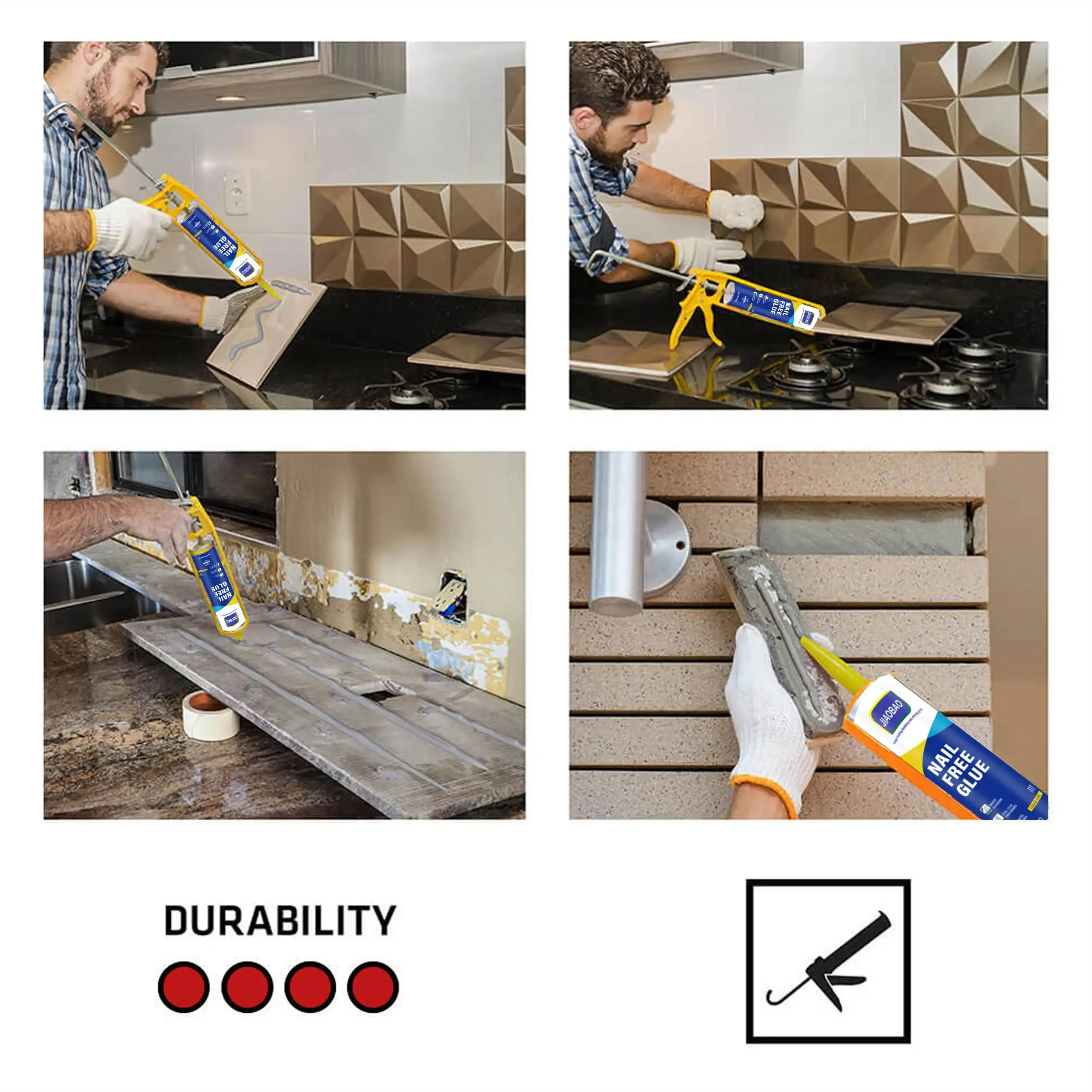
To choose the best fastening options, you need to compare them across a wide range of performance factors. It's helpful for installation service providers to know how different methods work in different operational situations. Compression and friction give mechanical devices their power. Pull-out resistance for a properly installed anchor in solid concrete is more than 100 kg, while the rating for drywall anchors is usually between 15 and 35 kg, depending on the type. Modern Nail Free Glue for Wall Mounting is getting close to these values; high-performance formulas can hold 20 to 30 kg of static load when spread out over a large enough surface area.
Safety profiles are very different. When you drill, you could hit electrical wiring or plumbing that is hidden inside walls, which could be a very bad mistake. There is no such risk with adhesive application, which makes it safer in retrofit cases where the contents of the wall space are still unknown. The stretchy nature of cured glue also absorbs shock, which lowers the stress that could break brittle wall surfaces or ornamental items when they settle or take small hits. While double-sided tapes are convenient, they are not very strong and can only hold 2 to 5 kg.
Command strips and other similar products are better than regular tapes because they can hold 5 to 15 kg and have special ways to stick to things and take them off. For light-duty tasks, these items work fine, but they're not strong enough for heavy decorations. Suction cups only work on smooth, non-porous surfaces. They are also less reliable over time because the seals break down, so they aren't good for long-term installations or valuable items.
Environmental factors test how long an attachment method will last. Different solutions are affected by humidity in different ways. In damp places, metal fasteners can rust, especially when two different metals touch and form galvanic cells that speed up the rusting process. Good MS Polymer adhesives don't break down when they come in contact with water, so the bond stays strong even in bathrooms and kitchens where the humidity level is usually higher than 70%. Cycling temperatures is hard for all attachment methods. Temperature changes can cause metal fasteners to expand and contract, which could cause them to loosen over time.
Elastomeric bonds can stretch 300%, so they can bend instead of breaking apart when these things move. When used outside or in places where the temperature changes a lot, this stretchy action is especially useful. Many adhesives break down when they are exposed to UV light, which makes them yellow, brittle, and eventually fails the bond. Professional-grade materials have UV stabilizers that keep the properties even after being in the sun for a long time, which is important for setups near windows or in sunrooms. UV light doesn't really hurt mechanical devices, but they don't help if the thing they're attached to gets damaged by UV light either.
The initial costs of materials only show part of the economic picture. Professional-grade adhesive packs cost between $8 and $15 for 300 ml, and each one can handle 10 to 15 normal installs. While mechanical fasteners only cost $0.50 to $2.00 to install, you'll need to spend $150 to $500 on good cordless drills and bit sets, and you'll also have to pay to replace drill bits and keep the batteries charged. Attention should be paid to the effects on labor costs. Technicians are more productive when installation times are cut down. If a team does 12 setups every day instead of 8, that's a 50% increase in productivity, which has a big effect on how much money the service company makes.
Less accurate drilling requires more skill than applying glue, which lowers the cost of training and increases the pool of qualified technicians. When it comes to long-term upkeep, adhesive fixing is the best option. When vibrations or settling happen, mechanical parts may need to be retightened. Once they're set, adhesive bonds don't need any maintenance and stay stable until they're taken off on purpose. Costs of fixing damage caused by drilling, like patching, sanding, and repainting, are secret costs that are completely eliminated by sticky mounting.
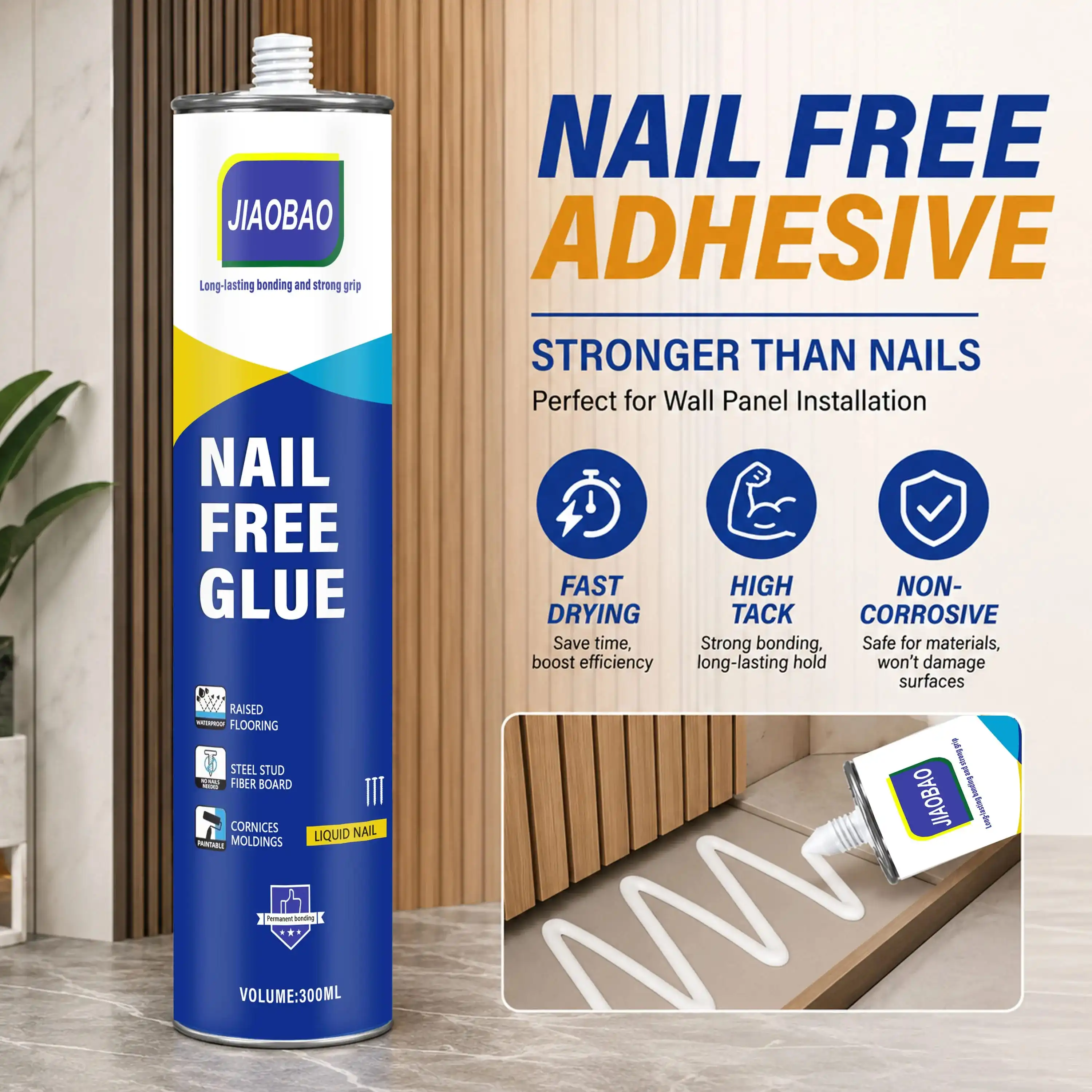
In order to make a procurement choice, technical specs must be carefully examined and matched to the needs of the application. Installation service managers have to look at a lot of factors to make sure that the Nail Free Glue for Wall Mounting meets their needs.
Technical specifications give us a place to start when we look at capacity. The material's maximum tensile strength shows how well it works in the lab, but in real life, safety margins are needed. A product with a rating of 2.5 N/mm² should be able to hold a lot of weight, but bonding areas and surface conditions in the real world make this impossible. Testing that is specific to an application confirms the ideal ability. To mount a 15-kilogram mirror, you need to figure out the contact area. For example, a 60-by-80-cm mirror with 2-cm sticky beads around the edges has a bonding area of about 280 cm². This arrangement creates stress levels that are well within the limits of the material while still leaving enough room for long-term dependability.
The type of decoration affects how it is mounted. Framed art puts most of its weight at the points where it hangs, but it has many adhesive application points that spread the weight out evenly. Shelving units have downward forces from the things they hold and rotational moments that try to pull the top edge away from the walls. To deal with these complicated loading patterns, you need to know how forces are distributed and use glue in a way that counteracts the expected stress directions.
Different types of wall surfaces need different kinds of adhesives. Painted drywall is a common residential substrate, but the type of paint affects how well it bonds. Latex paints stick well to substrates, but oil-based paints might need to have the surface roughened up with light brushing to stick better. Some low-VOC paints have additives that move to surfaces and make border layers that aren't as strong, which makes bonding less effective even though the paint itself is very adhesive. Glazed ceramic tiles are hard to place because they don't let air pass through them. For bonding to work, it needs enough curing time. For smooth surfaces, it takes 24 hours, but 48 to 72 hours for full strength development.
Applying the glue in separate vertical strips instead of one long bead makes sure that moisture can get to the area needed for curing. The roughness of the tiles has a big effect on how well they stick together. Smooth glazed tiles don't mechanically connect as well as grainy or matte-finished tiles. Because they are porous and have a rough surface, concrete and brick surfaces often have the strongest bonds. But any concrete dust or efflorescence (white mineral layers) must be cleaned off first by brushing or wiping with a cleaner. As concrete ages, it can form weak layers on top that need to be removed with a wire brush to reveal a solid base that can be bonded to.
Concerns about indoor air quality lead formulators to choose low-VOC products. When traditional solvent-based adhesives cure, they release volatile organic compounds that can be smelly and could be harmful to people who are in the space. Modern MS Polymer formulations cure through a reaction with water instead of solvent evaporation. This means they don't give off VOCs and can be used in places with poor air quality, like hospitals, schools, or homes. The ability to be waterproof opens up more application options. Adhesives that stay strong even when they're wet are needed in bathrooms, kitchens, and outside installs. After the full cure, good formulations show resistance to water immersion, which means that splashing, condensation, or direct contact with water won't break down the bond.
This feature also makes cleaning easier because the glue doesn't soften or link gets weaker. Regulatory compliance makes sure that a product can be sold in all places. ISO approval checks that quality control systems in factories are working properly, and performance standards like ISO 37 for tensile testing make sure that the systems are really working well. The CE mark shows that the product is safe for the European market, and different regional certifications show that it meets the rules in different areas. Service companies that work in more than one state can choose goods with broad certification coverage, which makes buying easier and lowers the cost of checking for compliance.

If you use the right application method, Nail Free Glue for Wall Mounting will work as well as it can. Installation technicians must follow organized steps to get the best results and avoid common mistakes that weaken the bond.
Surfaces that are clean are the basis for glue bonding that works. Contaminants like dust, grease, wetness, or release agents make the boundary layers weak, which stops the glue from sticking to the substrate materials. Different types of surfaces need different cleaning methods. For example, general-purpose cleaners are fine for most painted surfaces, but isopropyl alcohol or acetone may be needed to get rid of tough residues on surfaces that don't absorb water. When the surface is dry, moisture-cure adhesives react differently than solvent-based goods. A little wetness can speed up curing by making more moisture available, but surfaces that are completely wet or standing water stop the glue from sticking properly. When you touch the surface, it should feel dry, but the liquid content inside porous surfaces helps the curing process.
On the other hand, climate-controlled buildings that are very dry may slow drying, and light misting may be needed to provide enough wetness. The temperature at the time of application affects both the initial tack and the final bond development. Most professional formulas say that they should be used at temperatures between 5°C and 35°C. Cold surfaces slow down the initial flow and tack of adhesive, which can make positioning harder and possibly weaken the bond formation. Too-hot surfaces may cause skinning to happen before they make good touch with the ground. Getting things to room temperature before using them guarantees the best performance.
The shape of the adhesive beads affects both how much material is used and how strong the bond is. Continuous beads cover the most surface area, but they take longer to cure on surfaces that don't let water through because they can't get to the water. Intermittent beads or vertical strips help the bonding process go faster while still leaving enough room for the beads to stick together. A suggested pattern uses beads that are 1 cm wide and 5 cm apart across the mounting surface. Positioning plan determines how the glue will behave while it cures. Initial tack gives light support right away, but it takes time to get to full weight bearing.
During the first 24 hours, which are very important, temporary mechanical support like props or tape keeps the position while the adhesive builds up its functional strength. This safety measure stops slow slippage that could hurt both the bonding process and the accuracy of the final placement. Putting pressure on the base during the initial setting makes contact better. When you press down hard on mounted items, the adhesive beads spread out, creating more contact area and forcing out air pockets that are stuck inside, leaving empty spaces. Too much pressure that causes adhesive squeeze-out wastes material and doesn't improve bonding. It seems that the best pressure is about 80% bead spreading without full flattening.
Clear communication with clients is needed to meet time management expectations. A surface dry time of about 20 minutes lets you handle it gently, but it takes 24 to 72 hours, based on the conditions and the thickness of the beads, for the full structural strength to form. Based on the standard curing rate of 2.5 mm per 24 hours, a 5 mm adhesive bead needs 48 hours to fully cure. Testing procedures make sure that the installation went well before the job is finished. After 24 hours, light hand pressure testing checks to see how the bond is developing so far. When you try to slide fixed items parallel to the wall, you test their shear resistance.
When you gently pull them perpendicular to the surfaces, you test their tensile strength. Bonds that work well can withstand these mild forces without moving or making noises that would indicate they are coming apart. Keeping records helps protect both service workers and clients. Taking pictures of finished setups and writing down the dates of the adhesive application makes records that can be used to support guarantee claims if problems happen. Giving customers written instructions on how to use the product correctly and how much weight it can hold stops overloading, which could lead to failures that are mistakenly blamed on poor installation.
For deliberate removal, you need to be careful to avoid damaging the wall as much as possible. When you work thin wire or dental floss behind fixed items, it slowly breaks apart adhesive bonds through shear action instead of tension pulling, which can damage wall surfaces. This process needs time—hurrying it up increases the chance of damage. Using heat to soften most adhesives makes them easier to remove. Setting heat guns to a medium temperature (about 60°C) slowly warms the glue, making it less strong and easier to separate. Being careful keeps things from getting too hot, which could damage paint or make fires more likely.
For sensitive applications, other heat sources, like hair dryers, offer safer but slower heating. Getting rid of the residue finishes the process. Softened glue can usually be rolled off by hand, while citrus-based solvents or special adhesive removers can help get rid of tough residue. Wall surface scratching can be avoided by mechanically scraping the surface with plastic scrapers. However, patience is still needed. Getting rid of all the residue before painting again makes sure that the new paint sticks well and the surface looks good.
Knowing your market options and sourcing strategies will help you get the best results from your procurement. Installation service businesses benefit from having long-term partnerships with dependable suppliers who provide uniform quality and quick assistance. Jiaobao is one of the companies that makes professional Nail Free Glue for Wall Mounting solutions for installation service providers.
Jiaobao has been making high-performance adhesives based on modified silane polymer chemistry for more than 13 years, since it was founded in 2013. Their formulations have a tensile strength of 2.5 N/mm² and an elongation at break of 300%. This gives them the strength and flexibility that tough applications need. These goods come in 300ml and 600ml sizes and can be colored white, black, gray, or a color that you specify. They can also be colored to match your specific needs. The shelf life of 12 months makes it possible to buy in bulk without worrying about waste. International brands like 3M, Loctite, and Gorilla have long histories and a wide range of products.
Their premium status comes from having a well-known name and a large distribution network, but their prices are usually higher than those of local makers. These goods work really well in particular situations that need certain certifications or when brand specifications are part of architectural contracts. More and more, new manufacturers are offering competitive performance at appealing prices. No matter what name you know, ISO approval and strict quality testing prove that a product or service works. There is value in these options for service companies that want to cut costs, especially for standard tasks where premium brand features don't add much more value.
Regular buyers can get better deals on prices through wholesale outlets. Because they deal directly with the maker, there are no markups for distributors. However, smaller operators may have trouble meeting the minimum order amounts. Setting up accounts with makers like Jiaobao gives you access to technical help, the ability to make your own formulas, and priority scheduling for production during times of high demand. Verification of certification protects against low-quality products. Asking for ISO certificates, testing records, and safety data sheets backs up what the maker says. Testing small batches by a third party before making big purchases gives you even more peace of mind, but the costs must be weighed against the benefits of lowering risk.
Building ties with suppliers that show regular quality lowers the work that needs to be done to make sure that repeat purchases are made correctly. Logistics issues affect the total cost of acquisition. Ocean freight has the lowest cost per unit of transportation, but it takes longer to get to and needs larger orders to be shipped in containers. Regional distribution centers offer shorter lead times, smaller minimum orders, and prices that are in the middle between cost and convenience. By knowing when projects need to be done and how much space is available, you can make the best use of your buying patterns for both big shipments and quick replenishment orders.
Customized needs can be met by OEM and ODM skills. Custom color matching makes sure that the adhesive looks good with certain applications. This is especially helpful for projects that will be seen or that are specific to a brand. With private labeling, service companies that want to build a quality brand can sell their own goods, which increases the perceived value and customer loyalty. Technical help is what sets high-quality providers apart from average ones. Having access to application experts who know how to solve installation problems and suggest the best goods and methods is very helpful. Help with troubleshooting when problems happen keeps projects from being held up and lowers the risk of failures that cost a lot of money.
Jiaobao offers quick and helpful technical support to help installation workers get the most out of their products in a wide range of settings. Quality assurance programs show that a maker cares about being consistent. Professional production operations have documented quality management systems, statistical process control, and batch testing procedures. Suppliers who promise repair or refund for faulty materials within their shelf lives stand behind the quality of their goods. This lowers the risk of buying for service companies whose reputations depend on materials that work well.
Installers now have an easy way to mount heavy wall decorations on walls without using screws or nails. This is called Nail Free Glue for Wall Mounting technology. Modern formulations provide reliable load-bearing capacity when they are properly matched to the needs of the application and the conditions of the substrate. Procurement pros can easily recommend the right solutions when they understand adhesion chemistry, application techniques, and product selection criteria. Less damage from drilling, less time spent installing, and quieter operation are all benefits that give non-destructive installation methods a competitive edge in markets that value them more and more. Strategic buying from well-known makers guarantees stable quality, which is good for the service's image and for keeping customers happy.
Choosing the right Nail Free Glue for Wall Mounting often generates specific questions regarding its limits and environmental performance.
When used correctly and on a large enough surface area, high-performance MS Polymer glue can support this purpose. Figure out an area of about 300 to 400 cm² for gluing that can hold 20 kg of weight, and then apply glue around the mirror's edges. Allow 48 to 72 hours for the glue to fix before removing the temporary supports. Also, make sure the tile surfaces are clean and dry before applying the glue.
Moderate humidity speeds up the bonding process of moisture-cure adhesives by giving the water molecules needed for cross-linking reactions. The best humidity range is between 40 and 70%. Extremely low humidity can make curing take longer, and too much humidity can cause the surface to skin before the internal curing is finished. Good formulations can handle a wide range of humidity levels without losing much of their effectiveness.
Professional formulas usually have better temperature resistance, higher tensile strength (2.0–2.5 N/mm² vs. 1.0–1.5 N/mm²), and better aging properties. Also, the quality is the same from batch to batch, which is important for commercial uses. Consumer goods try to be as cheap and easy to use as possible, even if it means losing final performance to appeal to a wider audience.
Picking the right Nail Free Glue for Wall Mounting seller has a direct effect on the quality of your service and how well your business runs. Shandong Jiaobao New Material Co., Ltd. has been making professional-grade adhesives for 13 years and is trusted by installation service providers all over the world. Our tweaked silane polymer formulas have a tensile strength of 2.5 N/mm² and are very compatible with painted surfaces, tiles, concrete, and custom finishes. We keep up with our ISO certification and full quality control systems, which make sure that each batch is the same, which is important for business uses.
Short production lead times of one to two weeks and a choice of 300ml or 600ml packaging make it easy to keep track of inventory. Our technical team is here to help you choose the best products and use them correctly, whether you need standard formulations or custom color matching for a specific project. Get in touch with our purchasing experts at dorashen@cnjiaobao.com to talk about how Jiaobao can improve your services as the Nail Free Glue for Wall Mounting maker of choice.
1. Chen, M., & Liu, P. (2021). Adhesive Technology in Modern Construction: Performance Analysis of Modified Silane Polymers. Journal of Building Materials Science, 45(3), 178-192.
2. International Organization for Standardization. (2019). ISO 37:2017 - Rubber, Vulcanized or Thermoplastic: Determination of Tensile Stress-Strain Properties. Geneva: ISO Publications.
3. Roberts, K. L. (2020). Non-Destructive Mounting Systems for Commercial Interiors. Architectural Installation Quarterly, 28(2), 54-68.
4. Thompson, D. A., & Singh, R. (2022). Moisture-Cure Chemistry: Applications in Construction Adhesives. Polymer Engineering Review, 37(4), 301-318.
5. Wang, J., Zhang, Y., & Li, H. (2023). Comparative Analysis of Mechanical and Adhesive Wall Fastening Systems. Construction Technology International, 51(1), 89-104.
6. Wilson, T. R. (2021). Best Practices for Professional Installation Services: Quality Standards and Client Satisfaction. Service Industry Management Press, 2nd Edition.
November 16,2023
Enterprise Name
The sealant has very strong adhesion and performs well even on glass and aluminum. After curing, it remains flexible and shows no cracking. Perfect for our facade projects.
November 16,2023
Enterprise Name
Stable quality across batches. Our customers especially like the smooth application and consistent extrusion. It helps reduce installation time on site.
November 16,2023
Enterprise Name
I used it for bathroom sealing. Excellent waterproof performance and no mold issues so far. It's been holding up very well in humid conditions.
November 16,2023
Enterprise Name
The neutral silicone works well on sensitive materials without corrosion. Very suitable for industrial applications requiring stable performance.
_1779347426672.webp)