November 16,2023
Enterprise Name
The sealant has very strong adhesion and performs well even on glass and aluminum. After curing, it remains flexible and shows no cracking. Perfect for our facade projects.
Sep 23, 2026
When procurement teams ask which adhesive wins between MS sealant multi-purpose adhesive and polyurethane (PU), the honest answer depends on application context. However, for most modern industrial and home improvement scenarios, MS polymer sealant consistently outperforms PU on safety, substrate compatibility, and long-term flexibility. PU still holds ground where extreme mechanical load is the dominant demand. This article breaks down both chemistries with real performance data so you can make a confident sourcing decision — without guesswork.
The third version of elastomeric sealing technology is MS sealant, which stands for Modified Silane or Silane Modified Polymer. It fills the performance gap between polyurethanes and silicones by drying by absorbing water. This makes a link that is forever stretchy and doesn't let isocyanates, solvents, or silicone oil move around. It has a solid content of about 99%, which means that it won't shrink much after curing. Shore A hardness is usually around 45, and elongation at break is more than 400%. This means that the material can handle thermal movement and vibration stress without breaking.
A reaction between isocyanate and polyol makes a strong, stiff link in polyurethane glue. It has a very high tensile strength and works well under constant mechanical load. But PU chemistry makes CO₂ when it cures when it comes in contact with water, which can lead to bubbling and blistering, which is a known failure mode in damp places. PU also needs to be carefully prepared on the surface and includes isocyanates, which OSHA lists as breathing sensitizers that need to be handled in a very specific way.
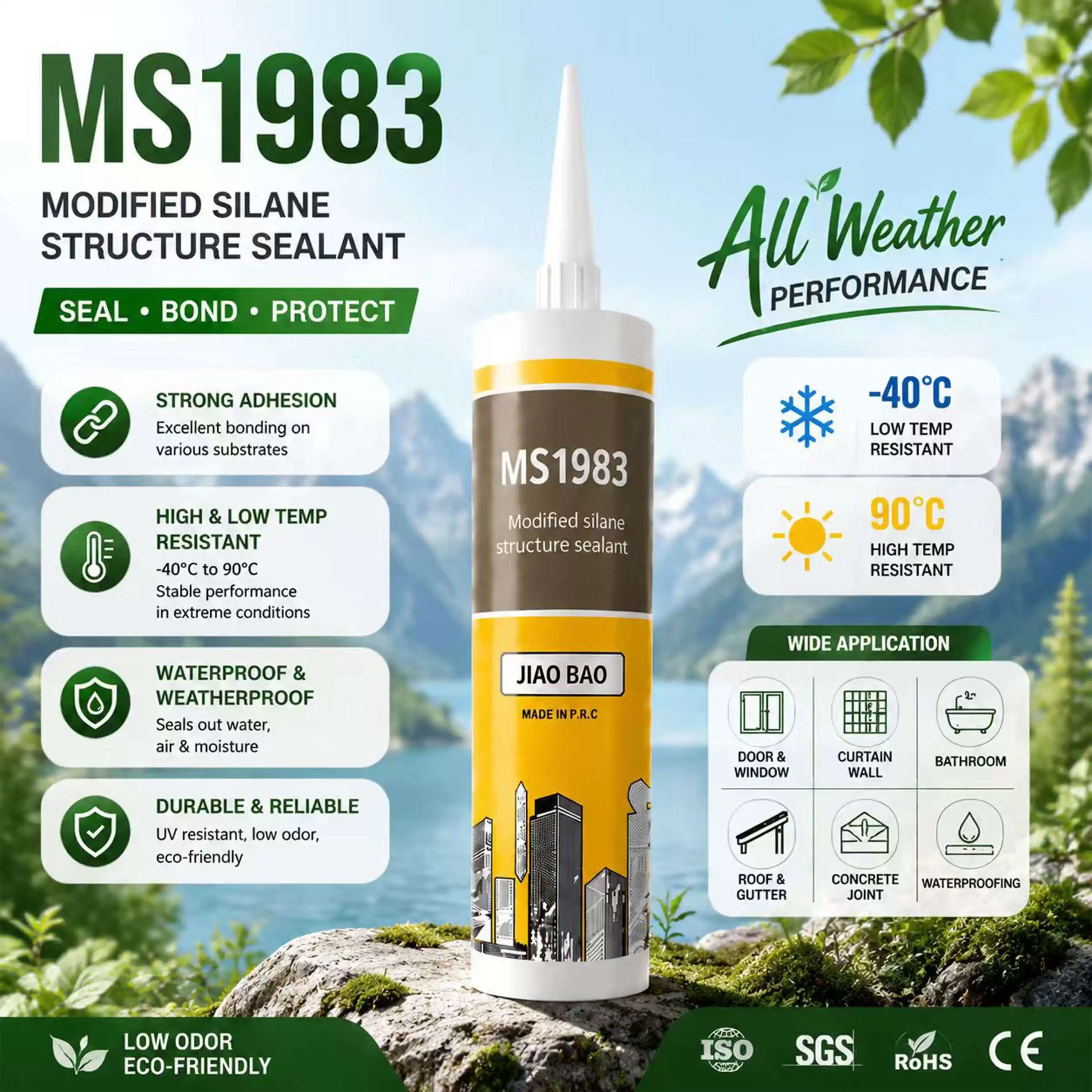
When you put these two chemicals through real-world stress tests, you can see the changes in how well they work.
Sticks to a Variety of Surfaces: MS polymer sealer sticks to glass, metal, galvanized steel, PVC, natural stone, ceramic tile, ABS plastics, and concrete without a primer, even when the surfaces are wet. Priming is often needed for PU glue on weak or low-energy surfaces, which adds time and money to every application.
Resistance from the environment MS sealant can handle temperatures from -40°C to 120°C without losing its ability to stick things together. It's better than regular PU sealants at resisting UV light and weathering, so it's the best choice for marine environments that get salt spray and chemical cycling.
Behaviors That Cure MS sealant cures at a rate of about 3.5 mm per day and is tacky-free in 25–40 minutes in the summer and 15–30 minutes in the winter. When there is a lot of humidity, PU glue take longer to dry and can create CO2 bubbles, which is bad for the structure of precision parts.
Profile for safety: When MS sealant cures, it only gives off small amounts of alcohol. There is no formaldehyde, no isocyanates, and no solvents. This means it can be used in living areas, medical facilities, and areas close to food-contact areas that would need extra ventilation controls and PPE compliance if PU glue was used.
When choosing adhesives for things like building facades, transportation panels, or marine hardware, where a mistake can cost more than the adhesive itself, these differences are very important.
When buying managers know the pros and cons of both chemistries, they can better assign goods to the right project level.
The competitive advantages of MS sealant multi-purpose adhesive make it appealing for a wide range of industrial uses. These are the main performance benefits that are worth mentioning:
There was no silicone oil contamination MS polymer doesn't leave an oily film on glass, stone, or metal like other silicone sealants do. This keeps facade cladding from getting dark streaks over time.
Primer-free bonding: MS sealant sticks to most surfaces without a primer, which lowers the cost of applying it to each joint and gets rid of the need for primer compatibility factors.
It's not just about price per cartridge when it comes to reliable sources. As part of this, suppliers must be quick, formulations must be consistent, and packing must be flexible.
Certifications are important to look at when choosing an MS sealant supplier. To use indoors with low emissions, look for goods that meet ASTM C920 or ISO 11600 standards and have environmental credentials that match EC1, French A+, or German GEV ratings. These licenses protect buyers at the brand level who put their goods in high-end markets.
Flexibility in packaging is also important. Jiaobao's RTV MS Sealant comes in two common sizes: 300ml cartridges and 600ml sausage packs. These are used by professionals and on OEM assembly lines. This item comes in white, black, gray, or custom-matched colors, and it can be used in branded private-label projects. It has a 12-month shelf life when stored normally below 25°C.
Jiaobao offers a full-cycle service for B2B buyers who are in charge of OEM projects. This includes customizing formulations and designing packaging, as well as production wait times of one to two weeks. Configurations that are protected by NDAs and MOQ structures that are flexible lower the risk of brands trying out new market segments.
Once you connect the needs of the application to the strengths of the chemicals, it's easy to decide between MS sealant and PU adhesive.
If your project requires multi-substrate bonding, paintable joint finishing, indoor air quality compliance, or exposure to moisture and UV cycle, choose MS sealant multi-purpose adhesive. It is the better choice for building surfaces, door and window glazing, kitchen and bathroom fit-outs, and putting together transportation panels where vibration damping is very important.
When you need the strongest adhesion possible, keep the temperature under control, and work on areas where the risk of CO2 bubbling is doable, choose PU adhesive. PU is still useful for load-bearing structures where flexibility is not a top priority.
For purchasing managers making a slim adhesive catalog, MS sealant's ability to do all three functions (bonding, sealing, and gap-filling) with a single product makes it easier to keep track of SKUs while still meeting high performance standards for most job types.

In most industry and building bonding situations, MS sealant multi-purpose adhesive works better than PU adhesive. This is especially true when environmental safety, substrate versatility, and coating compatibility are important. PU adhesive is still used in situations where rigid mechanical strength under load is needed. But modified silane polymer technology is the better overall value for brands and sourcing teams that want a single, certified, eco-friendly adhesive that works on a variety of surfaces and in a variety of settings.
Depending on the temperature, MS sealant is no longer tacky in 15 to 40 minutes. The full cure moves forward at a rate of about 3.5 mm per day. Under normal conditions (23°C, 50% RH), a standard 6mm bead cures all the way through in about two days.
Yes. MS polymer sealant can handle temperatures from -40°C to 120°C and doesn't break down when exposed to UV light, salt spray, or chemicals. This means it can be used to seal exterior walls, marine hardware, and transportation panels.
OSHA says that isocyanates, which are found in PU glue, can make your lungs more sensitive. There needs to be enough air flow and PPE. MS sealant is safer for busy indoor areas because it only releases small amounts of alcohols when it cures and doesn't pose a risk of isocyanates.
Most of the time, no. MS sealant sticks to metal, glass, PVC, clay, stone, ABS, and concrete without primer. It is necessary to clean the surface, but most surfaces don't need primer, which saves time and money on materials.
Jiaobao's RTV MS Sealant comes in 300ml tubes and 600ml sausage packs, and it can be made in white, black, gray, or unique colors. It can be stored for 12 months.
Jiaobao has manufactured certified sealant products since 2013 with over 13 years of production expertise. As a trusted MS sealant multi-purpose adhesive manufacturer, we offer OEM/ODM customization, flexible MOQ, 1–2 week lead times, and full after-sales support. Reach our team at dorashen@cnjiaobao.com to request samples, a competitive quote, or a product specification sheet today.

1. ASTM C920: Standard Specification for Elastomeric Joint Sealants — ASTM International, 2022.
2. ISO 11600: Building Construction — Jointing Products — Classification and Requirements for Sealants — International Organization for Standardization, 2020.
3. Adhesives and Sealants Industry Magazine: MS Polymer Technology in Construction Applications — Adhesives & Sealants Industry, 2021.
4. Occupational Safety and Health Administration: Isocyanates in the Workplace — Health Hazard Information — U.S. Department of Labor, OSHA, 2019.
5. Construction Sealants Market: Global Industry Analysis and Forecast 2023–2030 — Grand View Research, 2023.
6. Journal of Adhesion Science and Technology: Performance Evaluation of Silane-Modified Polymer Sealants vs. Polyurethane in Structural Glazing — Taylor & Francis, 2020.
November 16,2023
Enterprise Name
The sealant has very strong adhesion and performs well even on glass and aluminum. After curing, it remains flexible and shows no cracking. Perfect for our facade projects.
November 16,2023
Enterprise Name
Stable quality across batches. Our customers especially like the smooth application and consistent extrusion. It helps reduce installation time on site.
November 16,2023
Enterprise Name
I used it for bathroom sealing. Excellent waterproof performance and no mold issues so far. It's been holding up very well in humid conditions.
November 16,2023
Enterprise Name
The neutral silicone works well on sensitive materials without corrosion. Very suitable for industrial applications requiring stable performance.
_1779347426672.webp)