November 16,2023
Enterprise Name
The sealant has very strong adhesion and performs well even on glass and aluminum. After curing, it remains flexible and shows no cracking. Perfect for our facade projects.
Sep 14, 2026
In short, yes — fireproof building silicone sealant can replace traditional mortar in many fire-rated joint and penetration applications, and in several scenarios it outperforms mortar significantly. Unlike rigid mortar, this one-part RTV sealant accommodates structural movement, resists temperatures from -50℃ to +150℃, and cures into a flexible, durable seal that holds up under long-term stress. For commercial and industrial construction projects where compliance, elasticity, and verified fire ratings all matter, this material offers a technically stronger case than conventional mortar-based approaches.
Fireproof building silicone sealants are made with flame-retardant ingredients mixed into a silicone polymer base. When the material is heated for a long time, it turns into a stable char shield that stops fires, hot gases, and smoke from getting through. Standard building silicones don't have any of these added ingredients. In fact, the difference is very important because it tells us if a firestop system will keep its rating when tested under ASTM E814 (UL 1479) or ASTM E1966 (UL 2079) conditions. An F-Rating and a T-Rating are given to a certified fireproof building silicone sealant, and they must match the tested wall or floor assembly.
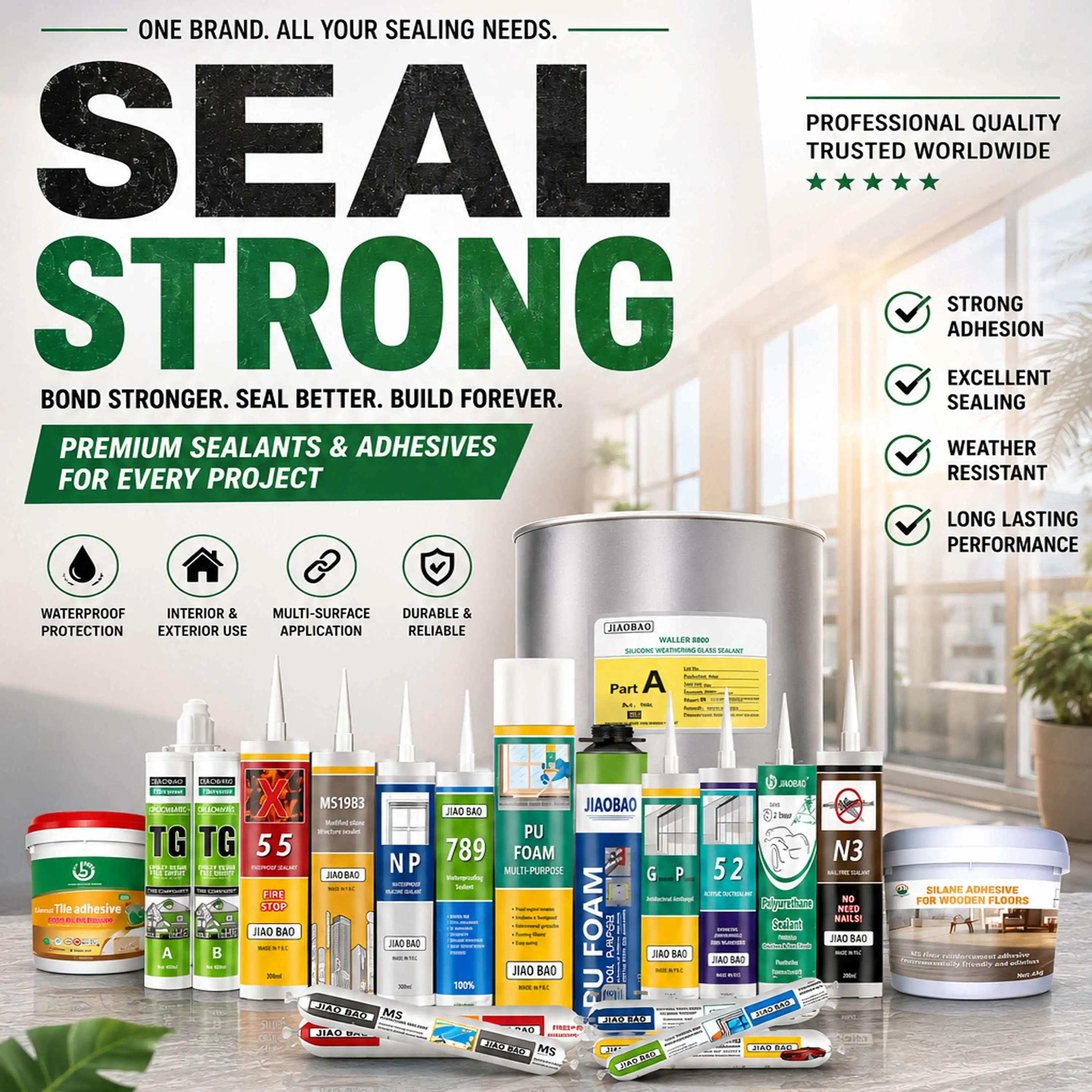
Jiaobao's one-part RTV fireproof building silicone sealant (acidic composition, paste type) was made to work in these conditions. It takes 45 to 60 minutes for the surface to dry, and it cures at a rate of 3mm per 24 hours in normal conditions (25℃, 50% RH). It can hold between ±20% and ±50% of its weight, and it is rated Class 1 W for water resistance. These are not marketing claims; they are properties that can be measured and checked against GB 13477 and GB 2793 test standards. It comes in cartridge or sausage packing and comes in 300ml and 600ml sizes. It can be shipped in white, black, gray, or unique colors to fit the needs of the project.

Even though traditional mortar has been used for a long time in building, it doesn't meet the needs of current passive fire protection. By its very nature, mortar is hard. It can't bend. When joints in a building settle and expand and contract because of changes in temperature, mortar cracks. And a firestop that is cracked is not working. When business buildings get older, they often have mortar-based entry seals that are broken because the structure has moved over time.
Here is how the two materials compare across key performance criteria:
When a purchase decision is tied to a fire inspection deadline or a warranty obligation that lasts for more than one year, these differences are important. It is hard and expensive to change your mind about the wrong material you chose at the specification stage.

If you are looking for a supplier of fireproof building silicone sealant for business or industrial projects, you must start by making sure that the certification is real. Before placing large orders, procurement teams should ask for the following: a type inspection report from a nationally recognized testing laboratory, a current fire certification certificate, and a technical data sheet with traceable batch information. The options should include well-known brands like 3M, Hilti, and Sika, as well as certified domestic manufacturers.
Jiaobao has been following ISO-compliant manufacturing standards since 2013. They are also CE certified and have been making things for over 13 years. Lead times are one to two weeks from the time an order is confirmed, and foreign buyers can choose between sea and land freight. Buyers who need unique labeling, exact color matching, or formulas that meet the needs of regional codes can get OEM and ODM production.
Stable supply is just as important as unit cost for fire engineering companies who are working on multiple projects at once. A sealer that ships on time and comes with all the paperwork it needs makes the proof and acceptance stage go more smoothly.
Fire rating legitimacy is tied to proper placement. No matter how good the product is, if the fireproof building silicone sealant is put below the tested minimum depth (6mm to 12mm, based on joint width), the certification is null and void. Here are the most important rules that football teams must follow when applying:
After installation, a written report of each sealed penetration's visual inspection and photograph helps the fire acceptance process and gives strong proof during any later audit or reinspection.
It is more cost-effective to use fireproof building silicone sealant instead of mortar in dynamic joint uses than to follow the rules. To fix mortar, you have to chip, remove, mix, and re-cure it. These are all very time-consuming steps that silicone restoration doesn't have to do. Fewer maintenance tasks save building owners and facility managers a lot of money over the course of a building's 20-year lifecycle.
Eco-formulated fireproof building silicone sealants with a low VOC content of less than 50g/L can also contribute to LEED v4, which is becoming an increasingly important part of business real estate approval. As environmentally friendly building design turns into a requirement for contracts instead of a way to stand out, builders can stay ahead of the rules by selecting low-emission fireproof building silicone sealants from the start.
Traditional mortar can still be used for structural fills that don't move, but it doesn't work well enough for current fire-rated joint systems used in business building. Fireproof building silicone sealant can fill in the holes that mortar can't. It is approved, flexible, and long-lasting. The specification choice is clear for people who work in purchasing and fire engineering and see compliance as a minimum rather than an end goal. That choice is based on verified certificates, stable supply lines, and technically correct datasheets.
Yes. The fireproof building silicone sealant from Jiaobao has a Class 1 W water protection grade, which means it can both keep out fires and water. This two-in-one feature is especially useful at outer wall perimeter joints and below-grade penetrations where water entry is a risk at the same time.
Fireproof building silicone sealants don't really expand, but they do burn and resist heat. People who use flammable penetrants, like PVC pipes, usually need intumescent acrylic sealants. This is because they expand when heated, filling in the hole left by a pipe that melts. Before replacing materials, look at the tested system specification.
If you keep a cartridge for more than 12 months, it usually starts to skin inside the tip too soon, needs too much extrusion force, or doesn't fix evenly. If you put fireproof building silicone sealant from a suspect cartridge on a fire-rated part, it might look like the seal is complete, but it won't hold up in high temperatures.
No, silicone surfaces don't let regular paint stick to them. You can order the product in any color that works with the finish you need for your project. You can choose from white, black, gray, or a custom color.
Jiaobao has been making fireproof building silicone sealant for more than 13 years and has ISO and CE certifications. This makes them a reliable choice for contractors who can't afford to fall behind on compliance. The team is ready to help you with your buying process, whether you need large amounts, special OEM formulations, or technical paperwork for a fire acceptance review. To get samples or a full technical datasheet, email dorashen@cnjiaobao.com.
1. ASTM International. ASTM E814: Standard Test Method for Fire Tests of Penetration Firestop Systems. ASTM International, 2023.
2. ASTM International. ASTM E1966: Standard Test Method for Fire-Resistive Joint Systems. ASTM International, 2022.
3. National Fire Protection Association. NFPA 101: Life Safety Code. NFPA, 2024.
4. Underwriters Laboratories. UL 1479: Fire Tests of Through-Penetration Firestops. UL Standards, 2023.
5. International Code Council. International Building Code (IBC), Chapter 7: Fire and Smoke Protection Features. ICC, 2021.
6. Construction Specifier Magazine. "Firestop Systems: Selection, Application, and Inspection Best Practices." Construction Specifier, 2022.
November 16,2023
Enterprise Name
The sealant has very strong adhesion and performs well even on glass and aluminum. After curing, it remains flexible and shows no cracking. Perfect for our facade projects.
November 16,2023
Enterprise Name
Stable quality across batches. Our customers especially like the smooth application and consistent extrusion. It helps reduce installation time on site.
November 16,2023
Enterprise Name
I used it for bathroom sealing. Excellent waterproof performance and no mold issues so far. It's been holding up very well in humid conditions.
November 16,2023
Enterprise Name
The neutral silicone works well on sensitive materials without corrosion. Very suitable for industrial applications requiring stable performance.
_1779347426672.webp)