November 16,2023
Enterprise Name
The sealant has very strong adhesion and performs well even on glass and aluminum. After curing, it remains flexible and shows no cracking. Perfect for our facade projects.
Sep 22, 2026
MS sealant for construction — technically a silane-terminated polymer (SMP) sealant — has earned genuine credibility across high-end building projects for its flexibility, low-VOC profile, and paintable surface. Yet even this advanced material fails when professionals overlook preparation protocols, misread environmental conditions, or source substandard product. Understanding why failures occur is not merely academic; it directly protects project budgets, timelines, and structural warranties. This article breaks down the root causes of MS polymer sealant failures and delivers actionable fixes grounded in technical data and field experience.
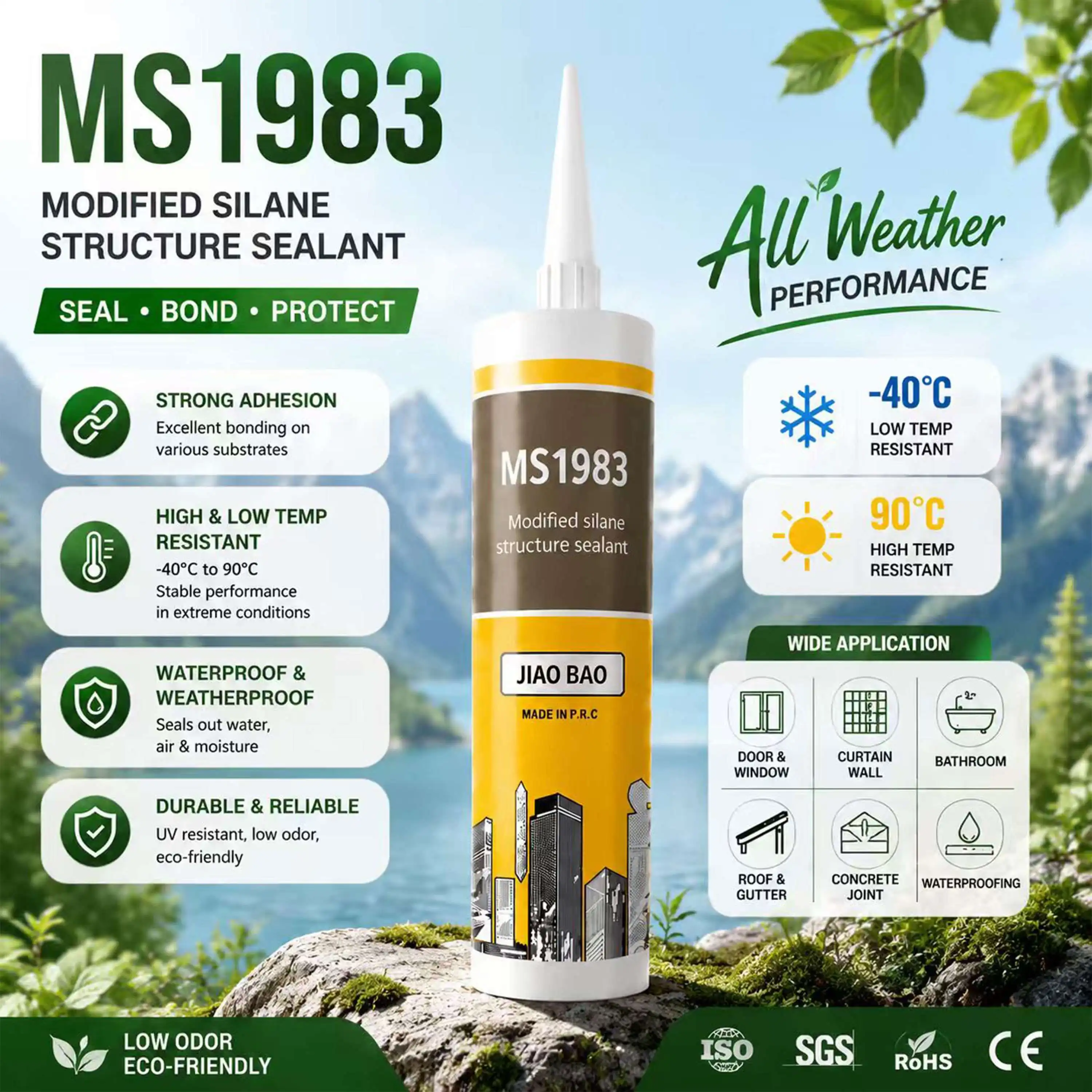
When it gets wet, modified silicone sealant, or SMP sealant, cures through silane-terminated prepolymers that are activated by moisture. This mixed chemistry has the mechanical strength of polyurethane and the weatherproofing properties of silicone, but none of the problems that come with either one. It usually doesn't need a base to stick to glass, metal, stone, concrete, PVC, and wood. With a Shore A hardness of about 45, a tensile strength of about 2.2 MPa, and an elongation at break of about 400%, it is a good material for current building parts that move.
Some signs that a sealant is failing are cohesive cracking through the sealant body, adhesive peeling at substrate surfaces, chalking or discoloration after UV exposure, and shrinking that can be seen in wide joint applications. Each sign is caused by a different, avoidable factor, and each one can be fixed by taking the right steps.
In peer-reviewed adhesion studies, contamination is the main reason why sealant bonds don't work. The chemical connection between the silane polymer and the substrate surface is broken by oil residues, dust, form-release agents, and remaining wetness. On porous surfaces like sandstone or concrete, small bits on the surface work as a weak border layer, letting the sealant separate from the surface instead of its own body. This is why MS sealant for construction projects demands rigorous surface preparation—no formulation can compensate for a contaminated substrate.
This risk gets a lot worse when you skip the primer on concrete that is easy to break or polyolefin plastics that haven't been treated. Industry research consistently shows that failures to adhere to concrete substrates drop by more than 60% when a compatible primer is used first, before the sealant is applied.
Polymer seals that have been changed by silane cure through wetness in the air. This is helpful when it's damp, but it's bad when the relative humidity drops below 30% RH or when the surface temperature rises above 40°C while the coating is being applied. In these conditions, the outer skin forms too soon, trapping uncured material inside and making a bead that is twisted and not strong enough to hold its shape.
Long-term UV exposure without a formulation that is stable in UV light also weakens and chalks surfaces over time. When temperatures are changed outside of the recommended range of -40°C to 120°C, especially when surfaces have very different thermal expansion coefficients, stress cracking at the edges of joints happens faster.
Not all MS polymer sealants work the same way. Fillers that lower elongation at break below 300% are often used in low-grade formulations. This makes them brittle in dynamic joints. Products that don't have EMICODE EC1 or a similar eco-certification may still have solvents or plasticizers that move to nearby surfaces and stain them or cause the coating to come off. For jobs where responsibility lasts after the application date, you must choose a construction-grade SMP sealer with checked technical data sheets.
Here are the main steps in preparation that get rid of most field failures:
When these steps are followed consistently, they fix the adhesion problems that cause most warranty claims in high-end construction projects. The best way to tell if a sealant will last is to make sure the surface is clean, primed, and dry.
When the temperature is between 5°C and 35°C and the relative humidity is above 40%, you should use MS polymer glue. Do not use in full noon sunlight on dark or heat-absorbing surfaces. In the winter, the tack-free time drops to 15–30 minutes, which means that tools need to be used more quickly. The tack-free window grows to 25–40 minutes in the summer, giving you more time to finish joints neatly. These application windows are exactly what MS sealant for construction professionals rely on to plan daily workflows and avoid rework.
Keep the depth of the sealant bead at least half of the width of the joint. The beads are too thin and don't have enough cross-sectional area to absorb joint movement without tearing.
The difference in performance between silicone, polyurethane, and acrylic sealants and silane-modified polymer sealants is clear in a number of real-life situations.
You can't paint over silicone sealants, and they leave behind silicone oil that stains natural stone forever. This is a major problem for high-end exterior work. Polyurethane seals can be harmful if they come in contact with isocyanates, break down when exposed to UV light for a long time, and can bubble up in wet conditions. Acrylic sealants can be painted, but they don't stretch or last as long as needed for structural or facade joints that are heated and cooled many times.
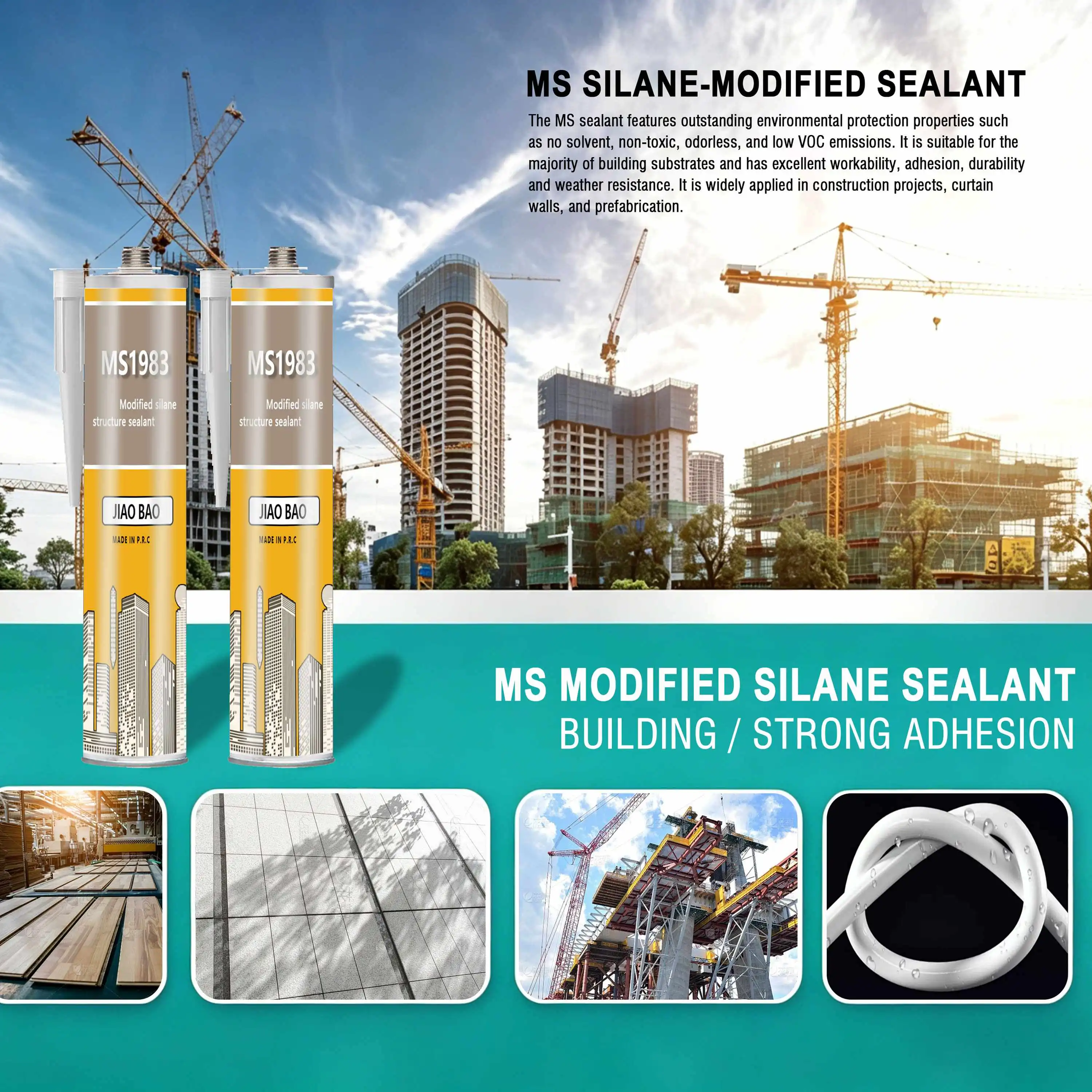
MS polymer glue is unique because it can stretch over 400% at break, doesn't contain any solvents or isocyanates, and can be painted with water-based finishes. Its solid content of about 99% means that it doesn't shrink much after it cures, which is useful for wide joints on premade panels or modular walls. For green building projects that want to meet LEED or BREEAM standards, the low-VOC, formaldehyde-free profile is often a requirement that silicone and polyurethane can't meet. This combination of elasticity, safety, and sustainability is what makes MS sealant for construction a preferred choice for specifiers on high-performance building envelopes.
When businesses buy coatings from each other, it's not just about unit price. Supplier value over a multi-project horizon is defined by consistent performance from batch to batch, tested results that can be trusted, and quick technical help. As a starting point, when looking at MS sealer manufacturers, ask for their full technical data sheet (TDS), VOC test report, and adhesion test data on the surfaces that are important for your application.
Choices of packaging are important for operations. From reputable makers, you can get both 300 ml cartridges and 600 ml sausage packs. For big projects, the sausage forms save money on per-volume costs and cartridge waste. Check the shelf life—usually 12 months—and the cold-chain storing rules if you're sending the food to a place where it gets hot.
When buying from an OEM, you should look at the company's NDA policies, how much they allow for formulation customization, and their minimum order numbers in light of your brand's rollout plan. When compared to distributors who carry third-party inventory, lead times of one to two weeks from a vertically integrated facility greatly lower procurement risk.
It is almost always possible to avoid MS sealant problems in building. With MS sealant for construction, the key is disciplined surface preparation, correct application windows, and choosing a formulation that matches the substrate and project requirements. The evidence consistently points to three things that can be fixed: not properly preparing the substrate, applying the product outside of the recommended environmental windows, and getting the product from a source without checking their technical credentials. Using written procedures to deal with these issues turns a weak design into a reliable long-term asset. The performance data—2.2 MPa tensile strength, 400% elongation, a temperature range of -40°C to 120°C, and almost no VOC—allows for sure specification as long as the product is used properly and comes from a responsible source.
The skin-over (tack-free) time can be anywhere from 15 to 40 minutes, based on the temperature and season. At normal site conditions, it takes about 3–7 days for a standard 6 mm joint to fully cure mechanically. For a longer window, deeper joints or very low humidity are needed.
Yes. It can stick to wet surfaces where polyurethane and silicone would bubble and fail to bond because of the way it reacts to moisture. Avoid situations like standing water or being immersed, which are outside the design limits for the normal formulation.
No, primerless bonding works well on metal, glass, PVC, and clean concrete. To get the recommended binding values, porous brickwork, friable concrete, and polyolefin plastics all need a primer that works with them.
Yes, it is safe for sensitive or busy indoor areas because it doesn't contain any solvents, formaldehyde, or isocyanates, and it has low volatile organic compound (VOC) emissions. This is something that standard silicone and polyurethane sealants can't say.
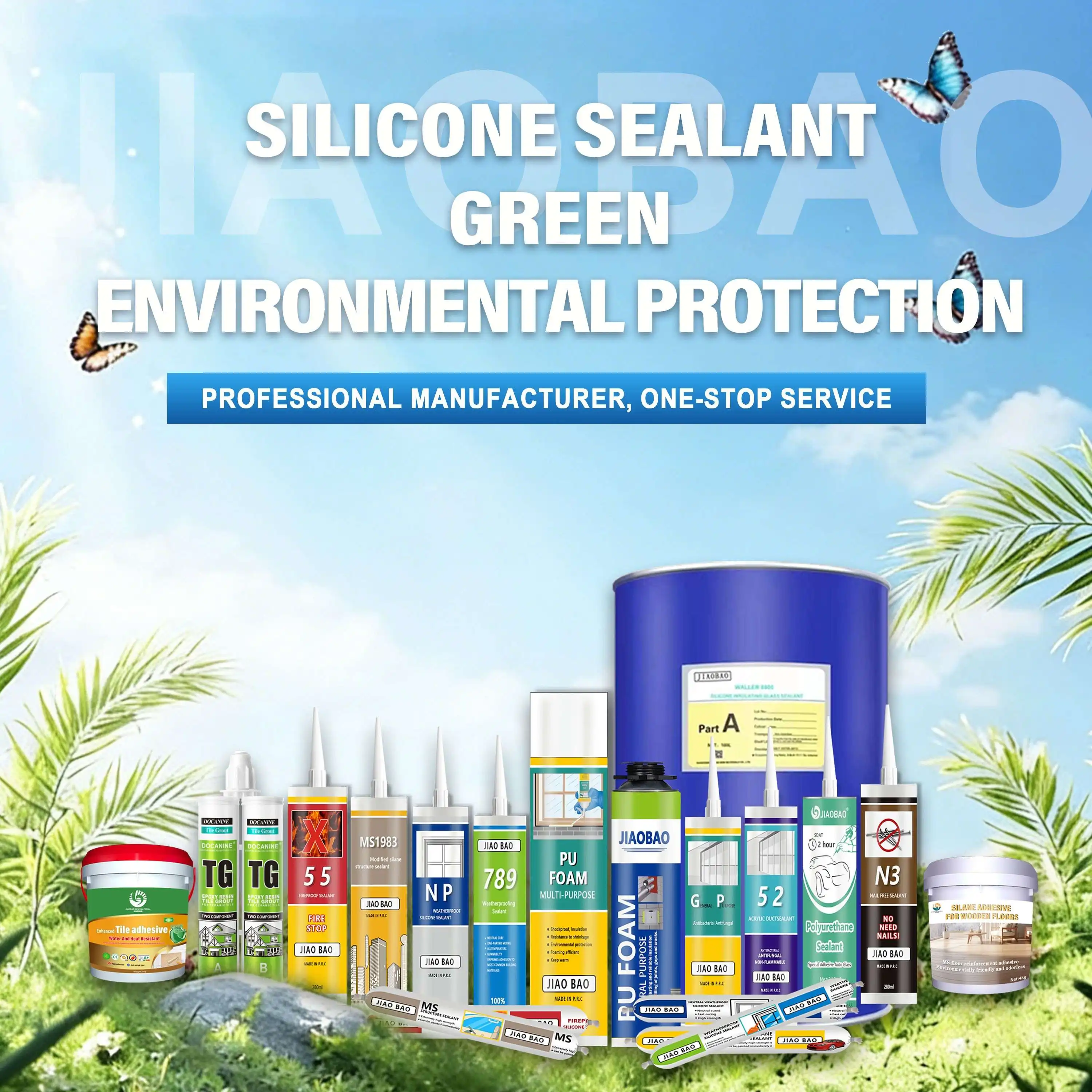
Since 2013, Jiaobao has been making construction-grade sealants. They have ISO and CE standards, a production wait time of one to two weeks, and can do both OEM and ODM work. Our technical team can help you with verified TDS reports, custom formulation options, and reliable support after the sale, whether you are expanding a line of green building products or looking for a bulk MS sealant supplier. To get a free taste right now, email us at doirashen@cnjiaobao.com.
1. Brockmann, W., Geiß, P. L., Klingen, J., & Schröder, B. (2009). Adhesive Bonding: Materials, Applications and Technology. Wiley-VCH.
2. Wolf, A. T. (2005). Durability of silicone sealants. Construction and Building Materials, 19(4), 301–309.
3. Petrie, E. M. (2007). Handbook of Adhesives and Sealants (2nd ed.). McGraw-Hill.
4. ASTM International. (2018). ASTM C920: Standard Specification for Elastomeric Joint Sealants. ASTM International.
5. GEV — Gemeinschaft Emissionskontrollierte Verlegewerkstoffe. (2021). EMICODE EC1 Plus Classification for Low-Emission Building Products. GEV.
6. Cognard, P. (2006). Handbook of Adhesives and Sealants: Volume 2 — General Knowledge, Application of Adhesives, New Curing Techniques. Elsevier.
November 16,2023
Enterprise Name
The sealant has very strong adhesion and performs well even on glass and aluminum. After curing, it remains flexible and shows no cracking. Perfect for our facade projects.
November 16,2023
Enterprise Name
Stable quality across batches. Our customers especially like the smooth application and consistent extrusion. It helps reduce installation time on site.
November 16,2023
Enterprise Name
I used it for bathroom sealing. Excellent waterproof performance and no mold issues so far. It's been holding up very well in humid conditions.
November 16,2023
Enterprise Name
The neutral silicone works well on sensitive materials without corrosion. Very suitable for industrial applications requiring stable performance.
_1779347426672.webp)