November 16,2023
Enterprise Name
The sealant has very strong adhesion and performs well even on glass and aluminum. After curing, it remains flexible and shows no cracking. Perfect for our facade projects.
Sep 16, 2026
When working with construction adhesive for wood and metal bonding, understanding curing time and load capacity is non-negotiable. Nail free glue for wood & metal — particularly modified silane polymer formulations — offers a practical alternative to mechanical fasteners in cabinetry, furniture assembly, and metal frame installation. Surface dry time as short as 20 minutes and a full cure depth of 2.5mm per 24 hours allow production teams to plan bond sequences with precision. This guide breaks down everything procurement professionals, installers, and OEM brand buyers need to know before committing to a construction adhesive supplier.
Point-load stress concentrations are made by traditional screws and nails. When you use adhesive bonding, on the other hand, the load is spread out over the whole glue surface. This is very important when combining different types of materials, like oak panels and metal extrusions, whose coefficients of thermal expansion are very different. A changed silane polymer adhesive works as a damping layer, which means it doesn't fight changes in size but instead absorbs them. According to ISO 37 testing results, a properly made nail free glue for wood & metal keeps its structural integrity from -40°C to 80°C. This temperature range covers almost all home and light business uses in the US.
Chemicals are useful for various tasks. Polyurethane sealants are often used for outdoor crafts because they harden quickly and don't get wet easily. Epoxy systems have a very high shear strength but not much flexibility, which is a problem for surfaces that grow and shrink. It joins quickly with cyanoacrylate, but it doesn't do well with low peel loads. Modified silane polymer (MS Polymer) mixtures are a good compromise because they can bond porous surfaces like MDF and wood with non-porous ones like steel, glass, PVC, and coated tile, and they can still stretch 300% when they break. Because of this, the bond doesn't break when the materials move with the seasons or the temperature.
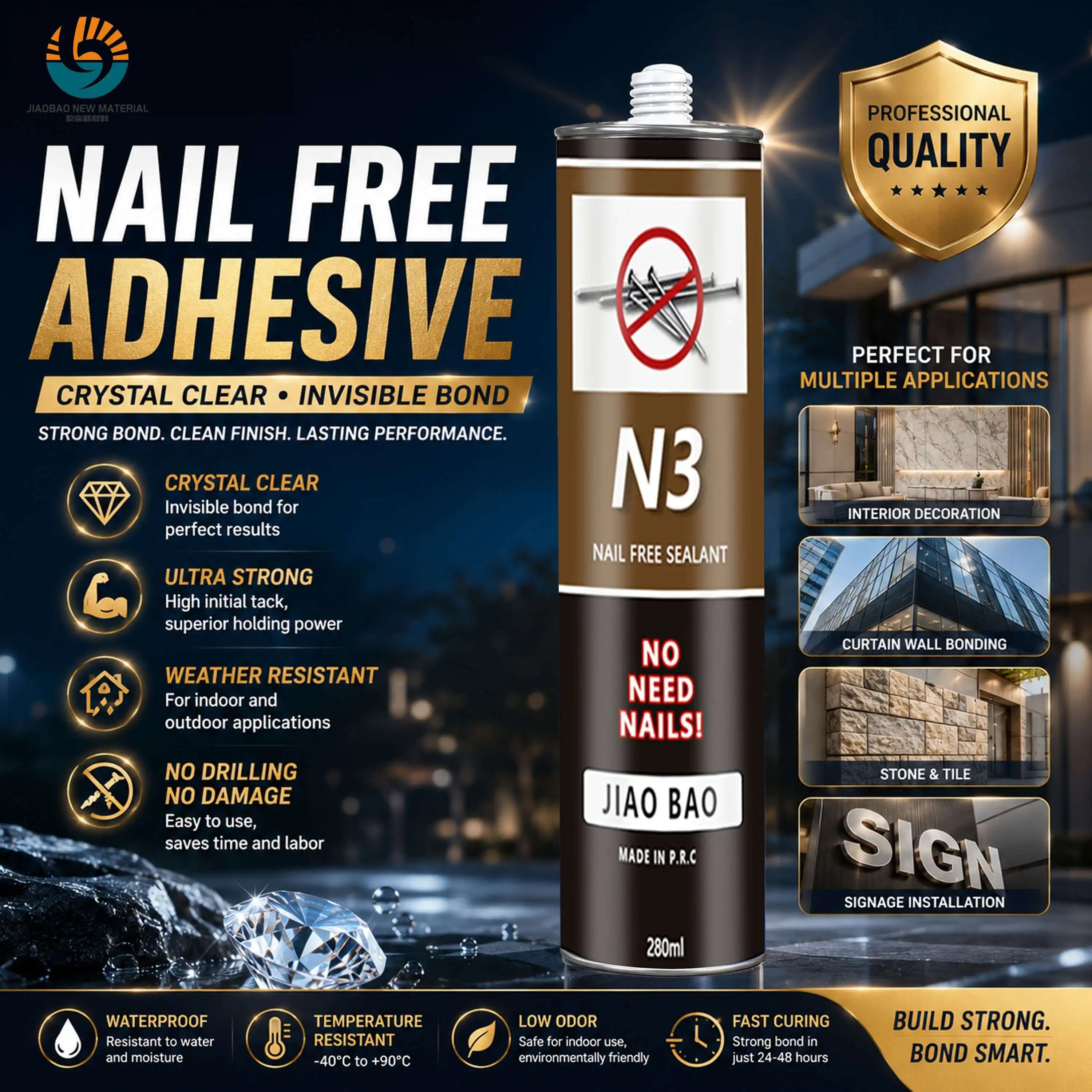
A Key Difference Between "Drying" and "Full Cure" Calling something "fully cured" or "surface dry" is not the same thing. Mixing them up is one of the main reasons why bonds fail too soon on production lines. At 23°C and 50% relative humidity, it usually takes about 20 minutes for a moisture-cure adhesive made of modified silane polymers to reach a surface that doesn't stick. However, the full mechanical strength doesn't form until the fix front moves through the bead, which happens at a rate of about 2.5 mm per 24 hours. Because of this, a 6mm bead needs about 48 to 60 hours before it can safely be loaded to full capacity.
Environmental factors change these dates in a big way. Dry winter air slows down moisture-cure systems, while higher humidity speeds them up. The porosity of the substrate is also important. When you bond metal to MDF, water moves through the wood face and speeds up the fix on that side while the metal-facing surface heals more slowly.
The following technical standards are important for judging any structural nail free glue for wood & metal used to make cabinets and furniture:
These standards make it easier for procurement managers to compare adhesive goods from different sources without having to rely on claims made by individuals.
Compatibility with the substrate is the most important selection factor. If you use solvent-based nail free glue for wood & metal on steel that hasn't been treated, they could cause flash rust or delamination on UV-lacquered board surfaces. Because water-based recipes depend on drainage through at least one open face, they don't work well when trying to bond metal to metal or metal to glazed tile. Modified silane polymers cure through atmospheric moisture instead of solvent evaporation. This means they don't react with wood, metal, PVC, stone, glass, or ceramic as a substrate. This is a huge benefit for installation contractors who have to deal with a wide range of materials on every job site.
In 2026, procurement managers should give more weight to sellers who offer full Technical Data Sheets and Safety Data Sheets in English, are certified by ISO and CE, and can show that their products are low in volatile organic compounds (VOCs) for markets with indoor air quality rules. OEM buyers looking for supplies for the North American do-it-yourself market should also make sure that the package design works with both 300ml cartridges and 600ml sausages.
Epoxy has higher shear strength numbers on paper, but joints that bend can't use it because it's too rigid. Surface damage from screws and nails can be seen and needs to be fixed on final furniture panels. Nail free glue for wood & metal keeps tile from getting damaged when it's drilled, protects wall finishes while trim is being installed, and lets you move things around within the open time window, which is usually up to 20 minutes after application. When compared to two-part epoxy systems, 20-minute surface dry and same-day handling greatly cut down on line downtime for cabinet makers with high-volume assembly lines.
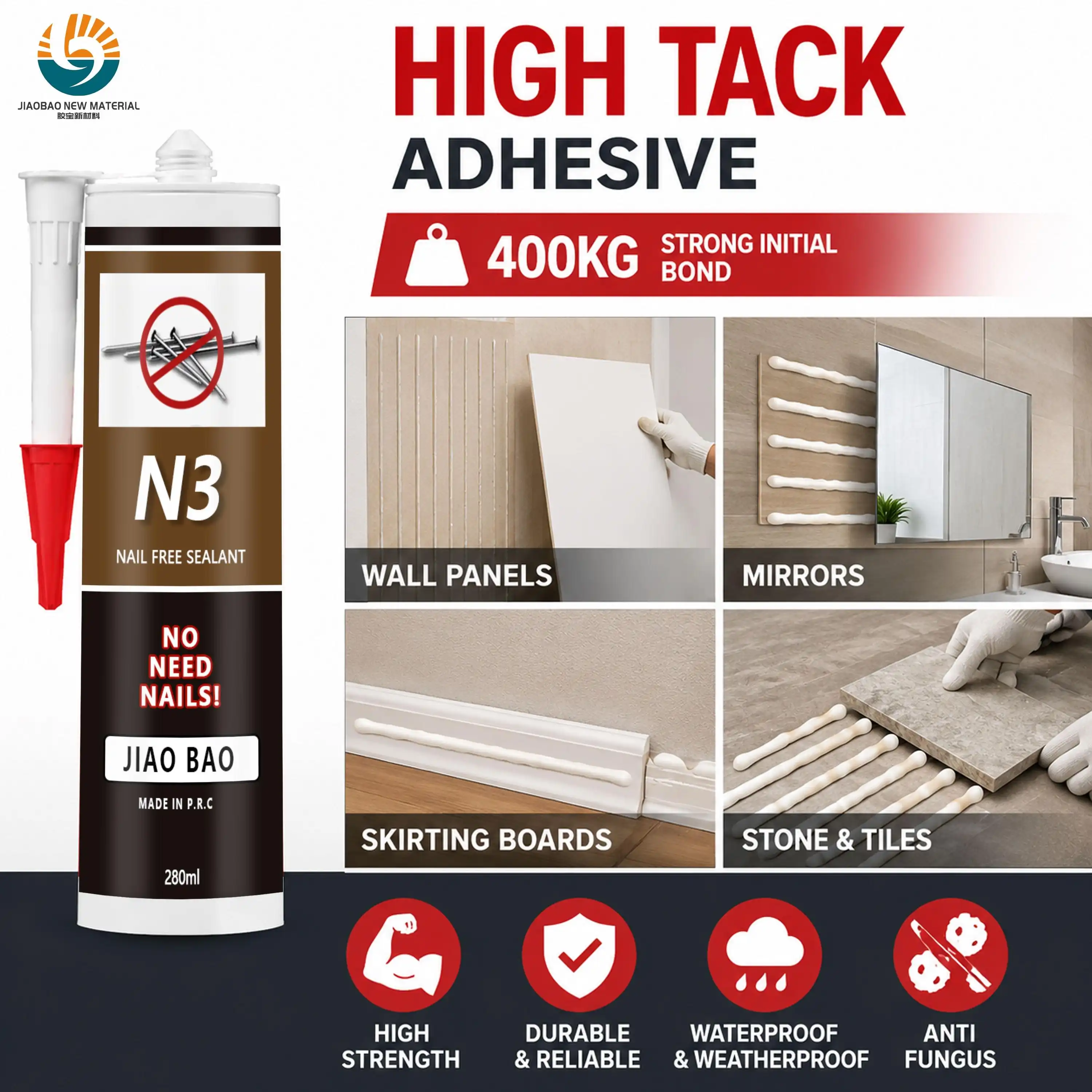
The strength of the bond depends on the surface that the nail free glue for wood & metal is stuck to. At the interface, sticking things together is hard because of dust, grease, water, and loose coatings. Before you use it, wipe metal surfaces with isopropyl alcohol. To get to the base, sand or lightly abrade smooth coated metal. Before the whole production run, it's a good idea to do a cross-hatch bonding test on a sample piece of wood panels that have been lacquered or UV-coated at the plant.
Here are the core application practices that support consistent bond performance:
When done regularly, these steps lower the number of repair tasks and protect the quality of the final product. Cartridges should be kept capped until they are used and stored below 25°C in a dry place. A shelf life of 12 months in the right storage conditions gives manufacturers and distributors more options in the supply chain.
To choose the right nail free glue for wood & metal for joining metal and wood, you need to know how the adhesive cures, how much weight it can hold, and what kinds of materials it can stick to. Modified silane polymer formulations solve the hardest parts of this problem: they stick to different types of materials, stay flexible under heat stress, and dry to the point where they can be used in 20 minutes. This type of glue can be used instead of mechanical fasteners in cabinetry, furniture making, and business joinery because it has a tensile strength of 2.5 N/mm² and a break stretch of 300%. Accurate technical expectations, careful surface preparation, and controlled curing conditions are always combined to make joints that last and don't get damaged at production scale.
At 23°C and 50% relative humidity, the surface dries in about 20 minutes. Full structural load shouldn't be put on the building until the cure front has moved through the whole depth of the bead. In normal conditions, this takes 24 to 48 hours for standard bead sizes.
Yes, nail free glue for wood & metal stick well to non-porous surfaces like glass, glazed tile, and polished stone, and most of the time, they don't even need starters.
The working temperature range, from -40°C to 80°C, includes the summer heat load and winter freeze cycles that happen in most of the US, even in very cold places.
The nail free glue for wood & metal comes in 300ml cartridges and 600ml sausage packs. Both can be used with normal caulking guns that are common in building and cabinets.
Unlike solvent-based options, modified silane polymer systems don't have as many volatile organic molecules built in. If a buyer needs special certification paperwork, they should ask their supplier for the SDS and independent test results.
Every batch of construction adhesive that Jiaobao makes is based on our more than 13 years of experience making things. ISO and CE standards are met by our nail free glue for wood & metal, and OEM/ODM customization is possible in White, Black, Gray, or any color you choose. Our wait times are one to two weeks, and we can ship by sea or land. For approved buyers, we also offer a free sample program. You can email our team at dorashen@cnjiaobao.com to get a quote on a sample or in bulk right away.
1. Journal of Adhesion Science and Technology — 2022
2. Construction and Building Materials — 2021
3. International Journal of Adhesion and Adhesives — 2023
4. ISO 37: Rubber, Vulcanized or Thermoplastic — Determination of Tensile Stress-Strain Properties — 2017
5. ASTM C557: Standard Specification for Adhesives for Fastening Gypsum Wallboard to Wood Framing — 2019
November 16,2023
Enterprise Name
The sealant has very strong adhesion and performs well even on glass and aluminum. After curing, it remains flexible and shows no cracking. Perfect for our facade projects.
November 16,2023
Enterprise Name
Stable quality across batches. Our customers especially like the smooth application and consistent extrusion. It helps reduce installation time on site.
November 16,2023
Enterprise Name
I used it for bathroom sealing. Excellent waterproof performance and no mold issues so far. It's been holding up very well in humid conditions.
November 16,2023
Enterprise Name
The neutral silicone works well on sensitive materials without corrosion. Very suitable for industrial applications requiring stable performance.
_1779347426672.webp)