November 16,2023
Enterprise Name
The sealant has very strong adhesion and performs well even on glass and aluminum. After curing, it remains flexible and shows no cracking. Perfect for our facade projects.
Sep 17, 2026
When evaluating sealants for aluminum curtain walls, metal door frames, or HVAC ductwork, the choice between NP silicone sealant for aluminum & metal and polyurethane sealant directly impacts project longevity, compliance, and cost. NP neutral cure silicone delivers exceptional weatherproofing, a working temperature range of -50°C to +150°C, and zero corrosive byproducts on bare aluminum. Polyurethane offers robust mechanical adhesion but carries UV degradation risks and higher VOC levels. Understanding where each excels helps procurement managers, fabricators, and OEM brand owners specify the right product with confidence.
When NP silicone sealant for aluminum & metal cures, it gives off oxime or alcohol instead of acetic acid. This difference is very important for aluminum, galvanized steel, and copper materials that have not been handled because acid leftovers from acetoxy silicone cause oxidation and surface stains. NP silicone sealant for aluminum & metal makes an elastomeric bond that is forever flexible. This bond stays in place through thermal changes without becoming less flexible. Because its siloxane backbone is naturally resistant to UV light, ozone, and water, it is widely used in architectural glazing and curtain wall assemblies around the world.
When polyurethane seals come in contact with moisture in the air, they harden and change into a tough, high-modulus rubber. Their tensile strength is often higher than that of silicone, and they can be painted over, which is useful for structural steel or coated metal panels where color consistency is important for looks. However, polyurethane turns yellow in the sun after being outside for a long time, absorbs water over time, and usually has a VOC content well above 100 g/L, which makes it hard to follow LEED standards and California Air Resources Board (CARB) rules. Polyurethane is still a good choice for indoor structural metalwork or painted assemblies that won't be exposed to UV light much.
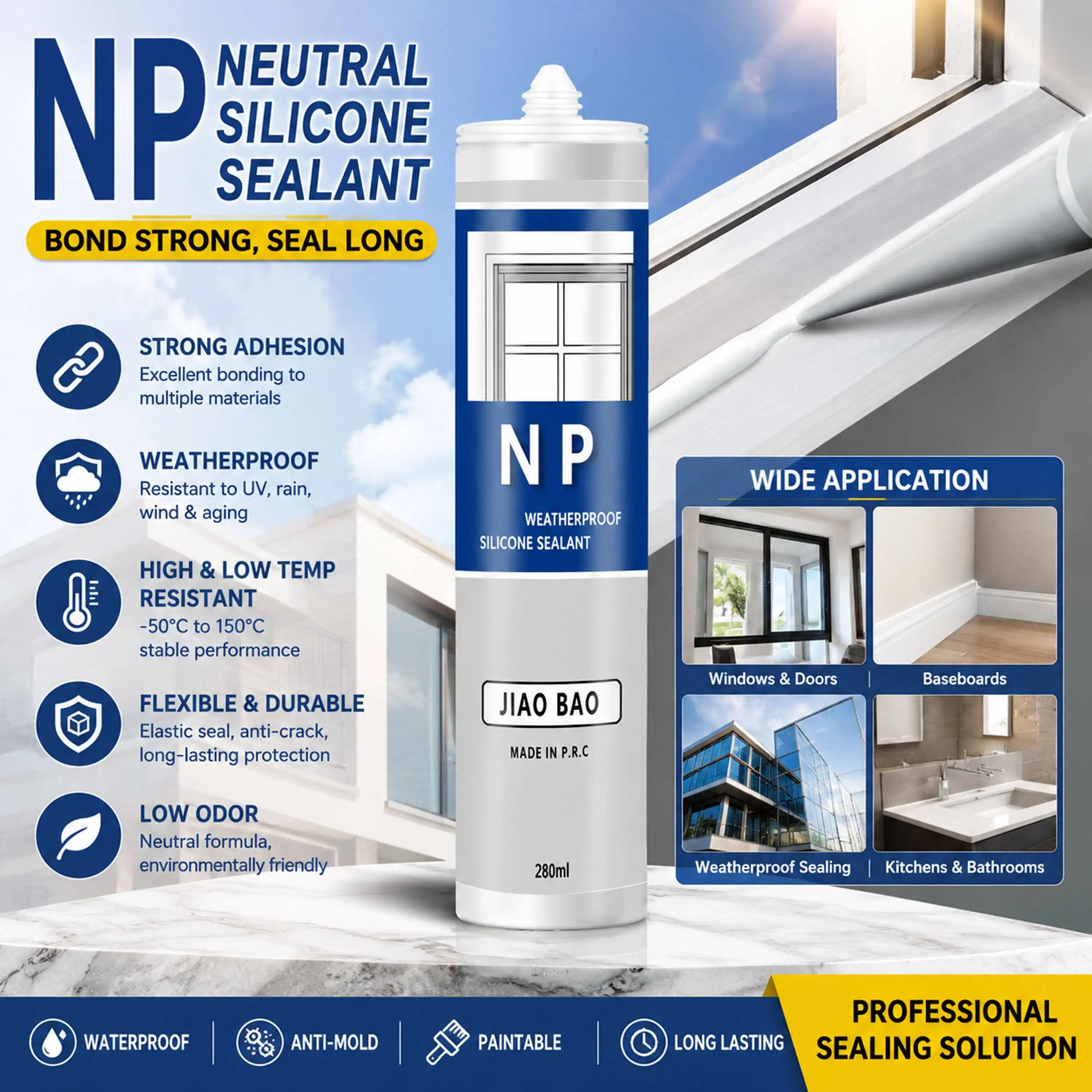
Selecting between these two chemistries requires matching performance data to actual project conditions. The table below summarizes the critical differentiators procurement engineers rely on.
| Property | NP silicone sealant for aluminum & metal | Polyurethane |
|---|---|---|
| Temperature Range | -50°C to +150°C | -40°C to +80°C |
| UV Resistance | Very good (no chalking) | Moderate (turns yellow over time) |
| VOC Content | < 80 g/L | 100–250 g/L |
| Movement Capability | ±25% (ASTM C719 Class 25) | ±20–25% |
| Paintability | No | Yes |
| Metal Corrosion Risk | None (neutral cure) | None |
| Full Cure Time | 7–14 days | 5–10 days |
Independent weathering tests, such as ASTM G154 rapid UV testing, show that NP silicone sealant for aluminum & metal keep more than 90% of their elongation after 5,000 hours of UV exposure. Polyurethane samples, on the other hand, usually lose their elongation and start to chalk up after 2,000 hours. This difference is very important for metal curtain walls that will be in full sunlight in hot places, like Middle Eastern markets.
According to GB 13477, Jiaobao's NP silicone sealant for aluminum & metal has a VOC content of less than 80 g/L. This means that it meets the requirements of both the US EPA's Architectural and Industrial Maintenance (AIM) coating regulations and the European Union's Directive 2004/42/EC. For polyurethane formulations to be workable, solvents need to be diluted. This raises VOC levels and makes it harder to get green building certification.

Whether a sealant fails to adhere or cohesively bond at the joint contact depends on how well the base is prepared. The two-cloth IPA method is the only way to clean aluminum and metal surfaces. First, wipe the surface with isopropyl alcohol on one cloth, and then dry it right away with a second clean cloth before the solvent evaporates. If you skip this step, surface contaminants will be redeposited, and the bond will fail early, no matter what kind of glue you use.
After making sure the surfaces are clean and dry, use a continuous bead to spread the NP silicone sealant for aluminum & metal. To get a smooth, void-free profile, use the tool during the skin-over window, which lasts for about 30 minutes at 25°C and 50% relative humidity. When applied to vertical joints, Jiaobao's one-part RTV neutral cure sealer has zero sag (ASTM C679: 0 mm). This is very important for sealing metal curtain wall mullions because downward slumping would ruin the look and performance of the waterproofing. It takes 7–14 days for full mechanical strength to form, and higher temperatures and humidity help the drying process go faster.
Polyurethane sealants are moisture-sensitive before cure. Once a cartridge is opened, it needs to be used right away, and metal surfaces should not have standing water or condensation on them. When it's below 5°C outside, the rate of curing slows down a lot, which makes joint safety wait times longer. If UV exposure is going to happen, polyurethane beads should be covered with a suitable primer coat after they have fully cured.
When purchasing metal sealants in bulk for businesses, buying managers should base their choice on three technical criteria: the ability to move relative to the joint width, the working temperature range, and VOC compliance for the final market. Most of the time, NP silicone sealant for aluminum & metal is better for HVAC ducts and aluminum curtain walls because polyurethane can't handle the heat cycles, UV light, and regulation scrutiny.
Packaging format also affects the cost of production. Jiaobao sells this product in 300 ml cartridge and 600 ml sausage pack sizes. It can be used with both hand caulking guns and pneumatic dispensing systems on automatic lines that make doors and windows. You can choose from white, black, gray, and custom-matched tones. This is useful for companies that make a lot of different metal anodize or powder coat finishes. The shelf life is 12 months if you store it the way the manufacturer suggests.
Before placing an order, procurement teams should look over these specification options:
These specifications position Jiaobao's NP silicone sealant for aluminum & metal as a reliable, high-quality choice that easily passes both internal quality control and third-party client checks.
Before the engineer would accept the material, the commercial glazing builder working on a mixed-use tower project had to find a NP silicone sealant for aluminum & metal that wouldn't stain and could pass the ASTM C719 Class 25 joint movement test. The contractor confirmed cohesive failure mode after getting cartridge samples and running an independent peel adhesive test (ASTM C794) on powder-coated aluminum coupons. This meant that the sealant tore inside itself instead of pulling off the metal easily. This result proved that the bond was strong and gave the material the green light to meet specifications. The project moved forward with 600 ml sausage packs to match the pneumatic filling process of the contractor.
Before, a medium-sized aluminum door and window maker used an acetoxy silicone that left white marks on dark bronze anodized frames. This caused unhappy customers and extra work costs. The rust staining problem went away completely when I switched to a NP silicone sealant for aluminum & metal. During a three-month test run, the factory's production manager said that the adhesive failed zero times, and the custom gray color matched their most popular frame finish without any extra masking steps.
It's not just a matter of price per cartridge when you compare NP silicone sealant for aluminum & metal and polyurethane sealant. This choice will affect how well the structure works, how well it meets regulations, how efficiently it is made, and how long the warranty covers. The scientific data always points to neutral cure silicone as the best choice for aluminum curtain walls, metal door and window systems, and HVAC sealing. It can handle a wider range of temperatures, is more stable under UV light, releases fewer volatile organic compounds, and doesn't corrode metal. Polyurethane is still useful in some structural or paintable indoor situations. By matching chemistry to conditions and using tested data to back it up, both the project and the person writing the specification are kept safe.
Yes. Aluminum, galvanized steel, stainless steel, copper, and brass will not rust when NP silicone sealant for aluminum & metal cures because it doesn't release acetic acid but alcohol or oxime instead. Acetoxy silicone, on the other hand, should not be used on aluminum that has not been cleaned or on flammable metals.
Run a Shore A hardness check on a specimen that has been cured and compare it to the standard value, which is usually between 25 and 40. Do a sag test on a vertical base as well. A Grade NS product should have 0 mm of flow. A big difference could mean that the filling was switched out or that the cartridge was contaminated with moisture.
Application is possible above 5°C, but curing slows noticeably below 10°C. The time it takes for a surface to dry is longer than the standard 30 minutes at 25°C. If the fitting will be done in cold weather, give the joint more time to fix before putting water or mechanical load on it.
Polyurethane can bond aluminum, but it doesn't work well for exterior curtain wall joints because it breaks down in UV light and absorbs water over time. Most architectural specifications and ASTM C920 curtain wall classifications reference silicone as the preferred material class.
Jiaobao — a trusted NP silicone sealant for aluminum & metal manufacturer with over 13 years of production experience — offers ISO and CE certified products, 1–2 week lead times, and full OEM/ODM customization. Whether you need standard cartridges or custom-labeled sausage packs, our team matches your technical requirements precisely. Request samples or a technical data sheet today at dorashen@cnjiaobao.com to explore the full product range.

1. ASTM C920: Standard Specification for Elastomeric Joint Sealants — ASTM International, 2022.
2. ASTM C719: Standard Test Method for Adhesion and Cohesion of Elastomeric Joint Sealants — ASTM International, 2021.
3. ASTM C794: Standard Test Method for Adhesion-in-Peel of Elastomeric Joint Sealants — ASTM International, 2018.
4. GB/T 13477: Test Methods for Building Sealants — Standardization Administration of China, 2017.
5. Petrie, E. M. — Handbook of Adhesives and Sealants — McGraw-Hill, 2007.
6. Wolf, A. T. — Durability of Building Sealants — RILEM Publications, 1999
November 16,2023
Enterprise Name
The sealant has very strong adhesion and performs well even on glass and aluminum. After curing, it remains flexible and shows no cracking. Perfect for our facade projects.
November 16,2023
Enterprise Name
Stable quality across batches. Our customers especially like the smooth application and consistent extrusion. It helps reduce installation time on site.
November 16,2023
Enterprise Name
I used it for bathroom sealing. Excellent waterproof performance and no mold issues so far. It's been holding up very well in humid conditions.
November 16,2023
Enterprise Name
The neutral silicone works well on sensitive materials without corrosion. Very suitable for industrial applications requiring stable performance.
_1779347426672.webp)