November 16,2023
Enterprise Name
The sealant has very strong adhesion and performs well even on glass and aluminum. After curing, it remains flexible and shows no cracking. Perfect for our facade projects.
Oct 19, 2026
NP silicone sealant for curtain wall is a one-component, neutral-cure elastomeric sealant engineered for the structural and weather sealing demands of modern façade systems. Unlike acid-cure silicones, it releases no corrosive by-products during curing, making it safe for use on glass, anodized aluminum, natural stone, and coated metal panels. With a service temperature range of −50°C to +150°C, a movement capability of 25%, and compliance with ISO and CE standards, this sealant class is the specification choice of curtain wall engineers worldwide who cannot afford seal failure at height.
Neutral Polymerized (NP) refers to the way the sealant cures chemically. Instead of acetic acid, it gives off neutral by-products like oxime or alcohol when it cures. This is important because acetic acid breaks down metals, damages mirror-finish coats, and hurts the films between layers in layered glass. To prevent all of these reactions, a neutral cure formulation is used. This is why NP-type goods are now the standard for curtain wall requirements all over the world.
While polyurethane sealants stick well, they break down over time when exposed to UV light and water. While polysulfide seals are good at resisting fuel and solvents, they become less flexible when the temperature drops. Acrylic sealants are simple to paint, but they can't move as well as silicone or stand up to heat as well. NP silicone is the best because it has long-lasting flexibility, UV stability, and a wide range of substrate compatibility all in one product. No other sealant type can do this across all curtain wall conditions.
Glass and aluminum curtain wall panels get bigger and smaller as the temperature changes. In the summer and winter, a 10-meter metal mullion can move more than 3 mm. If that movement can't be absorbed by NP silicone sealant for curtain wall, it will crack, peel off, or let water in. Because NP silicone keeps its stretchy qualities for decades, it is used in the material lists of many high-rise buildings in the Middle East, Southeast Asia, and big U.S. cities.
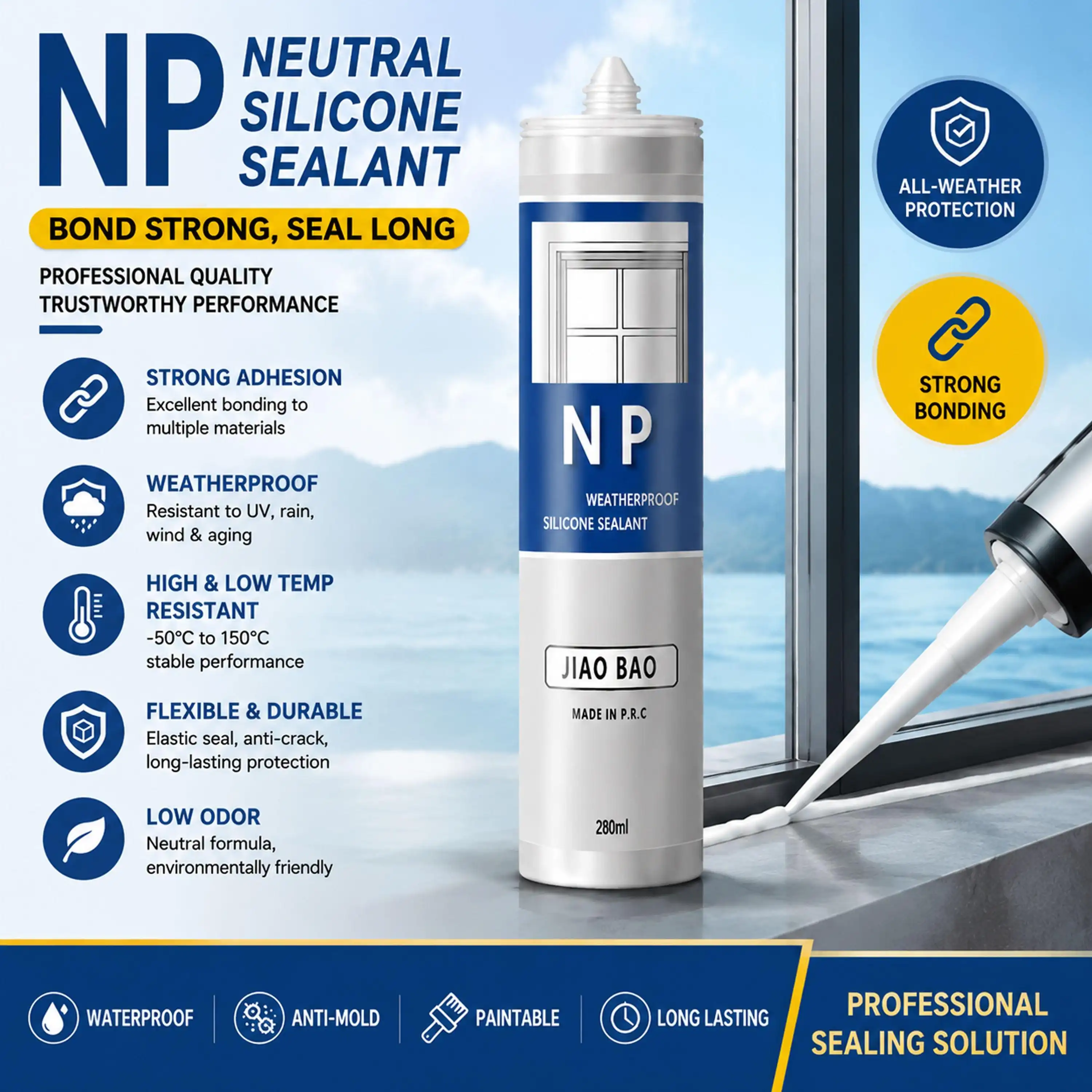
Jiaobao's NP curtain wall sealant is an RTV product that comes in the form of a paste. In 30 minutes, it has a surface that doesn't stick when it's at 25°C and 50% relative humidity. It takes 7–14 days to fully cure. It is Shore A 30 hard and has a tensile strength of 0.7 MPa after it has dried. The zero-sag result under ASTM C679 shows that it stays exactly where it is put on vertical joints, which is a must for installing both overhead and vertical facades.
The sealant works well in temperatures ranging from -50°C to +150°C without becoming weak or soft. This range includes building sites in the Arctic, high-rises in the Middle East desert, and places near the coast that get salt spray. The molecular silicone backbone is resistant to ozone attack and UV radiation. This means that it won't chalk and crack like cheaper products do after two to three years of being outside.
The formulation doesn't have any non-reactive plasticizers, so it won't move into nearby porous materials. This quality—confirmed by ASTM C1248 tests with no oil staining—is very important for marble and granite stone cladding, where one dirty joint can forever change the color of an expensive panel. GB 13477 says that the VOC content is less than 80 g/L, which means that it meets the standards for green building approval programs like LEED for indoor air quality.
All joint faces must be clean of dust, oils, moisture, and small particles before applying NP silicone sealant for curtain wall. With isopropyl alcohol and lint-free cloths, you can clean the sides of glass and frames made of metal. Wait until the surfaces are completely dry before moving on. In field applications, skipping this step is the most common reason why adhesives fail: no sealant, no matter what it is made of, can reliably stick to a dirty surface.
The width of the joint should be at least four times the amount of heat flow that is expected. The joint shouldn't be less than 24 mm wide for a standard unitized curtain wall panel that can move 6 mm. Use a backer rod to control the depth of the joint and keep the width-to-depth ratio at 2:1. The sealant should be pushed out in a single continuous bead, shaped right away to make full contact with the sidewalls, and smooth within 30 minutes of skin-over.
Keep the temperature in the room between 5°C and 40°C while the treatment is going on. Do not put it on areas that are frozen or wet from rain. Once the tools are done, wait 7–14 days for the full cure before testing the water. Pull-tab adhesion tests on sample parts during installation make sure the bond is strong before the system is sealed or covered with glass. Keep track of batch numbers for each application zone to meet the standards for project tracking on certified projects.
Across the four sealant types commonly evaluated in curtain wall specifications—NP silicone, PU, polysulfide, and acrylic—NP silicone delivers the widest operational envelope. PU sealants typically carry a 10–15 year service life estimate versus 25+ years for silicone. Polysulfide sealants require careful UV shielding in exposed joints. Acrylic sealants are unsuitable for dynamic joints with significant thermal movement.
Here is a direct comparison of the key performance attributes:
These differences translate directly into maintenance cost and long-term building envelope integrity. For a 50-year design-life façade, specifying the correct NP silicone sealant for curtain wall helps avoid remediation budgets that far exceed any initial material savings.
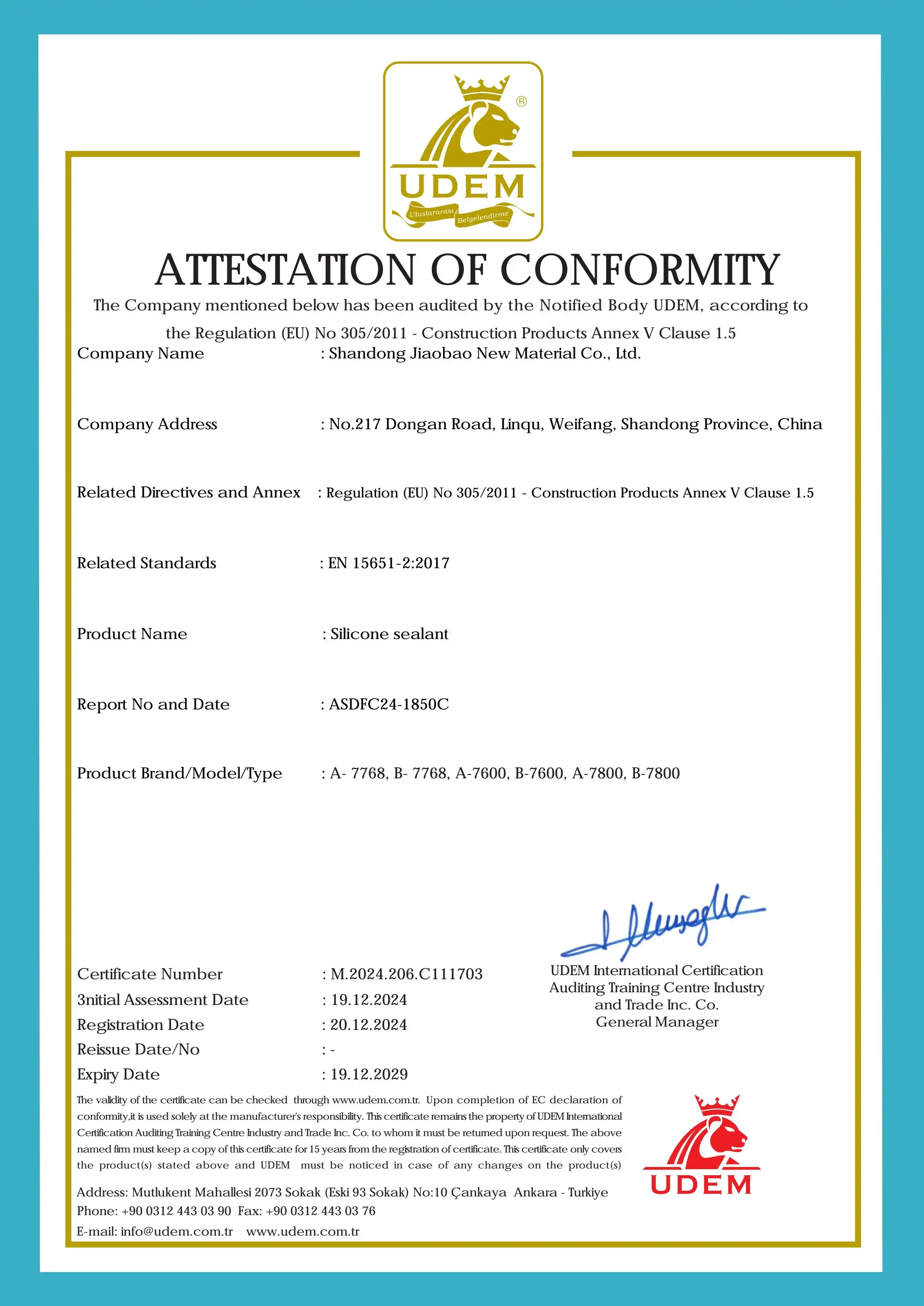
Ask the maker for their GB 16776 structural sealant test report, ISO certification papers, and CE statement of conformity when you're looking for a curtain wall-grade NP sealant. Find out about batch uniformity for at least three different output lots. Need the ASTM C1248 staining test result for projects that use natural stone cladding. No matter how much they charge, suppliers who can't provide these documents when asked should be taken off the list of approved vendors.
Jiaobao ships goods all over the world by sea or land, and the usual lead time for production is one to two weeks. The sealant comes in 300 ml tubes and 600 ml sausage packs, both of which can be used with normal pneumatic caulking tools that are used on construction sites around the world. The product can be kept for 12 months after it was made. If a quality problem is found within the shelf life, Jiaobao will either give you a full refund or a new product.
A seller of sealant that only sends product without giving advice on how to use it is a risk that buyers of complex façade projects need to be aware of. Jiaobao offers technical advice on how to design joints, make sure substrates work with each other, and use system-level sealing methods. The company has been making curtain walls for over 13 years and has users in China, the Middle East, and Southeast Asia. They have enough project references to help with both standard and non-standard curtain wall designs.
Picking the correct sealer for a curtain wall job is not a simple matter of buying something. NP silicone sealant for curtain walls has a neutral-cure chemistry, long-lasting UV and thermal resistance, and doesn't stain. It can meet the needs of high-rise façade systems that are meant to last at least 50 years.
Jiaobao's one-component RTV mixture comes in 300 ml and 600 ml sizes and can be white, black, gray, or unique colors. It is made according to ISO and CE standards and the quality of each batch can be tracked. The data clearly supports this choice for engineers and procurement managers who choose based on performance.
At standard conditions of 25°C and 50% relative humidity, the sealant achieves a tack-free surface in approximately 30 minutes. Full mechanical cure takes 7–14 days. Cure rate slows at lower temperatures, so in cold climates, allow additional time before water testing.
Yes. The sealant's service temperature range extends to +150°C, and its UV-resistant formulation prevents surface degradation in high-solar-radiation environments. It is currently specified on projects in Gulf region markets where façade surface temperatures regularly exceed 80°C in summer.
NP silicone retains elasticity and adhesion under prolonged UV and thermal cycling where PU products degrade. For exterior curtain wall joints that will not be repainted or recoated, NP silicone provides a significantly longer maintenance-free service life and is the specification standard in most international curtain wall projects.
Jiaobao's NP curtain wall sealant holds ISO and CE certifications. For projects requiring GB 16776 structural sealant certification, contact Jiaobao directly at dorashen@cnjiaobao.com to confirm the applicable product grade and obtain the relevant test documentation.
For more than 13 years, Jiaobao has provided NP silicone sealant for curtain wall projects in Asia, the Middle East, and other places. Our company makes NP silicone sealant for curtain walls and has goods that are ISO and CE-certified. We also offer OEM/ODM services, lead times of one to two weeks, and direct technical help from our engineering team. Contact us at dorashen@cnjiaobao.com or visit shandongjiaobao.com right now to get a sample or bulk quote.
1. ASTM International. ASTM C920: Standard Specification for Elastomeric Joint Sealants. ASTM International, 2022.
2. ISO. ISO 11600: Building Construction — Jointing Products — Classification and Requirements for Sealants. International Organization for Standardization, 2019.
3. General Administration of Quality Supervision, Inspection and Quarantine of China. GB 16776: Silicone Structural Sealants for Building. Standards Press of China, 2005.
4. Brookes, Alan J., and Meir Grech. The Building Envelope: Applications of New Technology Cladding. Butterworth Architecture, 1990.
5. Carbary, Lawrence D. Silicone Sealants in Structural Glazing Applications. Dow Corning Corporation Technical Report, 2004.
6. Schittich, Christian, ed. Glass Construction Manual. 2nd ed., Birkhäuser, 2007.
November 16,2023
Enterprise Name
The sealant has very strong adhesion and performs well even on glass and aluminum. After curing, it remains flexible and shows no cracking. Perfect for our facade projects.
November 16,2023
Enterprise Name
Stable quality across batches. Our customers especially like the smooth application and consistent extrusion. It helps reduce installation time on site.
November 16,2023
Enterprise Name
I used it for bathroom sealing. Excellent waterproof performance and no mold issues so far. It's been holding up very well in humid conditions.
November 16,2023
Enterprise Name
The neutral silicone works well on sensitive materials without corrosion. Very suitable for industrial applications requiring stable performance.