November 16,2023
Enterprise Name
The sealant has very strong adhesion and performs well even on glass and aluminum. After curing, it remains flexible and shows no cracking. Perfect for our facade projects.
Oct 27, 2026
The choice between silicone plus polyurethane exterior joint sealants affects building lifetime and customer satisfaction. NP weatherproof silicone sealant for facade surpasses PU in UV resistance, thermal range, and colour stability, which determine long-term external performance. PU sealants provide good adhesion and paintability but deteriorate quicker in the sun and dampness. Technical evidence consistently favours neutral-cure silicone to polyurethane for external seams with 5–10-year guarantees.
It's helpful to know why these two chemicals react so differently on an outside wall before comparing products.
Silicone sealants are thermally stable and oxygen-resistant owing to their silicon-oxygen polymer backbone. After curing, neutral-cure silicone generates non-corrosive byproducts. It works on delicate surfaces like natural stone and coated metal. Polyurethane sealants harden once isocyanate and polyol react. The denser, tougher substance adheres aggressively to porous objects like concrete and wood.
Silicone's Si–O bond energy exceeds PU's carbon-based backbone. This prevents UV radiation from breaking silicone chains. Field studies and lab data demonstrate that PU seals chalk, fracture, or lose elasticity after 3–5 years of direct sun exposure. Silicone joints hold together beyond that window under comparable settings.
PU adheres to porous surfaces without priming. Anti-pore surfaces like anodised aluminium, PVDF-coated trays, and glazed ceramic are hard to bind. Curing silicone using alkoxy or oxime systems makes it cling to glass, metal, and stone. Before installing fluorocarbon-coated aluminium panels, use a primer that works with both methods.
It's one thing to understand the science. A good way to decide which product to buy is to compare how well these two tools work together on a real job.
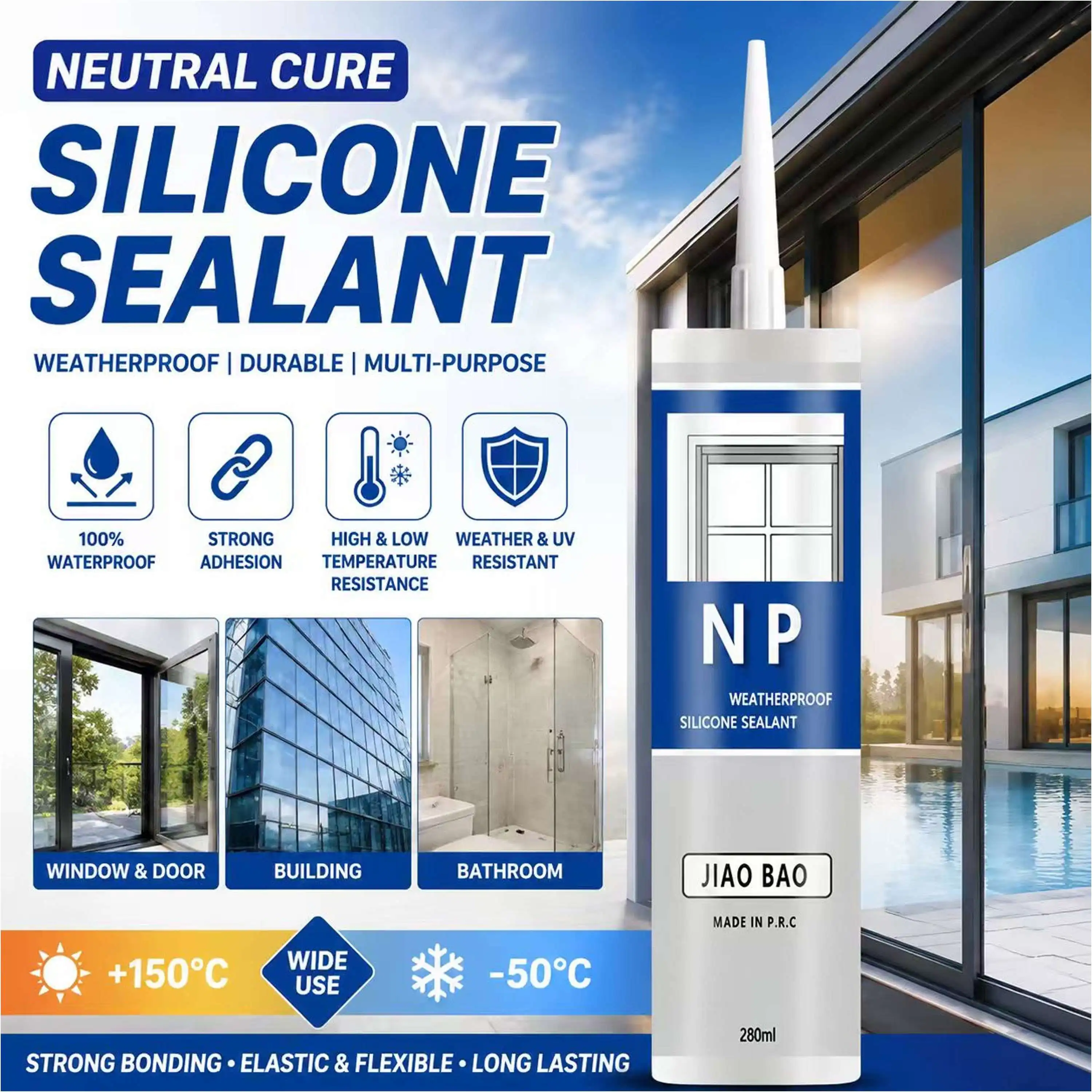
One-part neutral-cure silicone from Jiaobao stays flexible from -50℃ to +150℃, which is a temperature range that no other PU glue can match. NP weatherproof silicone sealant for facade belongs to this series; the ASTM C920 rating for facade-grade silicones confirms cyclic movement performance that most PU goods can't reach in the same amount of time. PU sealants are rated for a smaller range of temperatures and show early signs of surface wear in humid coastal areas.
Both types of sealer are paste-like, one-part items that can be used in cartridges or sausage packs. On average, NP silicone dries to the touch in 30 minutes and is fully cured in 7–14 days at 25℃ and 50% RH. PU adhesives usually stick to surfaces faster, but they can't handle water while they're curing, which can be a problem in wet places or when work has to be stopped because of rain. Silicone's cure doesn't depend on moisture, which makes it a better choice for exterior schedules.
A lot of the time, PU products cost less per cartridge. However, the lifetime cost argument changes when you consider how often the joints need to be resealed. For example, PU joints on sun-exposed surfaces may need to be fixed within 5 years, while silicone joints usually last 10–15 years. Here are the main cost factors that you should look at:
Because of these things, silicone is the better choice when looking at the total cost of the project, not just the price of the material.
Color stability must be met for any facade project where the client cares about how it looks. When exposed to UV light, PU paints turn a noticeable yellow color, usually within 2–3 years. NP weatherproof silicone sealant for facade is Jiaobao's NP silicone made so that it doesn't pollute, which was proven by ASTM C1248 tests. The sealant comes in white, black, gray, and custom colors, and it keeps its original look without chalking or letting pigments move onto nearby stone or panel surfaces, which is a common problem with normal PU stone coating projects.
Not every job needs the same things. To choose correctly, you need to match the properties of the sealant to the needs of the job.
Extreme climates, like the desert, the north, or coastal areas with a lot of UV light, need a sealant that won't break or flow when the temperature changes. Jiaobao's NP silicone has a movement capability rating of 25%, which means it can handle the normal thermal expansion and contraction that happens in aluminum curtain wall systems. This rating is the lowest that can be acceptable in places where temperatures change a lot from day to day.
Adhesion technique is based on the material of the face. There is no doubt that silicone is better than glass curtain walls and polished metal. Both can be used with concrete border seals, but silicone's chemical neutrality keeps galvanized steel backup structures from rusting. Before the full application, the standard "two-cloth IPA cleaning method" followed by a peel test should be used to make sure that composite panels with PVDF coatings are compatible.
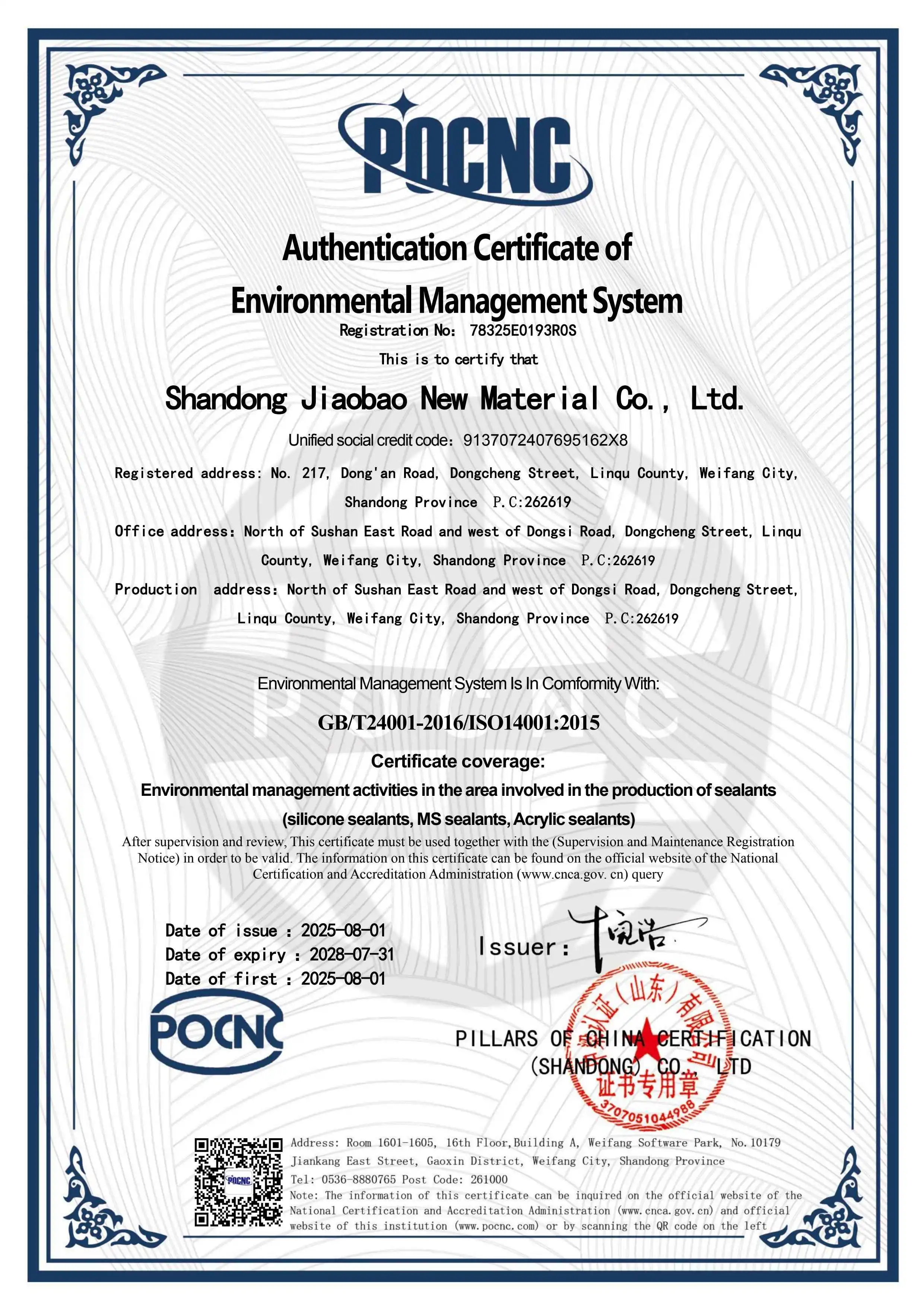
The VOC level in Jiaobao's NP silicone is less than 80 g/L (GB 13477), which is the level needed by most green building approval programs. ISO and CE approvals show that a product meets world standards for quality. Many PU sealants have higher solvent loads and isocyanate-related hazard classifications, which makes them harder to use on projects that want to get LEED points or meet local low-emission standards.
Good product performance still depends on correct installation. I've seen sound sealant choices fail because of surface preparation shortcuts.
Clean each joint surface with isopropyl alcohol (IPA) or MEK using the two-cloth method: wipe on with a clean cloth, wipe off with a second dry cloth before the solvent evaporates. This removes contaminants that prevent adhesion. For PVDF-coated aluminum or other low-energy surfaces, apply a compatible silicone primer and allow it to flash off completely before applying NP weatherproof silicone sealant for facade.
Load cartridges or sausage packs into an appropriate applicator gun. Maintain a consistent bead that fills the joint depth to at least half the joint width — for a 20mm wide joint, target a 10mm depth minimum. Tool the bead within the sealant's working time to ensure full contact with both joint faces. Avoid applying in direct sun on very hot days, as this can accelerate skinning before tooling is complete.
If the sealant is not curing after 48 hours, check ambient humidity. Neutral-cure silicone requires atmospheric moisture to vulcanize. In very dry environments (below 30% RH), slow or incomplete curing is expected. Store unused cartridges at room temperature away from direct sun; shelf life is 12 months from production date. If adhesion fails on a test substrate, a primer is likely required — do not skip adhesion testing before committing to a full project application.
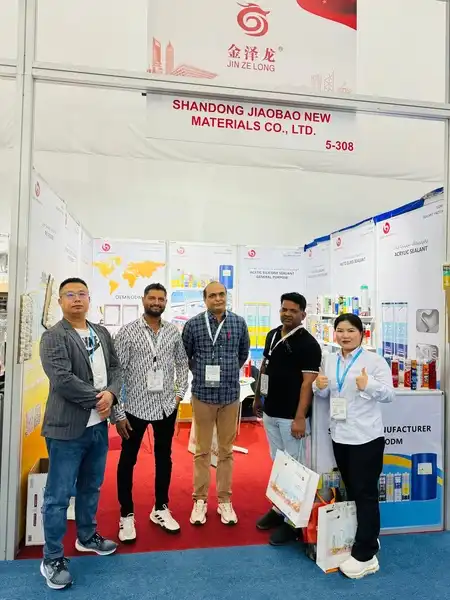
Since 2013, Jiaobao has been making silicone sealants and has built a quality control system that includes testing the final cartridges as well as the raw materials. After an order is confirmed, production takes one to two weeks. Shipping can be done by sea or land to fit projects in Southeast Asia, the Middle East, and other places.
OEM and ODM production are both options, as well as private-label packaging and custom colors to meet the needs of local markets. Each batch comes with paperwork that includes technical data sheets, application guides, and ISO and CE certification. This gives buying teams the paper trail they need to keep project records.
Neutral-cure silicone always works better than polyurethane for exterior joints that need to be resistant to weather, keep their color, and allow for movement over time. PU has its uses, like on porous surfaces inside or where paintability is needed, but its UV sensitivity and tendency to yellow make it dangerous for projects with multi-year guarantees on the outside of buildings. NP weatherproof silicone sealant for facade from Jiaobao directly addresses these risks with tested formulas, certified quality standards, and a product line made for sealing exterior joints in systems made of glass, metal, and stone.
Full cure takes 7–14 days under standard conditions of 25℃ and 50% relative humidity. Surface dry time is approximately 30 minutes. In cold or dry weather, curing slows. Avoid water contact on fresh joints for at least 24 hours.
Yes. Jiaobao's NP silicone remains workable in cold conditions because it stays flexible down to -50℃ after cure. Application in temperatures below 5℃ will slow curing, so allow extra time before exposing joints to water or mechanical stress.
NP silicone resists UV degradation, maintains flexibility across a wide temperature range, and does not yellow. PU sealants offer faster tack-off and lower initial cost but degrade faster under prolonged outdoor exposure and are not recommended for joints requiring 10-year performance guarantees.
No. The product has passed ASTM C1248 pollution testing, confirming zero oil or plasticizer migration onto adjacent materials — a critical requirement for granite and marble cladding applications.
NP weatherproof silicone sealant for facade projects can be bought from Jiaobao in 300ml cartridges and 600ml sausage packs. It comes in white, black, gray, and custom color choices. We have been making direct NP weatherproof silicone sealant for facades for over 13 years and offer reasonable prices, lead times of 1 to 2 weeks, and full expert support. To get samples, bonding test kits, or a bulk quote for your project, email our team at dorashen@cnjiaobao.com or visit shandongjiaobao.com.
1. ASTM International. ASTM C920: Standard Specification for Elastomeric Joint Sealants. ASTM International, 2022.
2. International Organization for Standardization. ISO 11600: Building Construction — Jointing Products — Classification and Requirements for Sealants. ISO, 2019.
3. Burchfield, T. "Sealant Performance in Exterior Building Envelopes." Journal of Building Enclosure Design, 2020.
4. Brookes, A. J., and Grech, C. The Building Envelope: Applications of New Technology Cladding. Butterworth-Heinemann, 1990.
5. Petrie, E. M. Handbook of Adhesives and Sealants. McGraw-Hill, 2007.
6. Wolf, A. T. "Durability of Silicone Sealants for Structural Glazing Applications." Construction and Building Materials, Vol. 23, No. 5, Elsevier, 2009.
November 16,2023
Enterprise Name
The sealant has very strong adhesion and performs well even on glass and aluminum. After curing, it remains flexible and shows no cracking. Perfect for our facade projects.
November 16,2023
Enterprise Name
Stable quality across batches. Our customers especially like the smooth application and consistent extrusion. It helps reduce installation time on site.
November 16,2023
Enterprise Name
I used it for bathroom sealing. Excellent waterproof performance and no mold issues so far. It's been holding up very well in humid conditions.
November 16,2023
Enterprise Name
The neutral silicone works well on sensitive materials without corrosion. Very suitable for industrial applications requiring stable performance.