November 16,2023
Enterprise Name
The sealant has very strong adhesion and performs well even on glass and aluminum. After curing, it remains flexible and shows no cracking. Perfect for our facade projects.
Oct 21, 2026
On job sites, learning how to remove and clean nail free adhesive construction grade materials is as crucial as applying them. This guide covers everything from substrate-safe removal to compliant cleanup protocols for regional building materials distributors managing downstream contractors and procurement managers sourcing structural adhesives at scale to help your teams work better without costly surface injury or safety incidents.
It's sturdy enough to replace fasteners that are in professional buildings. Nail-free adhesive construction grade is one. Construction glues differ from regular glues. Construction-grade glues bind metal, wood, concrete, ceramics, and blends together to retain weight using modified silane polymeric (SMP) or artificial rubber (SBS) chemistry. Jiaobao's SV815 one-part rubber glue hardens when wet. Stretches up to 300% and has a tensile strength of 2.5 N/mm².
The glue chemically joins molecules and mechanically locks porous base surfaces. Once cured, the bond is 50 ± 5 Shore A firm and 1.400 N/mm² elastic. It flexes instead of shattering when strained, which is better than inflexible mechanical fasteners in regions with extreme temperature variations from -40°C to 80°C.
Construction workers in the U.S. are increasingly using structural adhesive instead of nail-and-screw installations. It prevents substrate damage, eliminates puttying, and speeds up linear installations like door frames, skirting, or wall panels. Construction-grade gypsum wallboard adhesives must fail at the base before failing in lap shear tests to fulfil ASTM C557 requirements. Jiaobao's SV815 performs this.
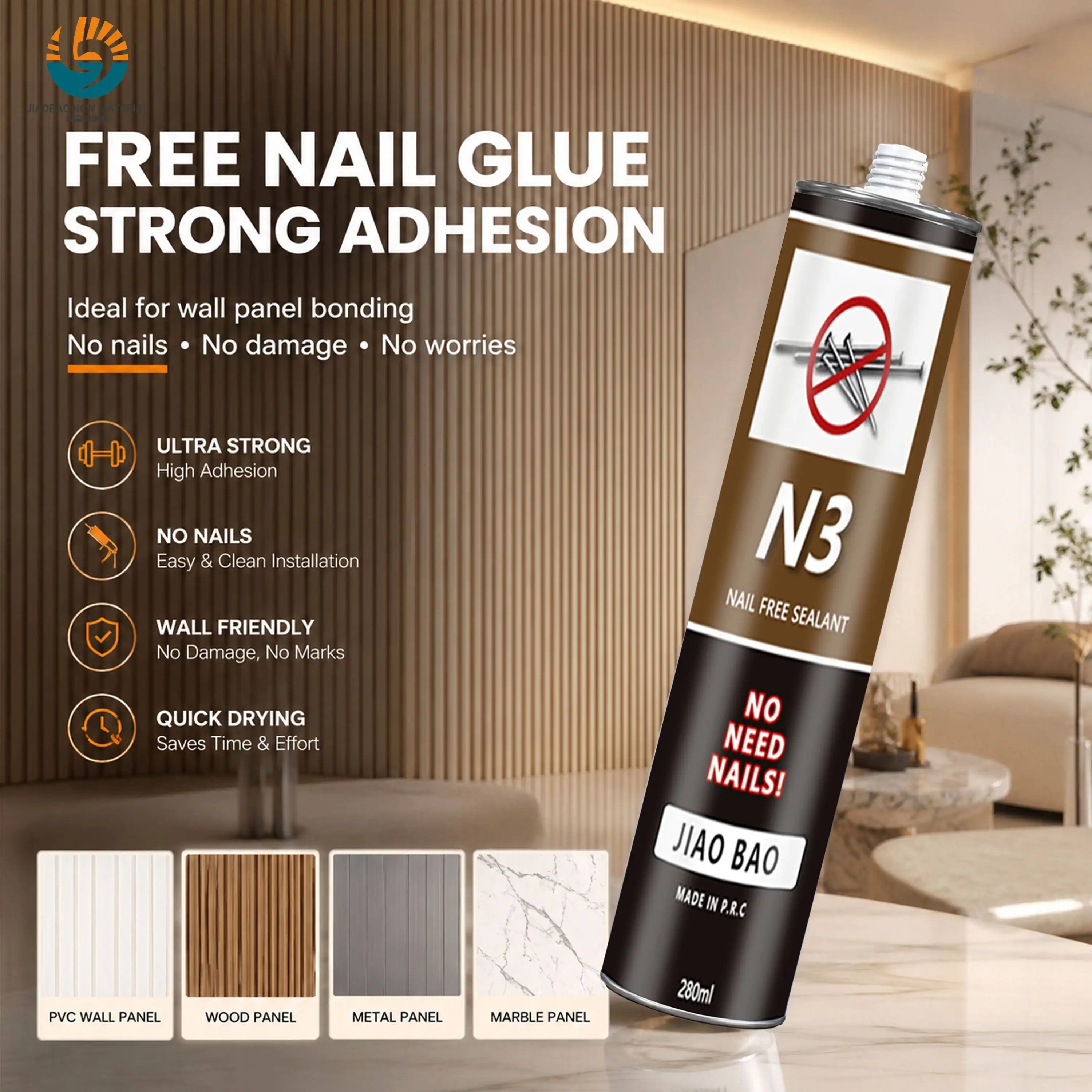
If you let a structural glue dry all the way, it makes strong bonds that can often be stronger than 3.0 MPa on dense surfaces. Do not try to remove something until it is ready. If you do not, you might tear drywall paper, break tile glaze, or gouge softwood surfaces. When someone wants to get rid of something, I always tell them to check the type of base first. What might not hurt a concrete wall could hurt an MDF panel that has been painted.
Here's a good way to remove nail free adhesive construction grade based on the type of surface:
If you use these substrate-specific methods, you will lose a lot less material and have to pay a lot less to do work over. This is something that project managers worry about a lot when they have big building jobs.
Neutral-grade construction adhesives are often used for large-format mirror bonding, which was used to remodel a commercial bathroom. Contractors who used heat softening and plastic scraping said the mirror didn't come off as easily as teams that used metal tools to force removal. It's thought that being patient is better than being stressed.
To clean up, the first thing that needs to be done is to choose the right solution. If there is glue residue left over from SMP-based glues like nail free adhesive construction grade SV815, mineral spirits or isopropyl alcohol can be used to get rid of it. It takes about 24 to 48 hours at 23°C/50% R.H. for the glue to fully set. After that, it needs to be removed by hand and then cleaned with a cleaner. Water-based cleaners won't get rid of silane polymer bands that are hard.
The rules for getting rid of hazardous waste in your area tell you how to get rid of cleanup materials that are full of solvent-based adhesive residue. For things that are tainted with solvents, the EPA's Resource Conservation and Recovery Act (RCRA) rules say that this is fine to do in the U.S. A full Material Safety Data Sheet (MSDS) for the SV815 product from Jiaobao is included. This sheet shows the VOC content, safe handling methods, and disposal rates. Before they sign any bulk supply agreements, your buying team should ask for these papers.
A simple step that cuts cleanup time by up to 60% on finished surfaces is to put low-tack masking tape along the lines of where the glue will go before you use it. The SV815 comes in 300ml cartridges for accurate applications and 600ml sausage packs for high-volume work. Choosing the right volume format also cuts down on the extra adhesive that is lost on-site.
When you take out mechanical fasteners like screws, nails, and rivets from framed assemblies, you often damage the nearby substrate. When you pull out a nail in softwood, the fibers get torn. When you pull out a screw in drywall, the holes get bigger, so you need to use filling paste and paint again. Taking off the glue in the right way, on the other hand, leaves the base whole and ready to be put back in place without any extra work.
When you're shopping for things, you should compare more than just the unit price. This is what you need to think about most about money during the whole project:
When sourcing a nail free adhesive construction grade solution for distribution or direct project use, four technical parameters matter most: initial grab strength (green strength), final shear strength after cure, service temperature range, and VOC compliance. Jiaobao's SV815 addresses each: it cures at 2.5 mm/24 hours under standard conditions, operates across -40°C to 80°C, and carries ISO certification with compliant VOC levels suitable for LEED project specifications.
Compliance with ASTM C557 and GB/T 27954-2011 standards provides procurement managers with objective benchmarks for evaluating supplier claims. Beyond certifications, I recommend requesting a lap shear test report showing substrate failure mode — this confirms the adhesive bond exceeds the strength of the material it bonds, not just meets a minimum threshold.
Jiaobao offers product samples in both 300ml cartridge and 600ml sausage formats across four standard colors: White, Black, Grey, and Customized. The 12-month shelf life supports bulk purchasing with manageable inventory cycles for regional distributors. For distributors building a "sealant + construction adhesive" one-stop supply line, requesting a full technical datasheet alongside the MSDS before committing to volume orders is standard due diligence.
The right way to remove and clean up nail free adhesive construction grade protects surfaces, cuts down on project costs, and makes sure that safety rules are followed on the job site. You could waste a lot of money on new materials instead of reinstalling things correctly if you don't use the right solvents, tools, and steps for your substrate. When buying managers and wholesalers are putting together a solid line of goods, they should choose a certified adhesive from a maker with a lot of experience. This lowers risk at every stage of the supply chain.
Yes. We changed the silane polymer structure so that it doesn't absorb water once it's totally hardened. This means that it can be used outside or in places like baths that are regularly wet.
Tie-made with construction-grade glues should last between 10 and 20 years in normal use, but there is no set service life. How long it takes to remove during repairs varies on how big the job is, not on how bad the glue is.
You should wear safety glasses and rubber gloves when you do mechanical removal. Before you use solvents, make sure there is enough air flow. Before you start working on the site, read the MSDS out loud. Every order from Jiaobao comes with all the paperwork you need.
Formulas that are based on chemicals can be bad for expanded polystyrene. If you want to bond insulation, pick a hybrid grade that is either water-based or solvent-free. Talk to Jiaobao's technology team to make sure it will work with the material you have.
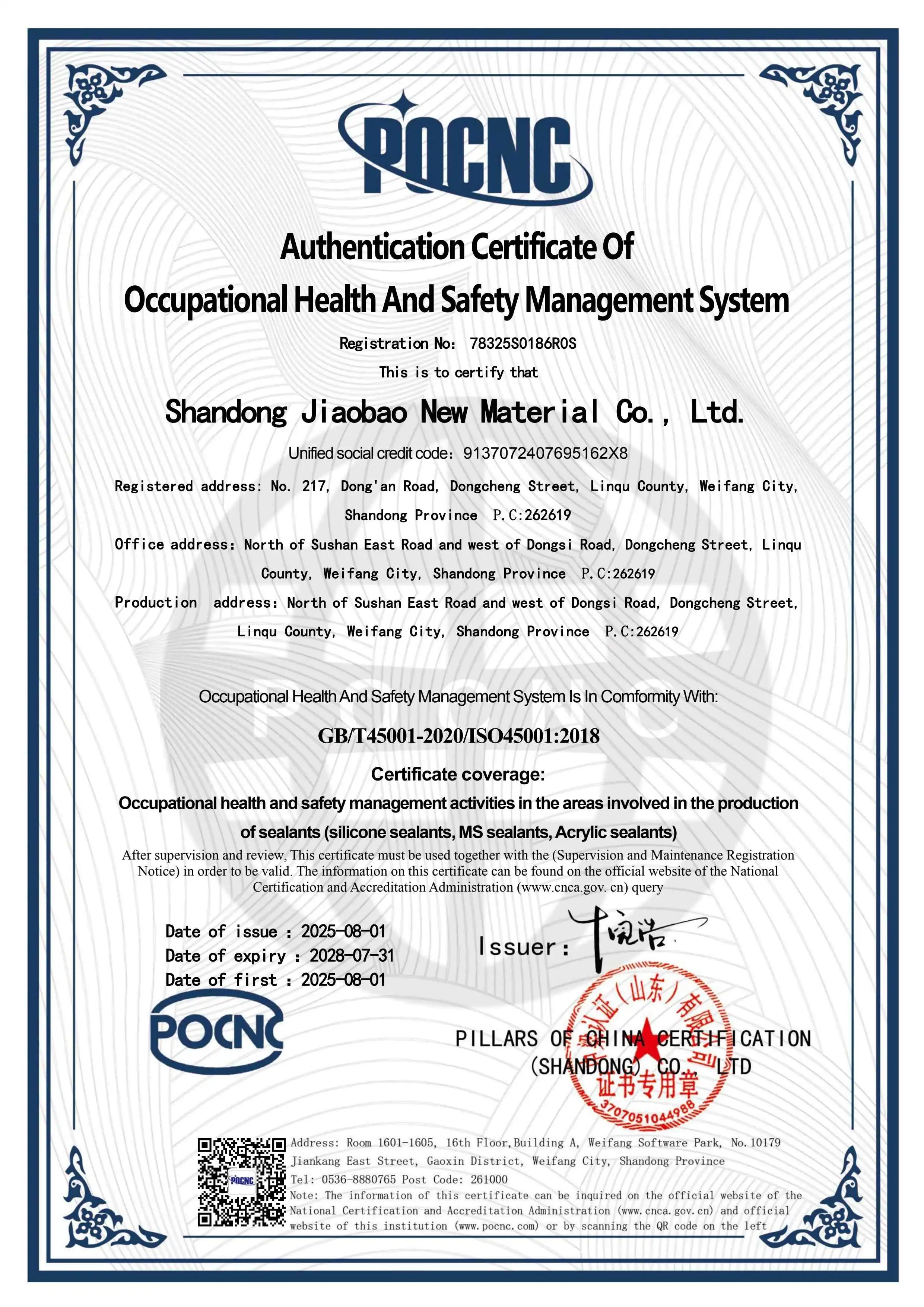
Both ISO and ASTM C557 standards have been met by the SV815 from Jiaobo. To get the technical datasheet and MSDS for the project-specific code, email dorashen@cnjiaobao.com.
Jiaobao has been making professional-grade glues and seals since 2013. They've been making these things for more than 13 years, and all of them are ISO approved. You can get nail-free adhesive construction grade from our company. We have quick lead times (one to two weeks), flexible 300ml and 600ml packaging, OEM and ODM options, and full support after the sale. You can email us at dorashen@cnjiaobao.com or visit shandongjiaobao.com right away to get samples or detailed datasheets.
1. ASTM International. ASTM C557: Standard Specification for Adhesives for Fastening Gypsum Wallboard to Wood Framing. ASTM International, 2019.
2. U.S. Environmental Protection Agency. Resource Conservation and Recovery Act (RCRA): Managing Solvent-Contaminated Materials. EPA Office of Solid Waste, 2020.
3. Cognard, Philippe. Handbook of Adhesives and Sealants, Volume 2: General Knowledge, Application Techniques, New Curing Techniques. Elsevier, 2006.
4. Petrie, Edward M. Handbook of Adhesives and Sealants. McGraw-Hill, 2007.
5. Standards Administration of China. GB/T 27954-2011: Silyl Modified Polymer Sealants for Construction. SAC, 2011.
6. Dillard, David A., and Abhijit Pocius, eds. The Mechanics of Adhesion: Adhesion Science and Engineering, Volume 1. Elsevier, 2002.

November 16,2023
Enterprise Name
The sealant has very strong adhesion and performs well even on glass and aluminum. After curing, it remains flexible and shows no cracking. Perfect for our facade projects.
November 16,2023
Enterprise Name
Stable quality across batches. Our customers especially like the smooth application and consistent extrusion. It helps reduce installation time on site.
November 16,2023
Enterprise Name
I used it for bathroom sealing. Excellent waterproof performance and no mold issues so far. It's been holding up very well in humid conditions.
November 16,2023
Enterprise Name
The neutral silicone works well on sensitive materials without corrosion. Very suitable for industrial applications requiring stable performance.

