November 16,2023
Enterprise Name
The sealant has very strong adhesion and performs well even on glass and aluminum. After curing, it remains flexible and shows no cracking. Perfect for our facade projects.
Oct 30, 2026
To apply fireproof silicone sealant high temperature joints correctly, confirm the real operating temperature first. Then clean and dry the surface and let the equipment cool. Set the right joint depth, apply a continuous bead, and tool it before a skin forms. Allow full cure before heat exposure. Match the product's rated range to the joint, and keep batch and inspection records. Below, I walk through each step, show where acidic one-part RTV silicone fits, and explain when a different material is the safer choice.
The first thing that comes to mind is always a number. Write down the steady temperature of the joint, as well as its short highs and lows and how often the equipment heats up and cools down. The seam in the oven moves every shift, but the door to the boiler might stay warm all the time. If you want an accurate number, you should measure at the joint surface instead of the heat source.
A label's high value doesn't tell you much about how often it is used because you can't use irregular limits instead of continuous limits. Our acidic one-part RTV silicone glue can be used from -50°F to +150°F. Some special kinds can work at temperatures of 200°F or more. You should use a different sealer that can handle heat if the joint gets hot.
Saying something can't heat or catch fire is not the same thing. When it gets hot, a sealant's heat resistance tells you if it stays together and keeps its shape. You can find out how long a system can keep smoke and flames out by giving it a try. ASTM E814 and UL 1479 are used to test door firestops in the US. Not just the sealant, but the whole assembly is on the list. A general fix bead can't be used to replace that part. Before you call the firestop for any product, make sure you have the test report and the named setup. Our data sheet says it is water resistant (Class 1 W), so I'm not listing it as a firestop.
What kind of material is on each side of the joint? Write it down, along with how wide, deep, and how much you think it will move. When they get hot, metal, glass, clay, and concrete all change in their own ways. It's important that the glue doesn't break when you bend and fix the metal. Our sealer can move around ±20% to ±50%, which means it can be used on any kind of door or window.
ASTM C1193 tells you how to make joints and how much width to depth to give you. Also, be careful of chemicals that might come from oil mist or cleaning supplies. Before you sign off on anything, read the technical data sheet and the safety data sheet. Early changes that don't work are stopped by writing them down briefly.
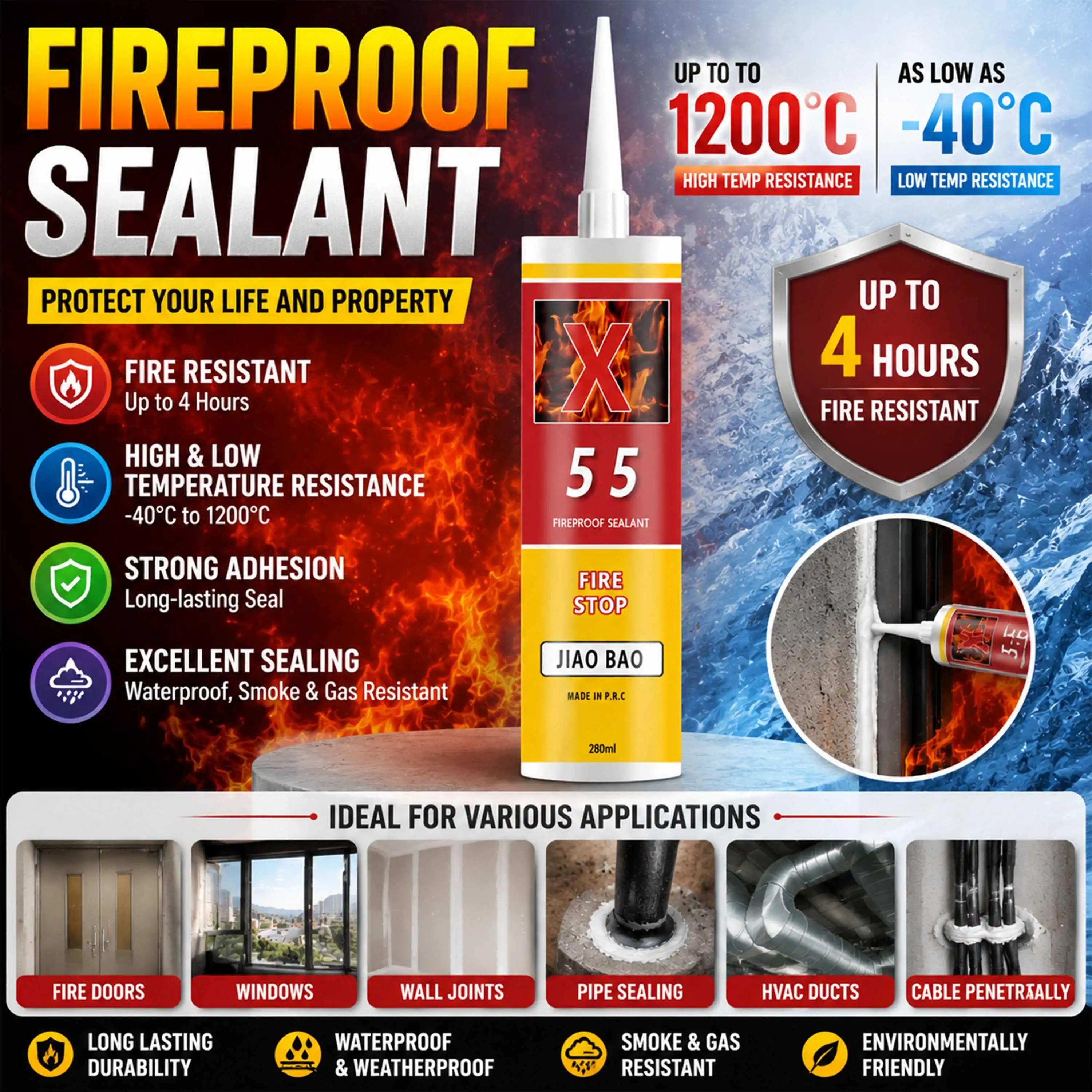
In general, it does a good job of covering up, but when it gets hot, it breaks down. Fireproof silicone sealant high temperature belongs to the category of RTV rubber that is made to work in hot conditions and stays flexible even when it's used in hot conditions. Fire-rated silicone has been checked to make sure that when it is added to a listed assembly, it doesn't smoke or catch fire. What the cure is made of is also important. When acids, which are also known as acetoxy, harden, they give off acetic acid and quickly form a skin.
Because they give off alcohol or oxime, neutral systems are usually good for metals that are easy to break. One-part items don't need to be mixed; they dry on their own. On the other hand, you need to measure out two-part products. Black or red doesn't look like they would keep heat out better based on shade. Instead, you should use the test scores.
Shandong Jiaobao New Material Co., Ltd. makes rubber sealant that comes in paste form. You can ask for any color. These are the first things I look at about it.
These facts show the best fit: warm-zone doors, windows, and panel gaps, not open-flame or kiln-interior joints.
When materials are heated and cooled, they need to be strong and able to stick to metal or ceramic in stoves and furnaces, but only when the temperature stays in the right range. In order to handle vibrations without becoming stiff, HVAC ducts, chimneys, and exhaust connections need to be able to bend. You need a firestop that has been checked to make sure that pipes and cables can go through it.
When new OEM lines are added, they bring new needs, like stable thickness, good filling, and pack that is uniform. Our acidic RTV can be used to seal cabinet seams, access doors, and enclosure panels that are close to heat. Fireproof silicone sealant high temperature is a refractory sealant suitable for sealing the inside of hot flues and kilns, in my opinion. This way, you don't have to choose between options that are "one size fits all."
Take some time to let the gear cool down. Silicone might bubble and not soak in right if you put it on something hot. A scraper, a wire brush, and a solvent wipe can get rid of oil, dust, rust, rusting, and old sealant. After that, the solvent needs to dry. Tape over the edges to make the lines straight. Stick a bar behind the sealant in deep spots so it only sticks to two sides instead of all three. The first thing I do is test a small area on bare steel, copper alloys, and non-acid sides. This is because acetic acid is released by an acidic treatment. If the medium needs a primer, all you have to do is one easy test.
Step 3: Cut the nozzle so that it fits across the joint. Step 4: Put the paper or sausage pack into the gun. Hold the tip at a 45-degree angle and push the bead all the way into the joint so it fills the whole space. If you can, do all of your work at once. Use a spatula or shape stick to make the sealer before the skin forms. It takes 45 to 60 minutes for the surface to dry, but I start working on it much sooner. While the sealant is still wet, remove the masking tape right away to keep the edges straight.
In hot service, how well you do will depend on how long it takes to cure. A 6 mm bead needs about two days to grow 3 mm every 24 hours when the humidity is right. Thick pieces take longer to cook. The core isn't always dry just because there is a skin on top. Let it dry at room temperature with some water on it and air moving around it.
Do not let the joint get wet or shake. Make sure the tools are cool before you warm them up. If you use heat too soon, it can trap water and burn or remove the glue. Note down the batch number, how long it took to cure, and the temperature and humidity of the area where the bead was made.
It's said that people make mistakes when they don't plan ahead. Silicone doesn't stick well to surfaces that are wet, dirty, broken, or too hot; it peels off. Joints can heal more slowly and be put under more stress if the wrong joint depth is used. It can also not cure if the backing material doesn't work with the joint.
Things get blisters and water gets stuck in them when you use them again too soon. Once you've done those things, make sure the fix time is met and the joint depth is set for fireproof silicone sealant high temperature. It should be cool outside and the floor should be clean and dry. Before the gear is turned back on, I think that each line should be signed by every crew member.
You don't have to think about things like how to get around, being close to chemicals, or fire safety if you only look at the hottest temperature. It's also important to avoid heat shock. When temperatures change quickly, they put stress on the bond. It can move ±20% to ±50% better than a hard filler when the area gets bigger as long as it stays within its recommended range.
Because of this, you should not use a regular silicone bead instead of a firestop unit that has been tested. The whole system is covered by ASTM E814 and UL 1479. If the joint stays hot for more than 200℃, you should switch to something that doesn't melt.
Use a flashlight and a probe to check again after the cure. Not a single hole, bubble, crack, pinhole, or empty space should be found on the sides or edges. Please press it on both sides to see if it stays in place. The ASTM C679 standard is used to find the tack-free time, and the ASTM C794 standard is used to test examples that have been sealed.
For each joint, write down the batch number, the temperature, the humidity, and the amount of time it took to cure. After the first round of heat, check again to see if the color has changed, the fabric has shrunk, or the edges have come up. If you find any problems, fix them with new sealer on clean surfaces. To find things quickly when something goes wrong, write them down.
Use real parts for test runs. Sealant should be put on the real surfaces, like the padding, coats, and backing rods. Moving the samples through the temperature range you chose is the next step. Check how it looks, how hard it is, how springy it is, how well it sticks, and how well it doesn't get wet. You should get samples and try them out in your own room before you make a big buy. You will learn a lot more from a test that is like a real-life service setting than from a data sheet, so this step should take two to four weeks.
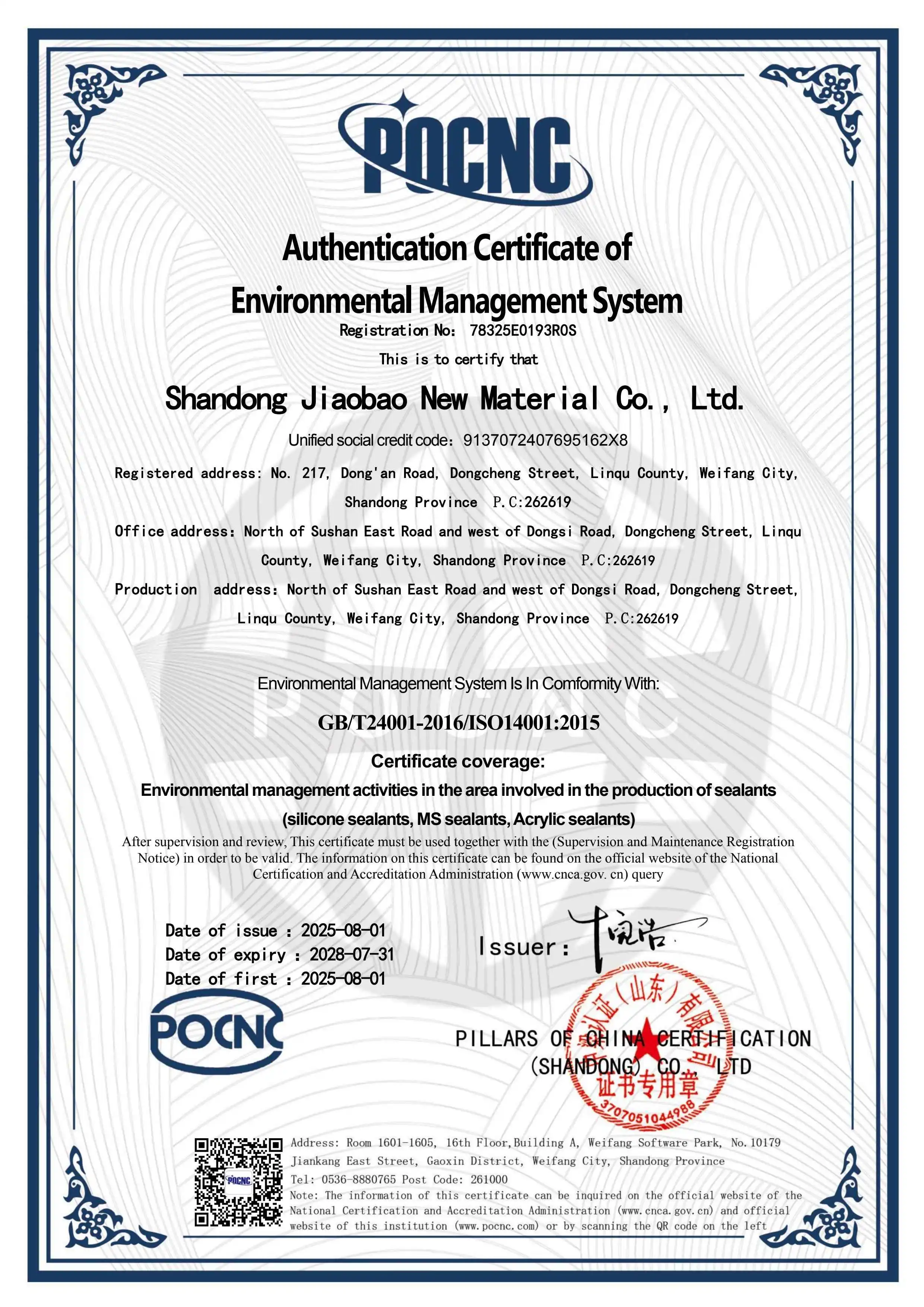
Ask each provider for the technical data sheet, the safety data sheet, the test results, the batch records, information on how long the product will last, and the warranty terms. The goods that Jiaobao makes have ISO and CE seals on them. We have more than 13 years of experience because we have been making silicone seals since 2013. You will either get your money back or a new one if the quality drops during the shelf life. Each report should match the product and batch you will receive. Also, make sure that the quality of the test fits your wants.
Quotes are correct when there are clear directions. List the substrates, the size of the joint, the operating temperature, the movement, the color, the packaging, the delivery date, the amount that will be made each year, and the market where it will be sold. You should pick a service based on more than just price.
You should also check how consistent the formula is, how well the plant controls quality, how much technical help they offer, how much experience they have exporting, and how long the lead time is. We can ship by land or sea, and it takes us one to two weeks to make something. You can also ask for colors and packaging that you can't find anywhere else through OEM/ODM. Based on the size of your job and gun, pick a 300ml or 600ml pistol or sausage pack.

For correct use of fireproof silicone sealant high temperature joints, first check that the product meets the requirements and then follow the exact steps for installation. The temperature range, movement, medium, and chemical contact should be written down first. It is important to keep fire resistance and heat resistance separate after they have seen tests. To fix holes in doors, windows, and walls in warm areas, you can use acidic one-part RTV silicone that is between -50°F and +150°F.
For parts that get hotter or need more control, you'll need refractory or approved firestop products. You can avoid making most mistakes if you use the right joint depth, a continuous tooled bead, and full curing at 3 mm every 24 hours. The proof comes from source papers, inspection records, and test runs. The best kind of seal is one that is based on facts, not just a weather number.
It can handle temps between -50°F and +150°F, so no. Some formulas can work in temperatures as high as 200°F. If it gets hotter than that, you need a refractory filler to fill in the holes because silicone works less well when it gets too hot.
It doesn't tell you how hot something is; it tells you how safe it is at that heat. Set tests, like the ones in ASTM E814 or UL 1479, rate how safe something is in case of fire. Get the report that lays out how everything is set up.
It dries in 45 to 60 minutes and gets 3 mm harder every 24 hours. The time changes depending on how deep the beads are, how humid it is, and how hot or cold it is. It doesn't mean the glue is dry just because there is a skin on top.
Yes, the color of something doesn't really tell you much about how well it works when it's hot outside. Use what you found on the sheet of data and in your own tests.
Please let Jiaobao know about the joint temperature, substrate, and order volume. We'll help you find a product that works. Fireproof silicone sealant high temperature is used in everything we make. Since we've been in business for 13 years, we've met ISO and CE standards and can do OEM and ODM work. It takes one to two weeks for leads to arrive. You can get samples, data sheets, and a quote by emailing dorashen@cnjiaobao.com or going to shandongjiaobao.com.
1. ASTM C920 – Standard Specification for Elastomeric Joint Sealants, ASTM International, 2018
2. ASTM E814 – Standard Test Method for Fire Tests of Penetration Firestop Systems, ASTM International, 2013
3. ASTM C1193 – Standard Guide for Use of Joint Sealants, ASTM International, 2016
4. ASTM C794 – Standard Test Method for Adhesion-in-Peel of Elastomeric Joint Sealants, ASTM International, 2018
5. ASTM C679 – Standard Test Method for Tack-Free Time of Elastomeric Sealants, ASTM International, 2015
6. Handbook of Sealant Technology, CRC Press, 2009

November 16,2023
Enterprise Name
The sealant has very strong adhesion and performs well even on glass and aluminum. After curing, it remains flexible and shows no cracking. Perfect for our facade projects.
November 16,2023
Enterprise Name
Stable quality across batches. Our customers especially like the smooth application and consistent extrusion. It helps reduce installation time on site.
November 16,2023
Enterprise Name
I used it for bathroom sealing. Excellent waterproof performance and no mold issues so far. It's been holding up very well in humid conditions.
November 16,2023
Enterprise Name
The neutral silicone works well on sensitive materials without corrosion. Very suitable for industrial applications requiring stable performance.

