November 16,2023
Enterprise Name
The sealant has very strong adhesion and performs well even on glass and aluminum. After curing, it remains flexible and shows no cracking. Perfect for our facade projects.
Sep 29, 2026
If you are sourcing a reliable nail free adhesive strong bond solution for interior finishing, bathroom fixtures, or facade installations, this guide delivers the technical clarity and procurement intelligence you need. Based on verified product data and industry standards, we break down what separates a high-performance construction adhesive from an average one — covering chemistry, substrate compatibility, curing behavior, and supplier evaluation — so you can make a confident purchase decision before the end of 2026.
These days, construction adhesives are a lot more advanced than simple grab glues. Modern no-drill bonding compounds use complex chemicals, mostly modified silane polymers (MS polymers), polyurethane, and hybrid formulations, to form strong bonds between different substrates.
A screw or nail puts all of the load stress on one spot. A spread adhesive, on the other hand, spreads the tension and shear forces out over the whole area it bonds to. ISO 37 testing standards say that good MS polymer adhesives can have a tensile strength of 2.5 N/mm² and an elongation at break of 300%. This means that the bond bends instead of breaking when it moves or when the temperature changes.
Here are the main performance advantages of these materials that make them more popular in professional construction:
All of these benefits lower the total cost of labor for a project, shorten installation cycles, and lower the rate of rework. This is great for procurement teams that are trying to stick to tight budgets.
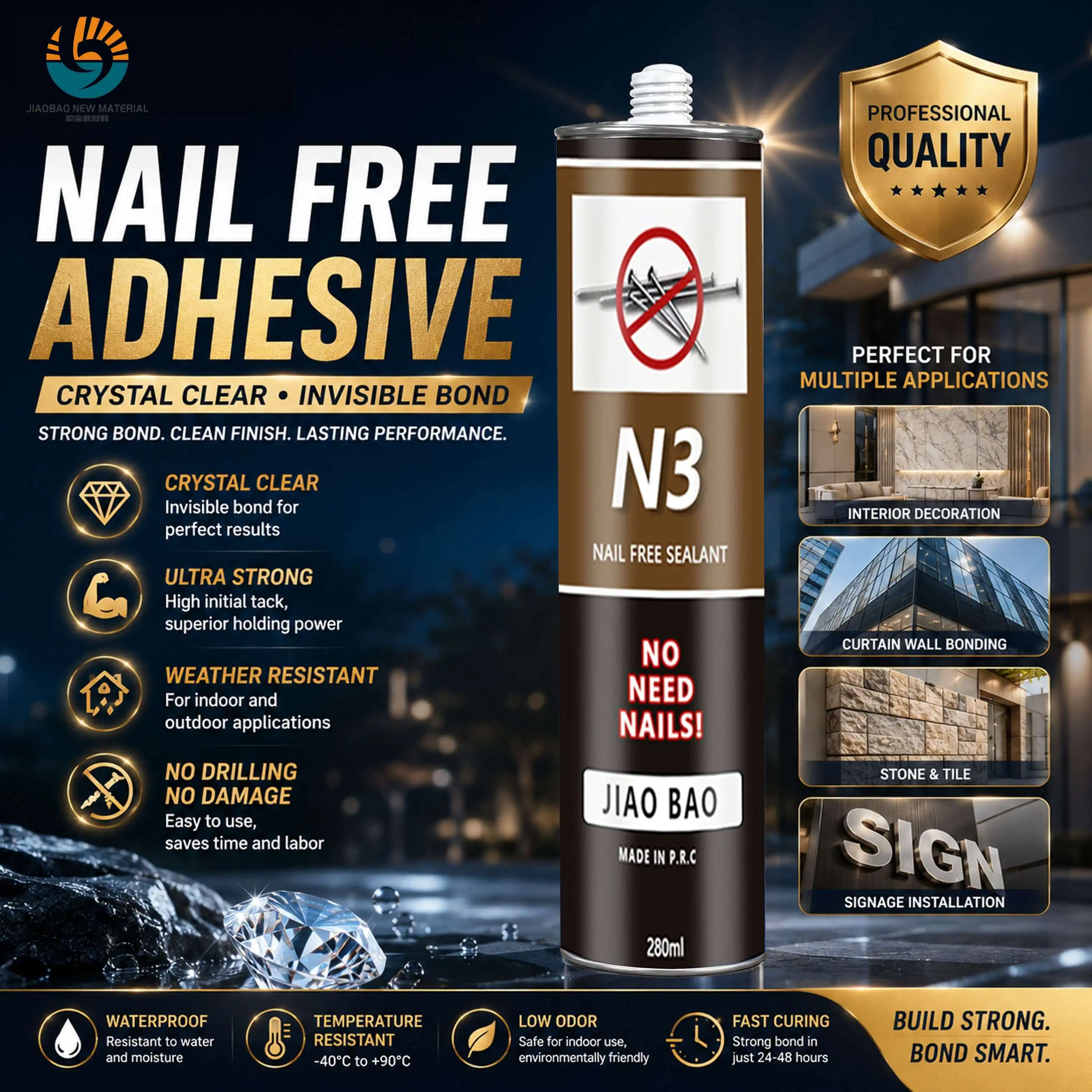
Mechanical bolts can handle a lot of point loads, but they can become loose from vibrations and rust over time. A fully cured MS polymer adhesive, on the other hand, fails in a cohesive mode during destructive shear tests. This means that the adhesive material breaks before it comes off the base. As per ASTM D1002 and ISO 4587, that is the standard that reliable makers test to, and it is also what gives a nail free adhesive strong bond its dependable performance.
If you don't drill, you won't need wall plugs, air tools, or dust extraction, all of which cost money and take time to use. Studies on the workflow of building projects have shown that installing skirting boards and wall trims with glue can cut the time needed by 30–40% compared to mechanical fastening on drywall systems.
Epoxy adhesives dry faster in hot conditions, but they become hard and brittle when fully cured, so they can't be used in situations that need flexibility. Acrylic-based grab adhesives stick quickly at first but don't stick as well in the end. MS polymer adhesives have a good mix between open time and drying reliability. At 23°C/50% R.H., the surface is dry in 20 minutes, and the depth cures at a rate of 2.5 mm per 24 hours.
Before choosing a glue, make sure it will work with both of the areas that will be bonded. It is easy for MS polymer glue to stick to metal, wood, glass, ceramic tile, gypsum board, and most plastics. They don't consistently stick low-surface-energy plastics like polyethylene (PE) or polypropylene (PP) together without a special primer. This is an important thing to check when you're buying them.
Viscosity and healing speed are directly related to the temperature of the application. Below 5°C, it's hard to extrude and the rate of curing slows down a lot. When the temperature goes above 35°C, the open time shortens, making it harder to make changes to the position. It is best to choose a mixture that can handle temperatures between -40°C and 80°C for service and 5°C to 35°C for building, so that the nail free adhesive strong bond stays reliable across both application and service conditions.
When buying in bulk, procurement workers should look for sellers that offer verified technical data sheets (TDS), quality paperwork that meets ISO standards, and samples that can be used for on-site validation trials. The type of packaging also affects how efficiently the business runs. For example, sausage packs (600ml) cut down on the time needed to change cartridges on busy job sites, while 300ml cartridges are better for smaller or more precise tasks.
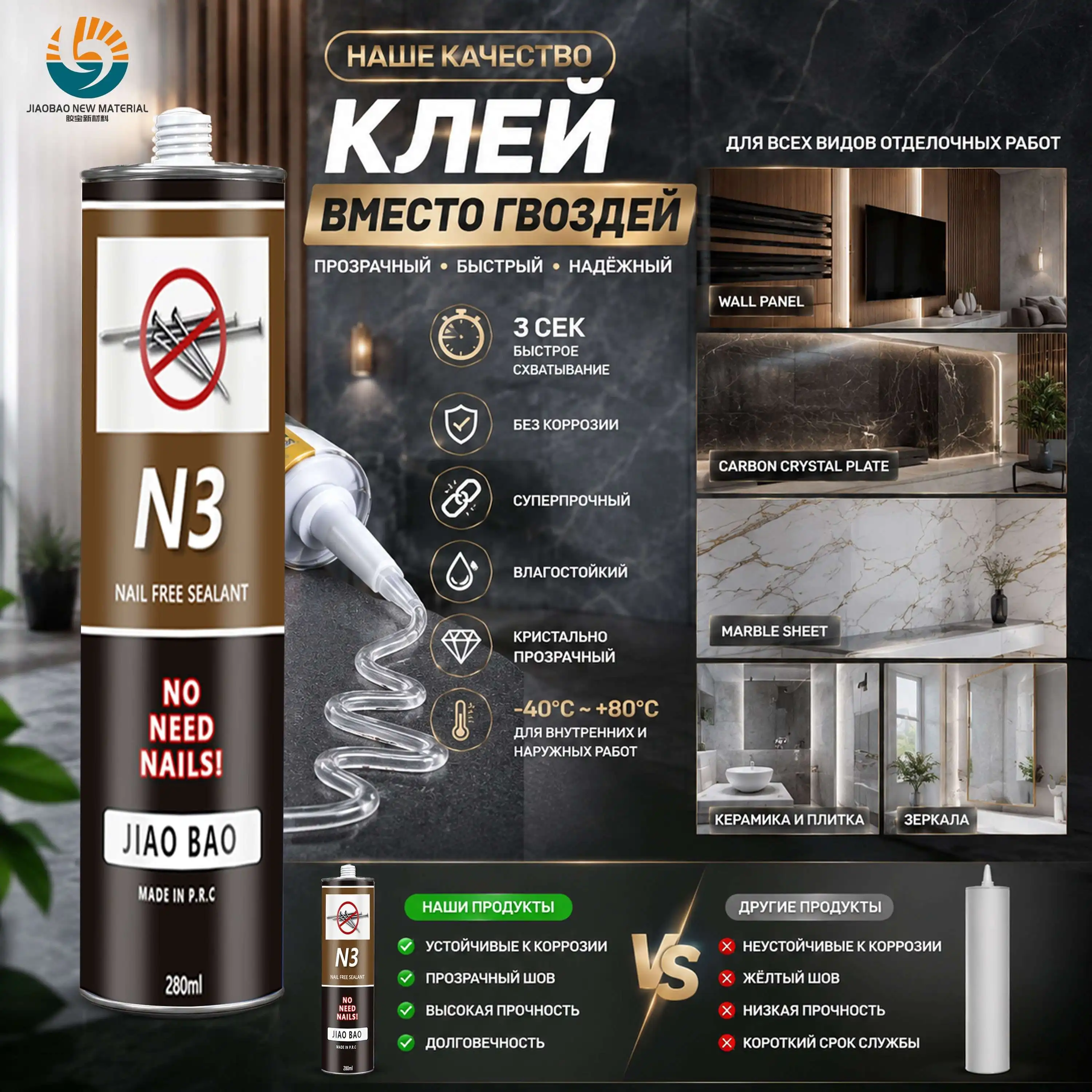
Three things that can be checked are a supplier's credibility in the adhesive category: following the rules for getting certified, making sure the same products are always made, and providing helpful support after the sale. Before placing a bulk order with a nail free adhesive strong bond manufacturer, make sure you see proof of their ISO certification and any regional compliance standards that apply.
Since 2013, Shandong Jiaobao New Material Co., Ltd. has been making sealants and building adhesives. They have over 13 years of experience making modified silane and silicone-based bonding materials. Their One-part RTV Nail Free Glue is made with changed silane polymers and has the confirmed technical profile below:
Maximum Tensile Strength (ISO 37): 2.5 N/mm². The material can stretch 300% at break (ISO 37) and dry in about 20 minutes at 23°C/50% R.H. It has a Shore A hardness of 50 ± 5 and can be used in temperatures ranging from -40°C to 80°C. It comes in 300ml and 600ml sizes and can be packaged in sausages or cartridges. It can be any color you want and has a 12-month shelf life, all of which make it an excellent choice for a nail free adhesive strong bond.
| Property | Value |
|---|---|
| Maximum Tensile Strength (ISO 37) | 2.5 N/mm² |
| Elongation at Break (ISO 37) | 300% |
| Surface Dry Time (23°C/50% R.H.) | ~20 minutes |
| Shore A Hardness | 50 ± 5 |
| Temperature Service Range | -40°C to 80°C |
| Available Volumes | 300ml / 600ml |
| Packaging | Sausage & Cartridge |
| Available Colors | White, Black, Grey, or Custom |
| Shelf Life | 12 months |
Jiaobao's production lead time of one to two weeks, ability to do OEM/ODM customization, and flexible shipping by sea or land make them a good choice for foreign buying teams that need to meet project-specific needs. A guaranty of quality includes the option of a return or replacement for problems with the quality that can be proven within the shelf life time.
In 2026, you need to do more than compare prices per cartridge to find the right construction adhesive. The total value of a purchase includes certifications for tensile strength, substrate compatibility, curing behavior on the job site, and seller responsibility after the sale. MS polymer-based nail free adhesive strong bond always protect the surface better, install faster, and keep their flexibility over time better than standard fasteners. Technical data that has been checked and a reliable supply chain are still the most important parts of any responsible buying choice.
Initial grab is the binding force that happens right away after application. It's usually enough to keep the bound piece in place for 10 to 60 minutes without any mechanical help. When you say "final cure," you mean the full chemical cross-linking process. After 24 to 72 hours, the bond is at its strongest. Heavy things that are heavier than the original grab capacity need temporary support until the full cure is done.
Standard glue that are based on solvents can attack mirror backings chemically and remove the silver. Always ask for a neutral-cure or MS polymer formulation. Either one will not harm the reflective coating and is safe for mirrors.
When temperatures are below 5°C, the viscosity of the product goes up, which makes it harder to extrude from the cartridge. Curing also takes a lot longer. Before using, let cartridges cool down at room temperature, and don't use them in cold places during the winter.
Not at all. Polyethylene and polypropylene are low-surface-energy materials that don't let regular adhesives stick to them. Before you can bond these things together, you need a special surface primer.
One-part RTV Nail Free Glue from Jiaobao is a production-tested, ISO-compliant nail free adhesive strong bond supplier. It was made for professional building use. With an OEM/ODM option, a lead time of one to two weeks, and a verified tensile performance of 2.5 N/mm², it is designed to handle the needs of large-scale finishing work. Get a sample or bulk price today by emailing dorashen@cnjiaobao.com or going to shandongjiaobao.com and reaching the Jiaobao team directly.
1. Construction Adhesives and Sealants Market Report — Freedonia Group, 2024
2. ISO 37: Rubber, Vulcanized or Thermoplastic — Determination of Tensile Stress-Strain Properties — International Organization for Standardization, 2024
3. ASTM D1002: Standard Test Method for Apparent Shear Strength of Single-Lap-Joint Adhesively Bonded Metal Specimens — ASTM International, 2023
4. Adhesives Technology Handbook — Sina Ebnesajjad, William Andrew Publishing, 2021
5. Handbook of Adhesives and Surface Preparation: Technology, Applications and Manufacturing — Sina Ebnesajjad, Elsevier, 2020
6. Global Sealants and Adhesives Industry Outlook — Grand View Research, 2025
November 16,2023
Enterprise Name
The sealant has very strong adhesion and performs well even on glass and aluminum. After curing, it remains flexible and shows no cracking. Perfect for our facade projects.
November 16,2023
Enterprise Name
Stable quality across batches. Our customers especially like the smooth application and consistent extrusion. It helps reduce installation time on site.
November 16,2023
Enterprise Name
I used it for bathroom sealing. Excellent waterproof performance and no mold issues so far. It's been holding up very well in humid conditions.
November 16,2023
Enterprise Name
The neutral silicone works well on sensitive materials without corrosion. Very suitable for industrial applications requiring stable performance.
_1779347426672.webp)