November 16,2023
Enterprise Name
The sealant has very strong adhesion and performs well even on glass and aluminum. After curing, it remains flexible and shows no cracking. Perfect for our facade projects.
Sep 29, 2026
When it comes to automotive glass bonding, choosing the wrong sealant can cost you more than money — it can compromise driver safety. For chain automotive service operators managing dozens or hundreds of locations, the stakes are even higher. PU windshield auto glass sealant has become the industry benchmark for structural glass installation, while silicone remains a go-to choice for secondary sealing and weatherproofing. This article breaks down the real differences between the two, so your procurement team can make a confident, data-backed decision that holds up across every service bay you operate.
Polyurethane (PU) sealant is a one-part glue that cures when it comes in contact with water. It was made to join structural car glass. It forms a tough, semi-rigid rubber when it reacts with water in the air. Silicone, on the other hand, is an organosilicon polymer that hardens through a condensation reaction.
It comes in neutral or acetoxy forms that release acetic acid. Silicone is chemically inert, which means it doesn't react with most substances and doesn't stick to many surfaces without a primer. PU chemically sticks to glass, metal, and painted surfaces, which means it can hold structural loads in a way that silicone isn't meant to.
Silicone sealants, like Jiaobao's one-part RTV acidity-type paste, work well for non-structural tasks like weatherstripping around doors and windows, sealing gaps around HVAC joints, and sealing door and window perimeters. They come in white, black, gray, or custom colors and have a shelf life of 12 months.
They are conveniently packaged in 300ml or 600ml sausage or cartridge shapes and are waterproof and resistant to UV light where structural load is not an issue. Because they are stable at a wide range of temperatures and chemicals, you can rely on them for those specific uses, including as a PU windshield auto glass sealant.

Teams that buy things often ask, "Can't silicone do the same thing?" The facts make it clear that the short answer is no.
When it comes to performance, these two sealant chemicals are different in these important ways:
When you run a chain of service centers, these differences are very important. Different places using different kinds of sealant can lead to different results, which is exactly the operating risk that standardization in buying is meant to get rid of.
Preparing the surface determines the quality of the bond. Use a safe cleaner to get rid of oil, dust, and moisture from the pinchweld. If the base has bare metal or ceramic frit, use an activator or starter. Use the PU bead in a straight, triangular shape that doesn't sag; the PU windshield auto glass sealant with a ≈45 Shore hardness value and a 0mm sag rating means the bead will keep its shape even when the glass is heavy. During the first cure window, don't touch the glass. Make sure the vehicle meets SDAT requirements before giving it back to the customer.
When it comes to covering the edges of doors and windows, silicone is easier to work with. Make sure the joint surface is clean, use a uniform bead, and tool during the open time. When acidity-type RTV silicone cures, it releases acetic acid, so make sure there is enough air flow. Since you can't paint over cured silicone, choose a color (white, black, or gray) before you apply it. The 300ml and 600ml cartridges work with standard caulking guns that are used in all service locations.
It takes more than picking the right chemistry to make sure that all 50 to 200 service sites have the same sealant stock. It needs suppliers that can be counted on to be consistent, trackable, and able to handle growing needs. Among the things that matter most when buying something are the following:
When you figure out the overall cost of ownership, you shouldn't just look at the unit price per cartridge. You should also look at the rework rates, warranty claims, and damage to your image. Choosing a PU windshield auto glass sealant that delivers consistent performance can significantly reduce these hidden costs over time.
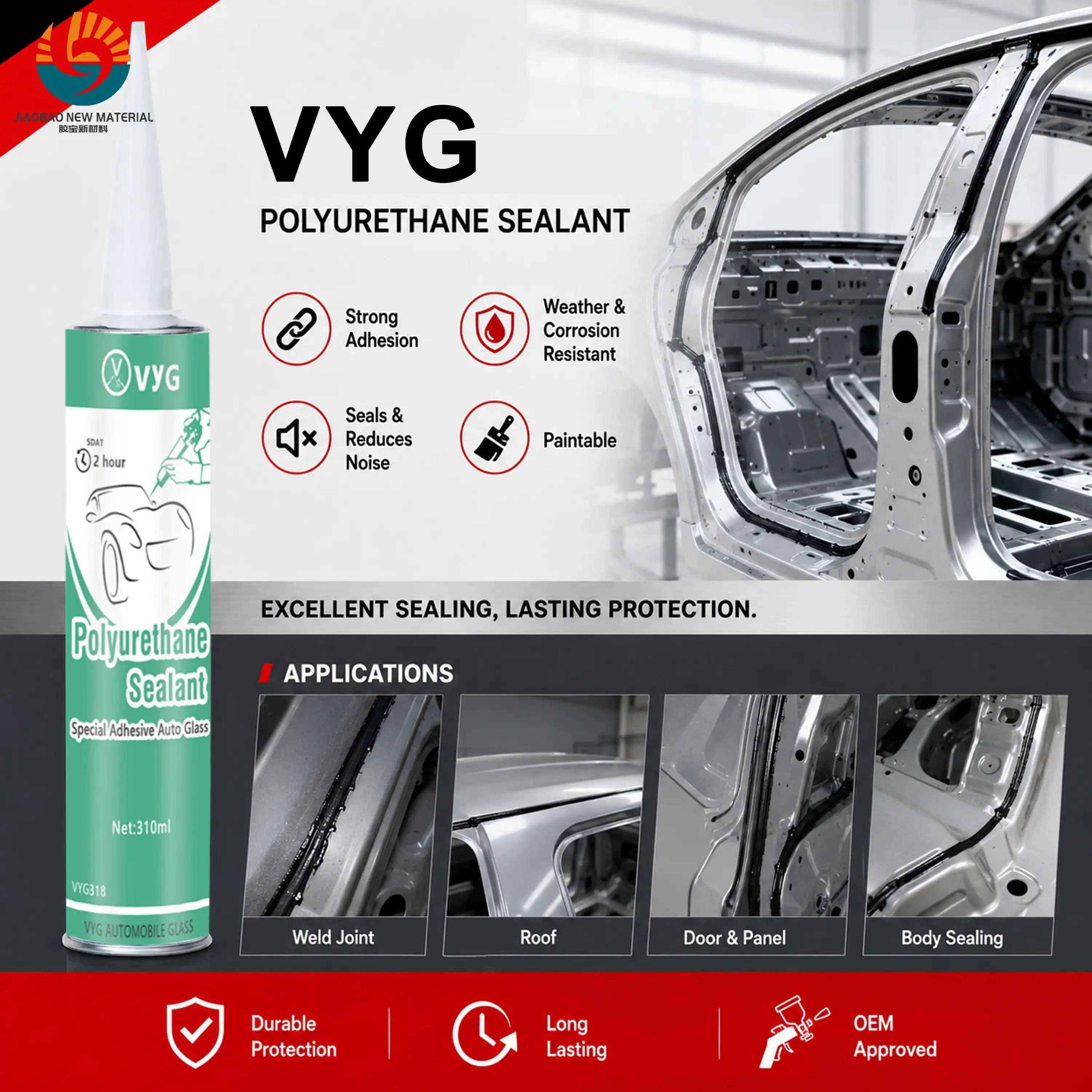
PU is needed for structural window gluing. That's not a matter of brand loyalty; it's the engineering requirement of FMVSS 212, which says that windshields must stay in place during crashes so that airbags can deploy and the roof stays strong. At the moment, there isn't a silicone formulation that meets this structural requirement for glass in stationary vehicles.
Silicone is still the best material for perimeter sealing, weatherstripping, and filling gaps that don't need to be loaded when flexibility and weather resistance are the most important factors. Running both products according to a standard SOP—PU for gluing glass and silicone for sealing trim—gives your technical teams a clear way to make decisions that makes installation more consistent across sites.
Some new trends that you should keep an eye on are low-VOC and primerless PU formulations that cut down on application steps without affecting the strength of the bond, and fast-cure systems that achieve structural SDAT in less than 30 minutes, which is a big time-saver for service operations that handle a lot of work.
When deciding between PU and silicone, it comes down to what they can be used for. When it comes to structural glass bonding, PU windshield auto glass sealant is the only choice. It has the bond strength, expected cure profile, and crash-compliance performance that chain auto service shops count on. When it comes to non-structural binding, silicone works well with other materials. The most important thing for procurement leaders in charge of supply chains with multiple locations is to find a provider that can meet your scale and quality standards and provide a uniform, traceable, and certified PU product.
To make a structural glue joint, PU chemically joins to glass and metal. Silicone, on the other hand, makes a flexible but not structural seal. To meet crash safety standards for windshield installation, the structure must work well. Silicone does not meet this requirement.
No, cross-linking chemistry may have broken down in old PU. It might look fine, but the bond between the two parts is much weaker, which means the windshield could come off in a crash. Check the lot number and expiration date every time before you use it.
Safe Drive-Away Time is based on how the sealant is made. Products with a 30-minute SDAT grade, which has been proven by FMVSS 212 crash tests, let you return your car faster. Before making any products the same across all of your sites, check with your seller to make sure they are SDAT certified.
When used on non-porous surfaces like painted metal, standard silicone usually needs a primer. Acetoxy silicone sticks well to glass and some metals, but it's not meant to be used for solid car glazing.
Since 2013, Jiaobao has built its reputation on consistent manufacturing and quick customer service. As a reliable provider of PU windshield auto glass sealant, we provide ISO-certified formulas, OEM/ODM custom packaging, lead times of 1–2 weeks, and full batch tracking. This gives chain service operators everything they need to make sure that quality is the same everyplace. Get in touch to talk about prices in bulk, sample orders, or a custom supply program. You can email us at dorashen@cnjiaobao.com or go to shandongjiaobao.com.

1. Automotive Body Repair News (ABRN) — Windshield Replacement Standards and Adhesive Technology Review, 2022.
2. Journal of Adhesion Science and Technology — Polyurethane Adhesives for Structural Glazing in Automotive Applications, 2021.
3. NHTSA Federal Motor Vehicle Safety Standards (FMVSS 212) — Windshield Mounting Performance Requirements, 2020.
4. Sika AG Technical Bulletin — One-Component Polyurethield Bonding Systems for Auto Glass Replacement, 2023.
5. Adhesives & Sealants Industry Magazine — Comparative Performance of PU and Silicone Sealants in Automotive OEM Applications, 2022.
6. ISO 4587:2003 — Adhesives: Determination of Tensile Lap-Shear Strength of Rigid-to-Rigid Bonded Assemblies, reaffirmed 2021.
November 16,2023
Enterprise Name
The sealant has very strong adhesion and performs well even on glass and aluminum. After curing, it remains flexible and shows no cracking. Perfect for our facade projects.
November 16,2023
Enterprise Name
Stable quality across batches. Our customers especially like the smooth application and consistent extrusion. It helps reduce installation time on site.
November 16,2023
Enterprise Name
I used it for bathroom sealing. Excellent waterproof performance and no mold issues so far. It's been holding up very well in humid conditions.
November 16,2023
Enterprise Name
The neutral silicone works well on sensitive materials without corrosion. Very suitable for industrial applications requiring stable performance.
_1779347426672.webp)