November 16,2023
Enterprise Name
The sealant has very strong adhesion and performs well even on glass and aluminum. After curing, it remains flexible and shows no cracking. Perfect for our facade projects.
Oct 22, 2026
Fire rated silicone sealant for joints is a specialized elastomeric compound engineered to seal construction gaps while maintaining the fire-resistance integrity of walls, floors, and partitions. Unlike standard sealants, it resists temperatures exceeding 1000°C, blocking flame, smoke, and toxic gases for rated durations of one to four hours. Certified under standards such as UL 1479, ASTM E1966, and EN 1366-4, these sealants address passive fire protection requirements in high-rise buildings, industrial facilities, and commercial construction where joint sealing directly affects life safety outcomes.
A fire-rated joint sealant has to pass two types of tests that are checked by outside experts: integrity (E), which means that no flame can pass through; and insulation (I), which means that heat transfer stays below a certain level. Products that get an EI 120 or 240 rating have shown that they protect for 120 or 240 minutes. If standard silicone is exposed to heat for more than a few minutes, it will melt and break, putting the whole fire compartment at risk.
Three certifications control purchases around the world. In North America, UL 1479 sets the rules for firestop devices, which include pipe, wire, and joint penetrations. ASTM E1966 talks about firestop joint devices that move back and forth. Linear joint seals sold in Europe must follow EN 1366-4. The first thing that must be done for any procurement to be legal is to make sure that the supplier has third-party listings that meet these standards, not just internal test data.
GB/T 9978 sets the test protocol for how fire-resistant building parts must be for projects that have to follow Chinese building codes. Compliance is proven by certificates from the National Center for Quality Supervision and Testing of Fixed Fire Extinguishing Systems. When purchasing things for more than one market, teams should ask for proof of both international and national standards. This is because local inspection authorities will only look at the national certification and not accept foreign listings as direct equivalents.
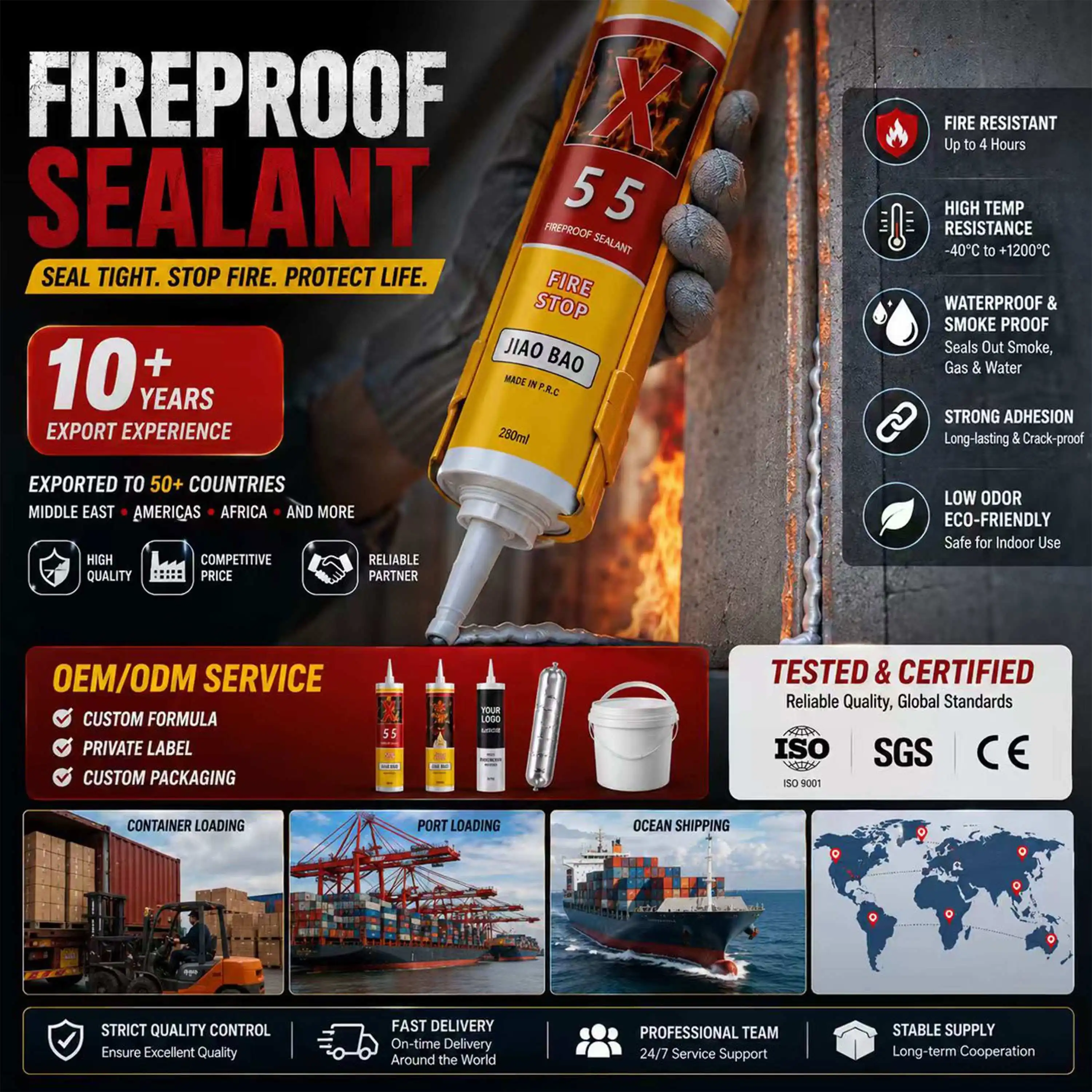
Because they are made of silicone polymer, fire rated silicone sealant for joints can be used in temperatures from -50°C to +150°C. This large thermal tolerance keeps the joint from opening when the building moves normally. When the mixture comes into contact with fire, the intumescent ingredients in it expand, blocking any openings for flames to pass through. This way of expanding—usually three times or more in volume—is what makes a fire-rated product different from a weather sealant that looks the same.
Fire-rated silicone sealants don't like water, so water doesn't break down the bond or move through the sealant over time. So, they can be used in mechanical rooms, wet areas, and on facades that will be exposed to rain. Chemical resistance to light acids and cleaning agents also makes it suitable for use in food processing and pharmaceutical plants that need to clean their equipment often, without affecting the fire-resistance performance.
The ISO 11600 rating says that high-performance fire-rated silicone can move up to Class 25LM or 50LM and have an elastic rebound above 80%. In real life, a joint that grows and shrinks by 6 mm with the seasons will not crack or come loose from the base. Because they last longer, silicone-based products are better than rigid intumescent acrylic alternatives, which tend to crack in moving joints. Because of these features, fire-rated silicone is the best choice for expansion joints in business buildings.
In tall buildings, the most dangerous linear part is the one between the floor slab and the face. The chimney effect says that fire can move up and down through this gap, and a fire-rated sealant that is properly applied is the first line of defense. The UL or EN system license says that the backing material for this job must be high-density mineral wool (at least 100 kg/m³), not normal plastic backer rod.
Jiaobao's one-part acidic RTV fire rated silicone sealant for joints is made to fill gaps between door and window frames in fire-rated buildings. It dries on the surface in 45 to 60 minutes and hardens at a rate of 3 mm per 24 hours at 25°C and 50% relative humidity, so it works well with busy building plans. The product has a 0mm sag rating according to GB 13477, which means it stays in place in vertical joints and doesn't sag before the cure is finished.
There needs to be a sealant that can handle vibrations, hydrocarbon exposure, and changes in pressure at expansion joints in concrete tunnel linings, data center compartment walls, and industrial floor joints. Jiaobao's recipe uses fire-rated silicone that has 99.5% non-volatile parts to make a seal that lasts and doesn't shrink or pull away from the edges of the base over time. Always follow the tested system specifications provided by the maker. Using materials that aren't part of the approved assembly will void the fire rating.
Acrylic-based firestop sealants expand aggressively when heated, which makes them effective in static, dry interior joints. However, they absorb moisture, become brittle at low temperatures, and cannot handle significant joint movement without cracking. Fire-rated silicone handles movement of ±25% to ±50% of joint width, making it the correct selection for any application where thermal cycling or structural settlement is expected.
Polyurethane sealants offer strong adhesion and paintability, but most formulations are not classified for fire resistance and degrade under sustained UV exposure on exterior joints. Where a project specification calls for a tested firestop joint system on an exterior facade, polyurethane cannot substitute for fire-rated silicone regardless of its other performance characteristics. Procurement teams should confirm that the product holds a valid fire test listing before writing it into a substitution request.
The selection process should follow this sequence: confirm the required fire rating (EI 60, EI 120, EI 240), identify the joint substrate materials, determine the maximum expected movement, and then select fire rated silicone sealant for joints that matches a certified test system covering all three parameters. Jiaobao supplies sealant in white, black, grey, and custom colors in 300ml cartridges and 600ml sausage packs, allowing specification teams to match both performance and finish requirements without requesting special production runs.
Manufacturers of fire-rated silicone sealant that you can trust have third-party listings as well as their own internal test reports. Ask for the real UL file number or EN test certificate number and check it on the website of the organization that issued it.
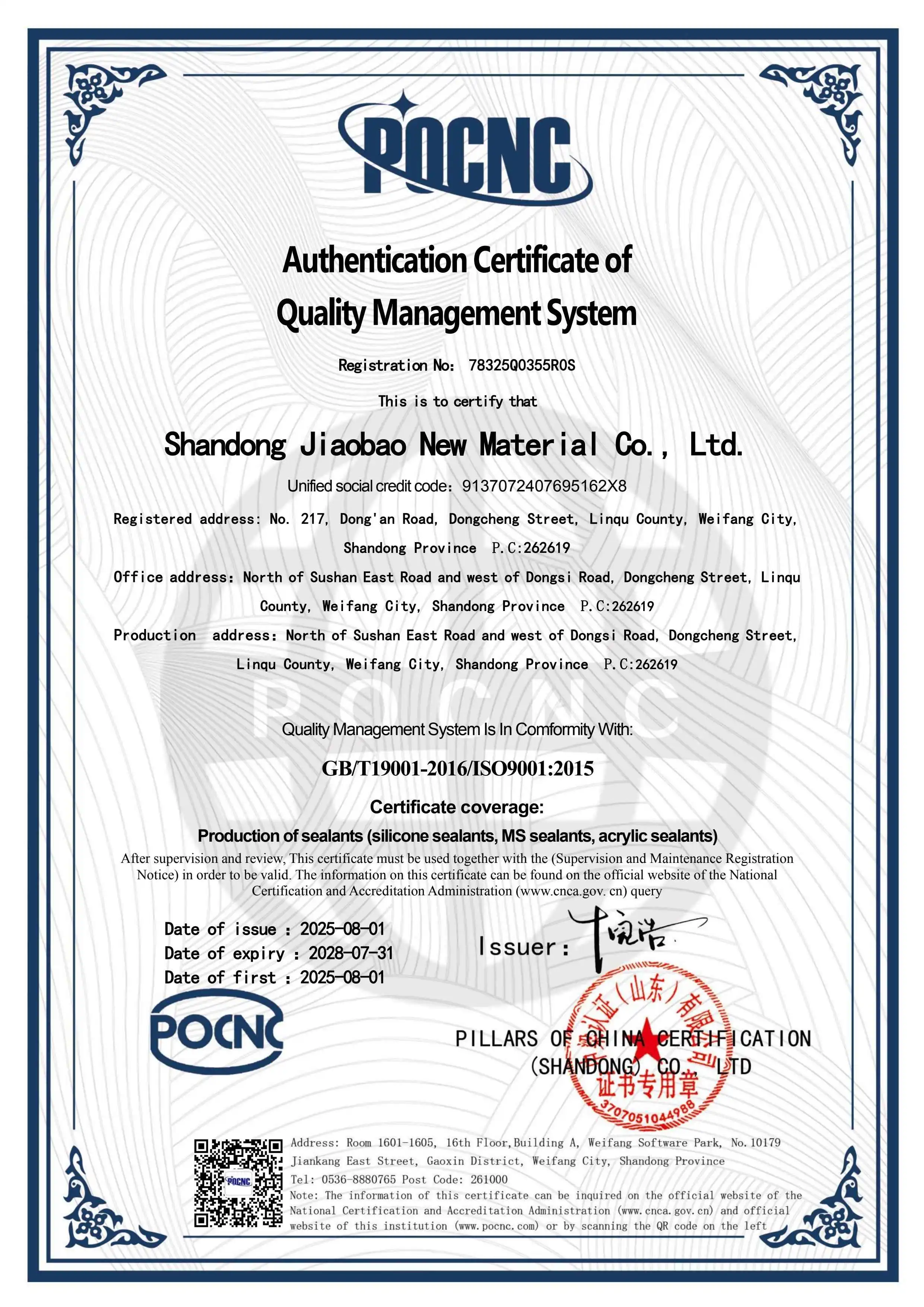
If a supplier can't provide approval paperwork that can be tracked, it's not safe for projects that will be inspected by the fire authority. Jiaobao goods meet ISO and CE standards and are backed by over 13 years of manufacturing experience and a quality management system that has been written down.
Before committing to large orders, the industry standard is to ask for examples, put them on surfaces that are similar to those in the real project, and watch how they stick and cure. The production wait time at Jiaobao is usually one to two weeks, and sample requests can be taken care of quickly. The product has a 12-month shelf life, so making sure that shipping times work with project plans keeps the product from going bad on-site.
The 300ml cartridge and 600ml sausage sizes from Jiaobo are both compatible with standard caulking guns used on job sites in North America and Europe. For large sales, there are discounts for buying in bulk, and shipping by sea or land is a choice for getting the goods to many places around the world. OEM and ODM production options are available for buyers who need private labeling or formulation changes to meet the needs of local regulations.
Standard building sealants and fire rated silicone sealant for joints cannot be used together. Their verified fire resistance, temperature stability, and ability to move all play important roles in keeping people safe and following the rules. To choose a product, you have to make sure that the fire rating, substrate compatibility, and movement class all match the tested system.
Jiaobao's one-part acidic RTV silicone sealant works consistently in tough joint applications and comes with certifications that can be tracked and years of manufacturing experience. If the specifications are correct from the start, there will be no need for expensive repairs during the fire authority review.
Yes. Fire-rated sealants made of silicone don't react to weather and can be used outside. Their hydrophobic features keep water out, and the silicone backbone doesn't break down in UV light like organic-based options would.
Above about 200°C, standard silicone gets soft and loses its stickiness. Fire-rated silicone has intumescent additives that make it controlled to expand when heated, which closes the gap. This mechanism for expanding is what makes the difference in function, and it can only be proven by approved fire tests.
Yes. The backing paper is an official part of the structure. For most rated joint systems, you need mineral wool with a density of at least 100 kg/m³. No matter how well the sealant works, using normal plastic backer rod will nullify the approved fire rating.
Tested systems can usually handle joint widths of up to 100 mm, though this depends on the exact certified configuration.
Always look at the product's fire test certificate to find out the largest joint size that has been tried.
Since 2013, Jiaobao has sold professional-grade fire-rated silicone sealant for joints to business and industrial projects. Our products come in 300ml and 600ml sizes and have a shelf life of 12 months. They can be shipped in white, black, gray, or custom colors. We offer OEM production, quick lead times, and full certification paperwork as a reputable producer of fire rated silicone sealant for joints. Contact our team right away to get samples or talk about prices for large orders. Email us at dorashen@cnjiaobao.com or go to shandongjiaobao.com to get in touch.

1. ASTM International. ASTM E1966: Standard Test Method for Fire-Resistive Joint Systems. ASTM International, 2023.
2. Underwriters Laboratories. UL 1479: Fire Tests of Through-Penetration Firestops. UL Standards, 2022.
3. European Committee for Standardization. EN 1366-4: Fire Resistance Tests for Service Installations — Linear Joint Seals. CEN, 2021.
4. International Organization for Standardization. ISO 11600: Building Construction — Jointing Products — Classification and Requirements for Sealants. ISO, 2022.
5. National Fire Protection Association. NFPA 101: Life Safety Code. NFPA, 2024.
6. American Society of Civil Engineers. ASCE 7-22: Minimum Design Loads and Associated Criteria for Buildings and Other Structures. ASCE, 2022.

November 16,2023
Enterprise Name
The sealant has very strong adhesion and performs well even on glass and aluminum. After curing, it remains flexible and shows no cracking. Perfect for our facade projects.
November 16,2023
Enterprise Name
Stable quality across batches. Our customers especially like the smooth application and consistent extrusion. It helps reduce installation time on site.
November 16,2023
Enterprise Name
I used it for bathroom sealing. Excellent waterproof performance and no mold issues so far. It's been holding up very well in humid conditions.
November 16,2023
Enterprise Name
The neutral silicone works well on sensitive materials without corrosion. Very suitable for industrial applications requiring stable performance.

