November 16,2023
Enterprise Name
The sealant has very strong adhesion and performs well even on glass and aluminum. After curing, it remains flexible and shows no cracking. Perfect for our facade projects.
Oct 2, 2026
When procurement managers and engineers ask whether neutral weatherproof silicone sealant outperforms acetic alternatives, the answer depends heavily on project context — but for most infrastructure and exterior construction applications, neutral-cure formulations hold a clear advantage. They cure without releasing acetic acid, protecting sensitive substrates like aluminum frames, coated glass, and concrete joints from corrosion or chemical degradation. With a movement capability of ±25%, low VOC content, and a service range of -50°C to +150°C, neutral silicone sealant delivers measurable performance benefits that acetic options simply cannot match in demanding outdoor environments.
In place of acetic acid, neutral weatherproof silicone sealant cures using an oxime or alkoxy process that produces non-corrosive byproducts, usually alcohols. Because of this chemistry, it can be used on more surfaces, such as galvanized steel, natural stone, ceramic tile, and anodized aluminum.
Acetoxy silicones give off smells like vinegar when they cure, but neutral systems don't change chemically during the vulcanization process. This keeps materials next to it from discoloring or rusting because of acid. The lower VOC output (below 80 g/L according to GB 13477) also fits with stricter environmental standards for commercial construction projects, making it easier to follow the rules during inspections of materials and project submissions.
When closing the outside, you need to be strong. Over the course of their useful lives, UV rays, freeze-thaw cycles, acid rain, and thermal growth all put stress on joint seals. Neutral-cure products are made to handle those pressures without breaking, cracking, or losing their stickiness.
Some of the main reasons why neutral coatings are better for use outside are listed below:
The cured elastomer in this neutral weatherproof silicone sealant can withstand temperatures ranging from -50°C to +150°C, so it stays flexible in sub-zero winters and stays the same size during the hottest parts of summer.
Sealants made of neutral silicone are used in many situations where long-lasting weatherproofing is important. For road and bridge expansion joints to work, the materials used must be able to handle constant movement and water exposure. Groundwater that is full of chemicals and atmospheric pressure can damage tunnel liner joints. Curtain wall outer seals have to deal with both wind-driven rain and structure movement at the same time.
In the building of highways and bridges, joint sealants have to meet standards like JT/T 203 and GB/T 14683, which say how much they can move and stick. When neutral silicone sealants meet these standards, they give project teams the proof of compliance they need to qualify bids and get approval from on-site inspections.
For business fenestration and curtain wall systems, the sealant that is put between the window frames and structure openings needs to be able to handle changes in the building's shape over the course of the year and keep air and water out. Neutral-cure silicone firmly bonds to glass, metal, concrete, and plastic substrates. This makes it easier to specify materials for a wide range of facade systems.
Knowing the pros and cons of these two chemistries helps procurement teams avoid making mistakes that cost a lot of money.
Acetic silicones cure and give off acetic acid. That acid starts rusting on metal surfaces. It breaks down metal backings on mirror glass. Over time, the pH unbalance can make it harder for things to stick to pavement or stone. This risk is completely eliminated by neutral weatherproof silicone sealant. They also don't give off a strong vinegar smell when they're being used, which makes the job safer and lowers the exposure of installation teams to irritants.
In long-term outdoor exposure tests, neutral formulations always do better than acetoxy alternatives at keeping their stickiness, resisting moisture, and blocking mold growth. A Shore A hardness of 30 after full curing means the elastomer is soft and flexible, able to absorb movement without putting stress on the substrate. This is a key quality for rigid materials like stone or glass cladding.
Acetic sealants do dry faster and cost less per unit, which means they can be used in non-metal interior uses where there is no chance of corrosion. But putting them on aluminum curtain walls, galvanized steel, or natural stone increases the risk of faster degradation, which cancels out any savings you might have gotten at first. The risk of material damage from acetic products is a real problem for projects that need to be inspected and come with a guarantee.
The selection process should be based on the type of substrate and the rules that must be followed. For projects with metal frames, covered glass, porous stone, or concrete, neutral-cure chemistry is the standard that can be defended. For bids to be accepted when national standards or client specifications refer to GB/T 14683 or similar international standards, procurement teams need Type Test Reports from approved laboratories.
Buying sealants in bulk for big building projects adds more factors than just the performance of the products. Project execution is affected by lead times, packaging formats, managing shelf life, and the availability of technical documentation. Sealants that come in both 300ml tubes and 600ml sausage packs give you options for the tools you use on the job site. A shelf life of 12 months means that the inventory needs to be carefully rotated, especially when materials are bought ahead of time during the bid process.
When switching from acetic to neutral weatherproof silicone sealant on façade and bridge projects, construction teams constantly report less joint re-sealing and cleaner base surfaces during inspections. The non-staining chemicals, high movement tolerance, and wide substrate compatibility lower the risk of not meeting specifications and make on-site quality testing processes run more smoothly.
Surface cleanliness is the first step in getting good adhesion. IPA or MEK cleaning with two cloths gets rid of surface oils, dust, and release agents that stop bonds from forming. Before the full application, a compatible primer makes adhesion test results better on Kynar-coated metal or especially non-porous surfaces.
Under normal conditions, the surface of neutral silicone dries in about 30 minutes. It takes 7 to 14 days for the silicone to fully cure, depending on the depth of the joint and the humidity in the air. When the sealer is applied at temperatures between 5°C and 40°C and the relative humidity is above 30%, the fix depth and bead integrity will be the same all the way through the joint.
Standard PPE should be worn when applying even non-corrosive formulas. Cartridges and sausage packs can last for 12 months if they are kept in cool, dry places out of direct sunlight. This also keeps the product's thickness within the specifications.
The neutral weatherproof silicone sealant works much better than acetic alternatives for exterior construction, infrastructure joint sealing, and any other use with metal, coated glass, or natural stone. Its non-corrosive cure chemistry, 25% moving ability, and wide range of substrate compatibility lower both the technical risk and the cost of long-term upkeep.
It can also change the color of porous objects like limestone and marble. A neutral-cure formulation is the right choice for these substrates from a technical point of view.
It's not possible to use regular building paint on silicone surfaces. When you order the sealer, it should be the same color as the base. Jiaobao lets you choose from white, black, gray, and custom colors to fit the needs of your project.
For neutral-cure silicones to vulcanize, they need moisture in the air. Most of the time, a product that hasn't dried properly is old, the relative humidity is below 30%, or the product was used in a sealed space where wetness from the air can't reach the joint depth.
Weatherproof sealants are low-modulus mixtures that are made to keep air and water out while still allowing joints to move a lot. High-modulus structural sealants are made to move mechanical loads from one part to another. They are not the same thing and should not be used in place of each other in engineering.
Ask a widely recognized testing facility for a Type Test Report. When building infrastructure in China, most projects must follow GB/T 14683 and JT/T 203. Jiaobao gives full technical paperwork, like plant inspection reports and conformity certificates, to help with submitting projects and inspecting them on-site.
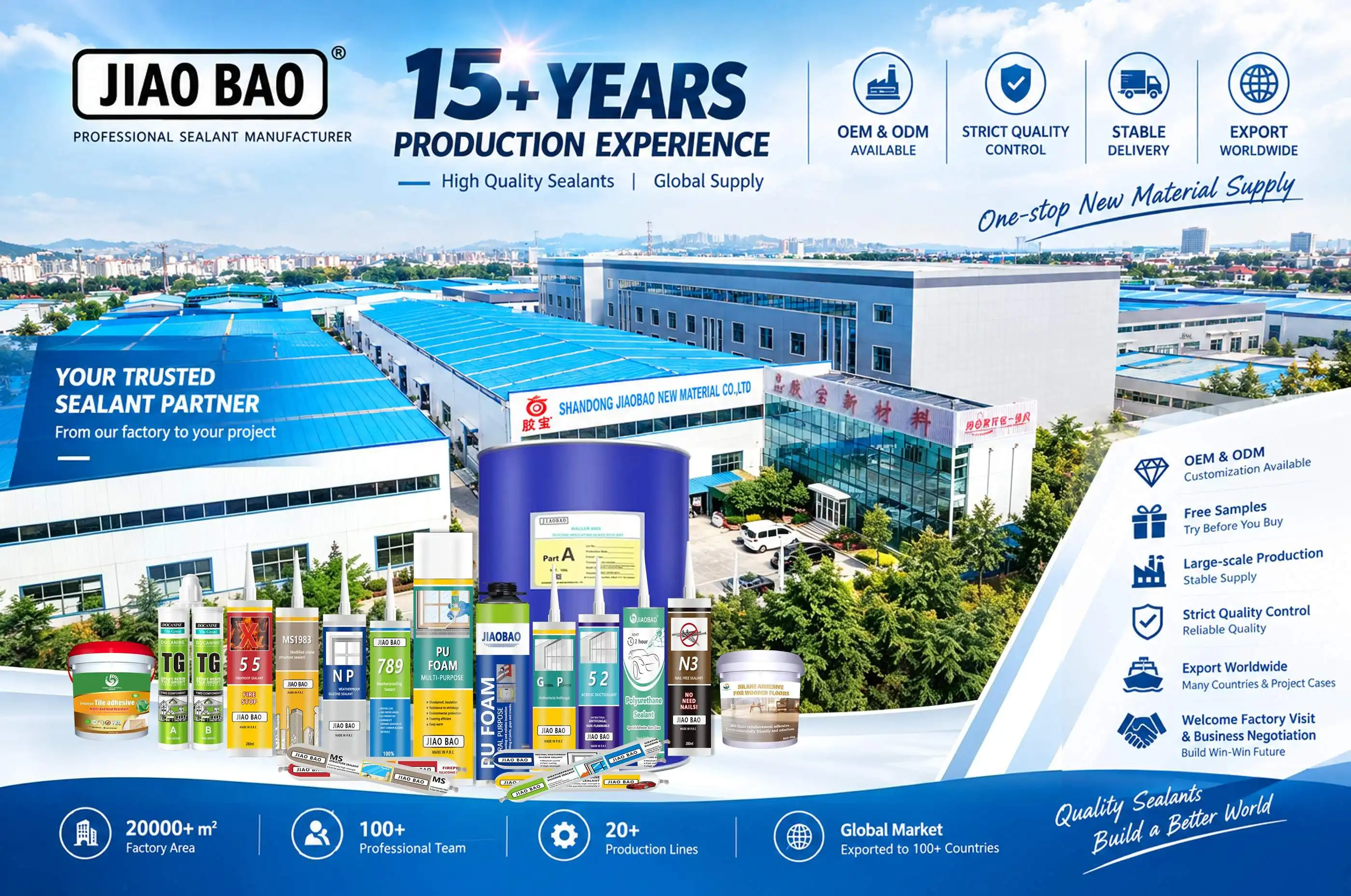
Since 2013, Jiaobao has been making high-performance silicone sealants. They offer neutral weatherproof silicone sealants to building projects in China and other countries. With ISO and CE certifications, lead times of one to two weeks, OEM/ODM support, and full engineering documentation help, we help procurement teams qualify materials, meet inspection requirements, and keep projects on schedule. You can email us at dorashen@cnjiaobao.com or go to shandongjiaobao.com to ask for samples or bulk prices.
1. ASTM International. ASTM C 1248: Standard Test Method for Staining of Porous Substrate by Joint Sealants. ASTM International, 2020.
2. ASTM International. ASTM C 679: Standard Test Method for Tack-Free Time of Elastomeric Sealants. ASTM International, 2019.
3. British Standards Institution. BS EN ISO 11600: Building Construction — Jointing Products — Classification and Requirements for Sealants. BSI, 2018.
4. National Standards of China. GB/T 14683: Silicone and Silicone-Modified Sealants for Building Construction. Standardization Administration of China, 2017.
5. Ministry of Transport of the People's Republic of China. JT/T 203: Silicone Rubber Sealant for Highway Bridge Expansion Joints. China Communications Press, 2020.
6. Wolf, A. T. Durability of Building Sealants. RILEM Publications, 1999.
November 16,2023
Enterprise Name
The sealant has very strong adhesion and performs well even on glass and aluminum. After curing, it remains flexible and shows no cracking. Perfect for our facade projects.
November 16,2023
Enterprise Name
Stable quality across batches. Our customers especially like the smooth application and consistent extrusion. It helps reduce installation time on site.
November 16,2023
Enterprise Name
I used it for bathroom sealing. Excellent waterproof performance and no mold issues so far. It's been holding up very well in humid conditions.
November 16,2023
Enterprise Name
The neutral silicone works well on sensitive materials without corrosion. Very suitable for industrial applications requiring stable performance.
_1779347426672.webp)