November 16,2023
Enterprise Name
The sealant has very strong adhesion and performs well even on glass and aluminum. After curing, it remains flexible and shows no cracking. Perfect for our facade projects.
Oct 2, 2026
The best acrylic sealant for wall and ceiling cracks depends on paintability, drying speed, substrate adherence, shrinkage resistance, and VOC content. An effective interior crack filler should skin over in 30 minutes, take latex paint without discoloration, and bind to gypsum board, plaster, or concrete without pulling away from the joint edges. Matching the sealant's performance profile to your surface and finishing timeline eliminates expensive returns and unattractive cracks weeks after completion, whether you oversee a construction team or a single room refresh.
Silicone elastomers harden when they come in contact with water. An acrylic joint cement, on the other hand, hardens when the water evaporates. As the water in the bead evaporates, the paste changes into a plasto-elastic rubber. This is exactly why acrylics can hold paint: once they're dry, the surface is chemically compatible with water-based and alkyd coatings, but silicone that isn't dry or is fully dry will not let them stick at all.
Acrylic seals are unique and can't be replaced when remodeling inside. While silicone is more flexible in wet areas and polyurethane is better at handling structure movement, neither one cleanly takes paint. A paintable acrylic solution is still the standard for closing the joint between ceiling cornices and walls, filling in small settlement cracks before decorating, or bridging the gap between door frames and plasterboard. Most makers use ASTM C834 as a guide.
It costs real money to make this mistake. If a sealant shrinks too much, it leaves a hollow space that can be seen through paint. One that doesn't stick well to porous surfaces pulls around the sides after a few weeks. Before I tell a site crew about a product, I compare it to these priorities.
Before you buy anything, you should look at these basic success criteria:
These factors don't work alone; they work together. A product that dries quickly but doesn't stick well still fails. When you look at all five together, you're left with only truly skilled choices.
Once you set the program setting, the comparison is easy to understand. Silicone sealants are most common in wet places like shower trays, bathroom tile joints, and glass on the outside of buildings because they can handle constant moisture and large amounts of movement. Acrylic sealant for wall and ceiling Polyurethane compounds are used for structural joints and high-traffic areas where acrylics can't handle the tensile demands.
Acrylic always wins when it comes to interior wall and ceiling joints with low to moderate movement (a Movement Accommodation Factor of ±7.5% to ±12.5% per ISO 11600 F 12.5 P) because it paints more easily, can be cleaned up with water before it hardens, and costs a lot less per linear meter of joint. If you have to replace thousands of linear feet of cornice joints or door frame edges as part of a repair job, that difference in cost adds up quickly.
Technique is just as important as choosing the right product. If you don't apply sealer correctly, even a high-quality one, the effects will be average.
Get rid of any loose bits, dust, and leftover sealant. The surfaces need to be dry and strong. A fine mist of water improves open time and workability on porous surfaces like raw concrete without making it less stable.
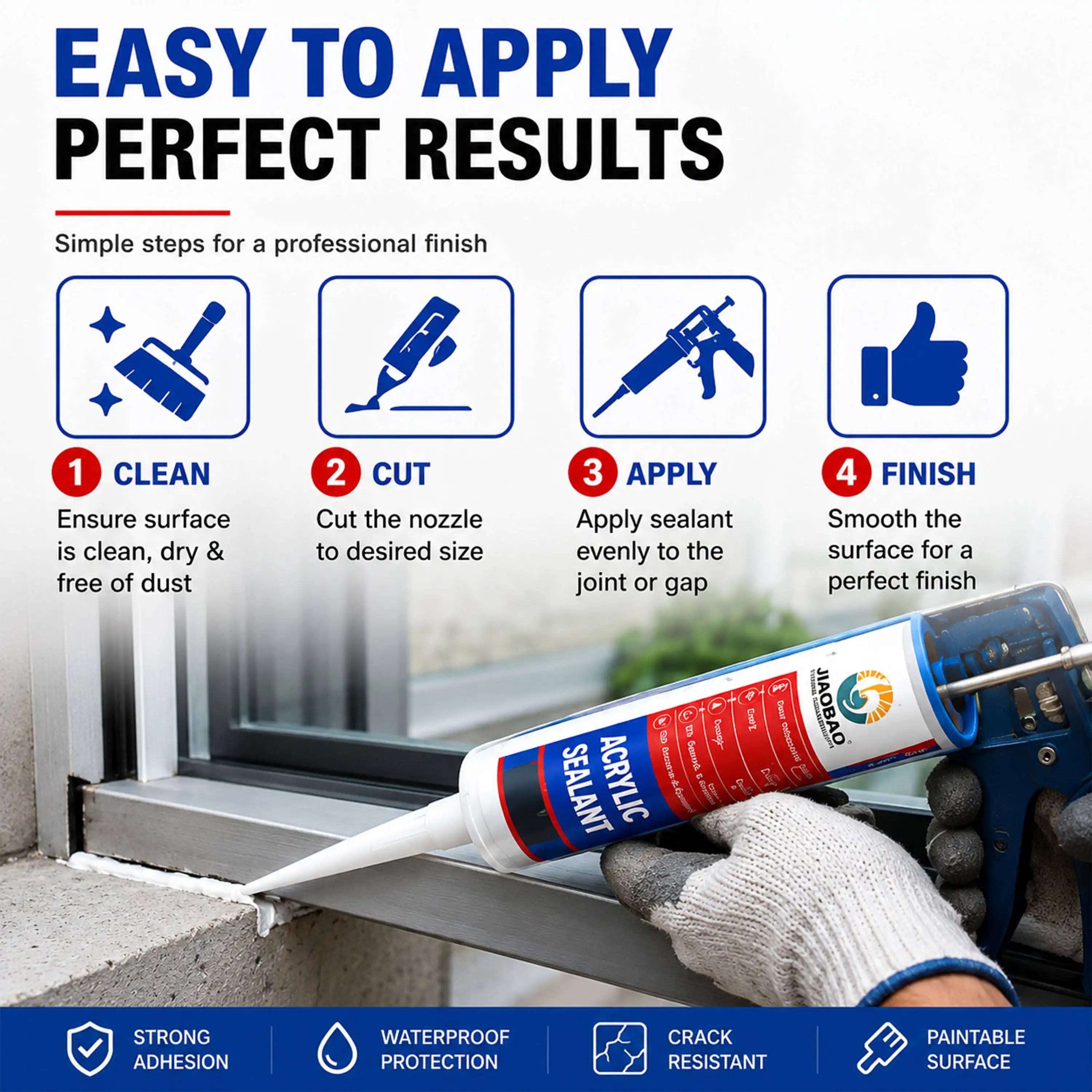
Cut the cartridge tip so that it is the right size for the joint at a 45-degree angle. Fill the joint in one pass by applying steady, even pressure. Right away, use a finger or spatula that has been moistened to press the bead against both joint walls and make a smooth, slightly concave shape. Jiaobao's recipe has an extrusion rate of 163 ml/min, which is much higher than the 80 ml/min limit. This means that the paste flows easily without needing too much hand pressure for long periods of time.
Before painting, wait until a hard skin has formed. This should take about 30 to 60 minutes in normal indoor circumstances. When you put latex paint over sealant that hasn't fully skinned, the paint film cracks as the water underneath it disappears. Standard latex or water-based topcoats stick to skin that is solid without changing the color or failing to stick.
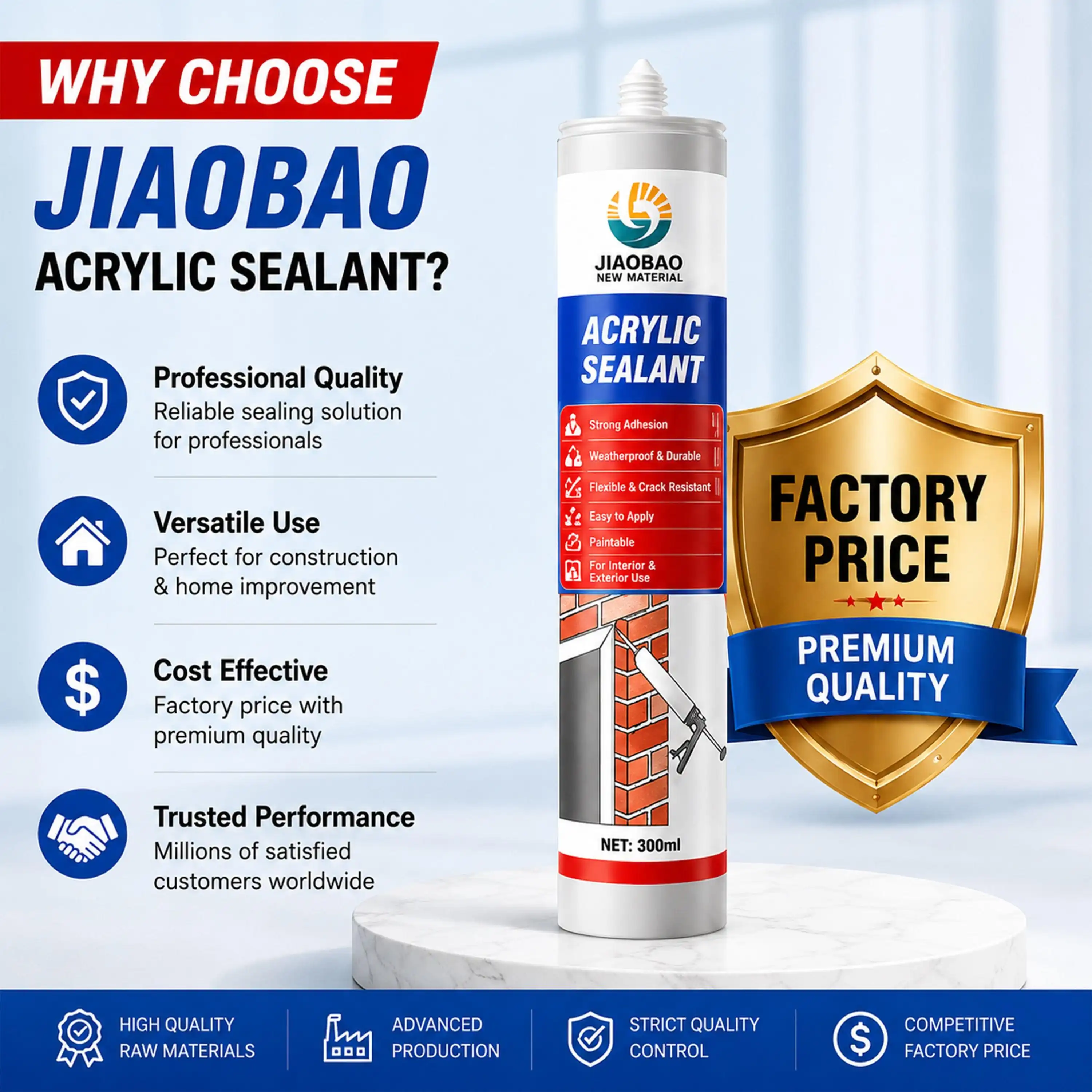
Jiaobao's one-part RTV acrylic sealant is made using ISO-certified methods and comes in 300 ml tubes and 600 ml sausage packs. It comes in white, gray, black, and unique colors that can be mixed to fit the needs of each project. This acrylic sealant for wall and ceiling is ideal for interior joint filling and finishing. Skin Dry Time: 0.5 hours | ≤3 hours | Extrusion Rate: 163 ml/min | ≥80 ml/min | Sag (Upright): 0 mm | ≤3 mm | Tensile Strength (23°C): 0.64 MPa | 0.4–0.6 MPa | Shelf Life: 12 months | — |
| Parameter | Measured Value | Standard Threshold |
|---|---|---|
| Skin Dry Time | 0.5 hours | ≤3 hours |
| Extrusion Rate | 163 ml/min | ≥80 ml/min |
| Sag (Upright) | 0 mm | ≤3 mm |
| Tensile Strength (23°C) | 0.64 MPa | 0.4–0.6 MPa |
| Shelf Life | 12 months | — |
Its ability to maintain zero-sag on both vertical and high surfaces makes it especially effective for work at ceiling junctions, where gravity testing is harsh.
It's not hard to choose a crack-filling compound for interior walls and ceilings, but you do have to make sure that the product's specs match the conditions on the job site. Put skin dry time, low shrinking, paintability, and material adhesion at the top of your list. If a product gives up solid content to be cheaper, stay away from it. The shrinkage will show up on the wall surface weeks later. Acrylic sealant for wall and ceiling with low-VOC formulations and water-based chemistry are still the most practical and cost-effective choice for large-scale interior renovation projects, as long as the product really does what it says on the label.
Yes, as long as the mixture has the right amount of thixotropy. The Jiaobao product has 0 mm of sag on flat surfaces and no deformation on parallel (overhead) uses. This means that it stays in place on ceiling parts while the tooling is done.
Wait until a hard skin forms. This should take about 30 to 60 minutes at room temperature and humidity. If you paint too soon, the paint could crack because the sealant is still losing water under the paint film.
Standard internal plastic joint cement shouldn't be used in places that are always wet. It might emulsify again if it stays wet for a long time. For applications in the shower or other wet areas, use a neutral silicone made for sanitary use.
If the sealant cracks after being applied, it's usually because the joint moved more than the sealant's ±12.5% MAF or the product had too much water in it, causing it to shrink a lot. For any joint that will be heated and cooled, make sure you choose a formulation with a high solids content.
A wet sponge can be used to clean acrylic sealer that hasn't hardened yet. To get rid of cured material, you have to scrape it off or lightly sand it.
Our acrylic sealant for wall and ceiling applications ships with a lead time of one to two weeks and is available in both 300 ml and 600 ml sizes. Jiaobao has been making professional-grade sealants since 2013. We are a certified producer of acrylic sealant with ISO and CE certifications. We accept OEM/ODM orders and provide samples before committing to a large order. You can email our team at dorashen@cnjiaobao.com or go to shandongjiaobao.com to ask for details and prices.

1. ASTM International. ASTM C834: Standard Specification for Latex Sealants. ASTM International, 2023.
2. ASTM International. ASTM C1241: Standard Test Method for Volume Shrinkage of Latex Sealants During Cure. ASTM International, 2021.
3. ISO. ISO 11600: Building Construction — Jointing Products — Classification and Requirements for Sealants. International Organization for Standardization, 2022.
4. U.S. Environmental Protection Agency. Indoor Air Quality: Volatile Organic Compounds' Impact on Indoor Air. EPA Publication, 2022.
5. Wypych, George. Handbook of Sealant Technology. ChemTec Publishing, 2019.
6. Petrie, Edward M. Handbook of Adhesives and Sealants. McGraw-Hill, 2007.
November 16,2023
Enterprise Name
The sealant has very strong adhesion and performs well even on glass and aluminum. After curing, it remains flexible and shows no cracking. Perfect for our facade projects.
November 16,2023
Enterprise Name
Stable quality across batches. Our customers especially like the smooth application and consistent extrusion. It helps reduce installation time on site.
November 16,2023
Enterprise Name
I used it for bathroom sealing. Excellent waterproof performance and no mold issues so far. It's been holding up very well in humid conditions.
November 16,2023
Enterprise Name
The neutral silicone works well on sensitive materials without corrosion. Very suitable for industrial applications requiring stable performance.
_1779347426672.webp)