November 16,2023
Enterprise Name
The sealant has very strong adhesion and performs well even on glass and aluminum. After curing, it remains flexible and shows no cracking. Perfect for our facade projects.
Oct 16, 2026
When a fire breaks out in a large building, the difference between a contained incident and a catastrophic loss often comes down to how well the passive fire protection system was installed—and what materials were used. Fireproof silicone sealant for construction fills the gaps, penetrations, and expansion joints that standard sealants simply cannot protect. It stops flames, smoke, and toxic gases from migrating between fire-rated compartments, buying critical evacuation time and preserving structural integrity. For general contractors managing complex projects with strict inspection requirements, selecting the right fire-rated sealant is not a minor detail—it is a compliance obligation.
A silicone sealant that can withstand fire is not the same as other silicone sealants that have different names. Tests like ASTM E814, UL 2079, and EN 1366-4 are done by a third party to make sure it is safe and won't catch fire. When the solid material is heated, it either turns into a stable char layer or starts an endothermic reaction that covers the joint and stops heat transfer for a certain amount of time, usually between one and four hours.
Because they get bigger when it gets hot, the intumescent seals fill in the holes left by plastic lines melting. On the other hand, fire-safe rubber doesn't bend or move. This is the best stuff for sealing empty holes in metal pipes, concrete expansion joints, curtain wall head-of-wall systems, and door or window surround seals that need to be able to move but still keep out fires.
Three main types of applications meet the needs of building a business. In curtain walls, the head-of-wall joints need a sealant that can take on different temperatures and keep the walls safe from fire at the same time. MEP penetration seals around metal conduit, wire bundles, and HVAC pipe that goes through fire-rated walls need to be able to keep their shape so that work can be done above head. Chemical protection and fire grades of EI 120 or EI 240 are needed for expansion joints in buildings and tunnels.
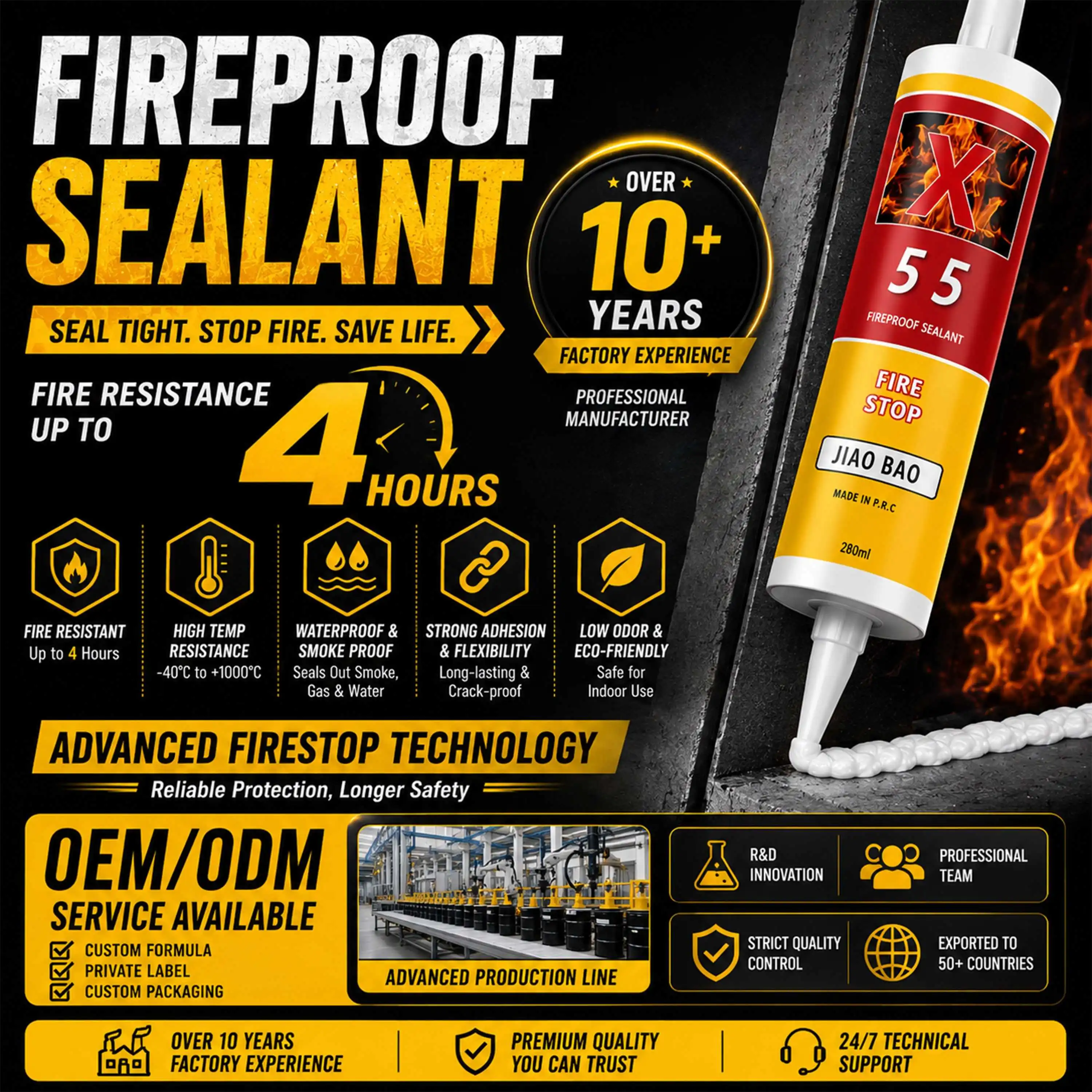
Most rigid materials used to stop fires break when the building moves. Fireproof silicone sealant for construction is a professional-grade fire-rated silicone sealant with hardness of 20 to 35 Shore A and elongation over 300 to 500% before breaking. In accordance with ISO 11600, it can accommodate movement classes of ±25% to ±50%. Because of this, the base doesn't come apart. During fire checks, this is the type of failure that is found most often.
When it comes to long-term costs, these are the main performance factors that matter:
These features save money on upkeep over the life of the project by cutting down on the number of failed inspections, repairs, and total costs.
To follow US building codes like IBC Chapter 7 and NFPA 101, firestopping devices must be listed by a third party, such as UL or FM Approvals. You won't have to blame the general builder if you choose a listed fire-rated joint sealant. The authority having jurisdiction (AHJ) will be happy with the final review, and the property insurance will be able to meet their standards. One of the things that must be with the product when it is inspected is a list of all the system lists and batch test results.
When people buy fireproof silicone sealant for construction, they should look at the fire rating time (one, two, three, or four hours), the class of movement, the substrate adhesion data (for concrete, metal, glass, and drywall), and the rate at which the material heals. To plan joint work on a building site that is already in use, remember that the surface should dry in 45 to 60 minutes and the through-cure speed should be 3 mm per 24 hours.
Third-party certification is needed for business projects. In ASTM E814 and UL 2079, firestops that go all the way through are talked about. For projects in Europe, a number called EN 1366-4 is used. Buyers should ask for a Certificate of Conformance for every batch of goods they buy. A Loss on Ignition test should be part of this document to make sure that the filler has the same consistency as the tried mixture. It's against the law for sellers to not be able to give batch-specific COC papers.
It costs a lot more than the money saved on materials to fail the fire test after dropping the price per unit. It costs money to buy the things, time to put them together, time to do the paperwork, and the chance that more work will need to be done. How should it be done? A good way to get a good return on your investment (ROI) is to buy in bulk from a reliable manufacturer who makes sure quality stays the same across batches and gives you all the technical paperwork. This is better than buying one item at a time from a sketchy source.
They must be clean, dry, and free of dust at the very least. Before you put on the sealant, get rid of all the oils, lifters, and loose dirt. There is a right way to set the joint depth-to-width ratio that comes with the joint. And you lose material when you fill a joint too much. It doesn't make it safer in case of fire. When the joint depth is more than the recommended fill depth, you should use a backing bar.
Before the project starts, there should be an agreement on the framework supply. This is useful for general builders who are in charge of grounds that have a lot of buildings or projects that are being built in stages. If you follow these steps, it will be safer for you to buy things for big sites:
These controls should be put in place before buying fireproof silicone sealant for construction so that there are no problems with the supplies or lost paperwork that slow down the final fire inspections and handover of the project.
A sealant source is useful if they can help with technical problems on-site while the sealant is being put on and if they can answer quality questions quickly during the fault liability time. To make sure that a project's substrates or joints don't break the rules, the maker should state in writing that the system meets the fire rating.
Head-of-wall joints had to be sealed on about 18,000 square meters of the outside of a 42-story mixed-use tower project. There was a need for a fire-resistant neutral-cure silicone system that would let the parts move about 25%. The system had to last for two hours in a fire. At the final inspection by the fire authority, there were no broken parts that could be seen from the outside. The project was finished on time.
A company that works with oil asked for fire-rated silicone filler to fill in about 2,400 holes in EI 120-rated concrete fire walls for metal pipes and wires. Because the formulation didn't have any lumps, it was possible to apply over the top, and batch CoC papers were sent to the project quality register. While the check was going on, not a single fix had to be made.
If you use fire-rated, low-VOC silicone seals to make the inside of your home better, you can now get LEED v4 and BREEAM New Construction credits. According to the Global Sealants report from The Freedonia Group, the need for fire-resistant silicone products is growing at a rate of about 6% per year in industrial building markets. This is because cities are making it harder to build big buildings.
In an office or business building, fireproof silicone sealant for construction serves as a key fire-rated silicone sealant within any passive fire safety system. Not only does it not break when joints move, but it also doesn't break down over time in harsh conditions. If it's specified and installed correctly, it keeps fire compartmentation intact in an emergency.
It's easy for people who are in charge of getting things for big projects to decide what to get: fire ratings that have been checked, full batch paperwork, proven bulk supply capacity, and quick technical support. If you choose a company that meets all four criteria, they are less likely to break the rules. This helps the job get done on time.
No, most of the time. Paint doesn't stick to hard rubber very well. Painting the joint can also make it less flexible, which could make it less fire-safe. Make sure the sealant is the right color for a visible joint as soon as you order it. You can pick a color that is white, black, gray, or something you make up.
It's "fire-retardant" if it doesn't catch fire. Based on a well-known standard, like UL 2079 or ASTM E814, it has been shown to keep fires out for a certain amount of time, like one, two, three, or four hours. The building code says that the compartmentation standards can only be met by things that are allowed for use in fires.
Not by itself. In fires, plastic lines fall apart, leaving a hole. For holes in metal pipes and static joints, the best caulk is fire-rated silicone. There needs to be a collar or wrap system that melts with the pipe in order to get it through a hole.
Once a year, companies like Jiaobao offer framework supply deals with delivery plans that are broken down into stages. Firms can lock in prices and be sure they will always have goods on hand for projects that last more than a year. Things can be made quickly because they only take one to two weeks to make.
Since 2013, Jiaobao has been making skilled silicone covers for general builders and big building projects in China and other places. We can make our one-part acidic RTV fire-rated silicone sealant in any color you want. It comes in 300ml and 600ml cartridge or sausage packs. You can keep it for a year, and it can handle water up to Class 1 W. It is made of 99.5% non-volatile materials. We sell fireproof silicone sealant for construction and offer full batch paperwork, OEM/ODM services, and a quality guaranty that lasts as long as the product is in stock. You can email us at dorashen@cnjiaobao.com or go to shandongjiaobao.com to get samples or a price quote for buying in bulk.
1. Freedonia Group. Global Sealants: Industry Study with Forecasts. 2022.
2. ASTM International. ASTM E814: Standard Test Method for Fire Tests of Penetration Firestop Systems. 2023.
3. Underwriters Laboratories. UL 2079: Tests for Fire Resistance of Building Joint Systems. 2019.
4. National Fire Protection Association. NFPA 101: Life Safety Code. 2021.
5. International Code Council. International Building Code, Chapter 7: Fire and Smoke Protection Features. 2021.
6. British Standards Institution. BS EN 1366-4: Fire Resistance Tests for Service Installations — Linear Joint Seals. 2021.
November 16,2023
Enterprise Name
The sealant has very strong adhesion and performs well even on glass and aluminum. After curing, it remains flexible and shows no cracking. Perfect for our facade projects.
November 16,2023
Enterprise Name
Stable quality across batches. Our customers especially like the smooth application and consistent extrusion. It helps reduce installation time on site.
November 16,2023
Enterprise Name
I used it for bathroom sealing. Excellent waterproof performance and no mold issues so far. It's been holding up very well in humid conditions.
November 16,2023
Enterprise Name
The neutral silicone works well on sensitive materials without corrosion. Very suitable for industrial applications requiring stable performance.