November 16,2023
Enterprise Name
The sealant has very strong adhesion and performs well even on glass and aluminum. After curing, it remains flexible and shows no cracking. Perfect for our facade projects.
Nov 24, 2026
GP general purpose silicone sealant is a one-component, ready-to-use rubber sealant that fills gaps, blocks water, and weatherproofs common joints around windows, doors, glass, and bathrooms. It comes in a cartridge or sausage pack, cures by absorbing moisture from the air, and becomes a flexible silicone rubber that holds up to sun, rain, and temperature swings. Most general purpose grades use acetic cure, which forms a skin fast and bonds well to glass and aluminum. In this guide, I explain how it works, where it fits, and what wholesale buyers should check before they order.
That's right, GP general purpose silicone sealant is a ready-to-use, one-part rubber sealant that keeps water out of gaps and around windows, doors, glass, and baths. It comes in a rod or a pack of sausages. It takes in water from the air as it cures and turns into a flexible silicone rubber that can handle rain, sun, and changes in temperature. Most general-use grades quickly form a skin and stick well to metal and glass when fixed with acetic acid. People who want to buy a lot of something should read this first to get a sense of how it works and where it fits.
A sealer that only needs one thing to work is ready to use. You put a shell in a caulking gun. To make a sausage gun, you open a pack of sausages and press a bead into the joint. When the paste is put somewhere wet, it turns into rubber that can be stretched. We don't need to mix it, heat it, or press on it.
The acidic type smells like vinegar and heals faster. As the sealer sets, the smell goes away. First the outside starts to harden, then the inside. When beads are dry and shut up, the process moves more slowly because thick beads take longer to fix than thin ones.
When people are shopping, they often mix these three words up, but they all mean different things. A thin film called skin forms on top of the surface. From now on, you should not tool the bead. The time when a surface doesn't stick when you lightly touch it is known as "tack-free time." It says on the back of the package that it won't stick in 15 minutes.
When the bead turns into rubber and is at its strongest, it is fully cured. It might take a day or more, depending on the weather, humidity, and how thick the beads are. People should plan for full healing, not just tack-free time, before they put a joint in water or move it around.
Water, air, and dust can't get into a joint that's been sealed. When you add two parts, bonding is what keeps them together. GP general purpose silicone sealant does a great job on the first job, but it can't be used instead of screws, brackets, or structural adhesives. Our grade can only hold 1.5 MPa of weight, so it's better for closing links than for links that hold weight.
Additionally, "general purpose" does not equate to "every environment." If you are working with metals that are easily damaged, alkaline surfaces, or surfaces that are always wet, you might need a different formula.
There are different kinds of silicones for different jobs. An all-purpose silicone can't always do the job. Sanitary silicone has a fungicide in it that makes it safe for wet sites. Not only does neutral-cure silicone smell better, but it also works better on concrete, bricks, and metals that are still soft. Strathcona is made to hold weight when it sticks glass to frames. Lots of heat is too much for high-temperature rubber to handle for building. Most aquarium-grade silicone doesn't have any fungicides in it, so it can be used in glass vessels. When putting in glass, glazing silicone has to follow certain rules.
If a project is in one of these groups, I think the technical data sheet (TDS) should be used to make the final choice.
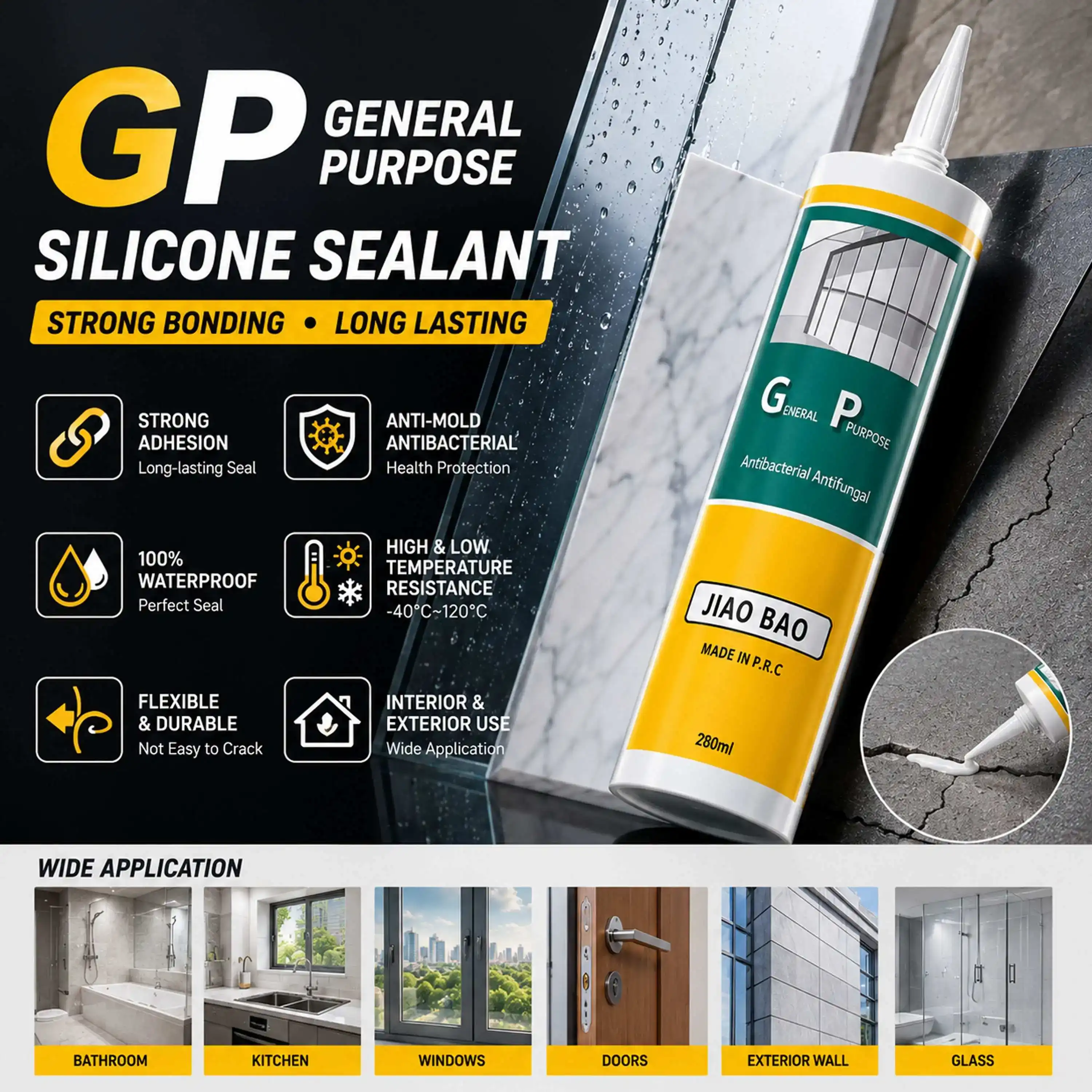
When silicone dries, it forms a sheet of rubber that keeps water out from snow, rain, and wind. Its backbone is made of silicone, which doesn't react with ozone or UV light. This means that it doesn't chalk or crack as quickly as some acrylic and polyurethane sealants do. That's why GP general purpose silicone sealant is often used to join metal and glass on the outside.
When it freezes and thaws, it's also easy to deal with because the rubber stays soft. These silicone seals work best when the temperature is between -50°C and +150°C (-58°F to 302°F). Before telling a customer what the temperature is, you should always check the TDS.
Joints move in real life. Alu. frames get bigger in the summer, and glass moves around when the wind blows. It's better for cured silicone not to crack and lose its stickiness because it can stretch and bounce back. We can pull our acetic sealant apart more than 300% of its weight, and it has a Shore hardness of 18. In other words, it's soft and can be bent. When it comes to grade, silicone seals can move between ±20% and ±50%. Check to see what the rating is for the item you have.
In the end, more than just the formula determines the outcome. It is important to think about how the joint is designed, the size of the beads, how the surface is prepared, how the coating dries, and how good it is overall. The usual guide for using joint sealant, ASTM C1193, goes into a lot of depth about how joints are designed. If the joint is too small, the sealant won't work, no matter how good it is.
Here are the listed properties of our one-part RTV acetic silicone sealant.
| Property | Value |
|---|---|
| Composition | One-part RTV silicone sealant (acetic) |
| Appearance | Paste |
| Colors | White, black, grey, custom |
| Shelf life | 12 months |
| Volume | 300 ml, 600 ml |
| Packaging | Sausage and cartridges |
| Tack-free time | 15 minutes |
| Shore hardness | 18 |
| Maximum bond strength | 1.5 MPa |
| Tensile rate | >300% |
| Specific gravity | 0.87 |
| Consistency | 0.88 |
These numbers give your team a clear baseline for comparing quotes from other suppliers.
Adhesion changes with the surface. The table below gives a practical starting point, but I always suggest a small test on the real material.
| Substrate | Expected adhesion | Preparation | Primer | Typical use |
|---|---|---|---|---|
| Glass | Strong | Clean, dry | Usually none | Window and glass joints |
| Aluminum | Strong | Remove oil and dust | Usually none | Window and door frames |
| Glazed ceramic | Good | Clean, dry | Usually none | Fixture and tile edges |
| Painted metal | Varies | Check paint is sound | Test first | Trim and flashing |
| Plastics (PVC) | Varies by type | Clean, test patch | Test first | Plastic frames |
| Concrete, masonry | Not advised for acetic cure | Alkaline surface | Choose neutral cure | Use neutral silicone |
Procurement teams should verify TDS values and run compatibility tests on critical jobs.
Most of the time, our product is used to seal around door and window gaps. You can use it to fit glass into frames and seal around finished window and door units that don't have an alkaline surface because it sticks well to both metal and glass. It comes in white, black, and gray, all of which match common frame colors. You can also use custom colors to get a better match for a job.
The surface needs to be clean, dry, and stable to begin with. Clean both sides of the joint with tape, use a tool to make clean lines, and work the bead before the skin forms.
There are many small parts in bathrooms and kitchens, such as shower walls, sink edges, and tub edges. If you want to seal these gaps, most GP general purpose silicone sealant will work. It stays flexible even when the surfaces move. It also covers the hole in a wall or panel that a pipe makes.
Rubber that doesn't grow mold or get dirty might last longer in damp places. Also, keep in mind that silicone can only be used to fill in gaps between pipes and not in place of threaded fittings or pressure joints.
One more thing that GP rubber can be used for is light maintenance. Builders put it on small cracks in the structure that aren't part of the structure itself, gaps around vents and pipes, seams in sheet metal, and joints on rain- and sun-damaged outside trim. If you heat and cool the rubber many times after it has dried, it will still keep its shape.
Like, paint won't stick to silicone that's already hard. Paint the joint first, then fix it, or choose a different sealer.
We need products that have been cleared for certain tasks. Some of these are places that are chemically aggressive, systems that provide potable water, structural glazing, and plumbing that can handle high pressure. Keep in mind that acetic cure can damage copper, brass, lead, and zinc, so you need a neutral-cure sealer.
You can't use silicone in place of mechanical bolts, plumbing parts, or building repairs. You could get calls and reports if you choose the wrong product here. Your reputation could also be harmed. If you're not sure, ask your supplier about the use before you place the order.
You can't tell which sealant works better by its price alone. Find out what the TDS from each supplier says about the following: how long it will last, how stiff it is, how fast it stretches, how strong the bond is, and how fast it stretches. So get some samples and check how they work with the metal, glass, and other things your customers use. Check out how the bead skins, dries, and sticks together in a day or two.
When you do this with two or three sellers, you can get a good idea of how much each box costs and how much it's worth. Before you sell a new item, you should also check the VOC rules in your area.
Uneven batches lead to returns that are bad for a wholesaler's reputation. You should find out how the company checks each batch and if they keep samples. Next, make sure that the goods you offer meet your customers' wants. Our GP general purpose silicone sealant is available in different colors besides white, black, and gray. For stores and contractors, it comes in 300 ml tubes. For bigger jobs, it comes in 600 ml sausage packs.
Order the right amount based on how quickly things sell and get rid of old stock first. That keeps cash from sitting on old stock.
Customers further down the chain order again quickly, so how fast you deliver is important. Since 2013, Shandong Jiaobao New Material Co., Ltd. has been making silicone seals. We make them for a week to two weeks. You can ship things by land or sea. ISO, CE, and other groups have checked our goods to make sure they meet international standards. We can also make things for you if you need OEM/ODM. If the quality goes down during the shelf life, we will either give you a return or send you a new one.

If you put GP general purpose silicone sealant in water, it hardens. It is a one-part rubber sealant. This stuff fills in cracks and keeps joints on glass, metal, and other similar things from getting wet. You can use it right if you know about skin time, tack-free time, and full cure. It doesn't work past the line between sealing and bonding. It's useful because it's waterproof, doesn't fade in UV light, is flexible, and can handle a lot of different temperatures.
The joints, the surface, and the way it is applied are also important for getting the right effects. You can use acetic cure to fix windows, doors, and many home joints. But you'll need to use other items for alkaline surfaces, sensitive metals, damp areas, and systems that are allowed for use. People can make better buying decisions when they look at the TDS, try samples, and make sure the batch stability is good.
If the rubber is hard, paint won't stick to it. You can paint the surface first and then seal it, or you can pick a GP general purpose silicone sealant that you can paint over.
Most of the time, no. Acetic acid is made when you use acetic fix. This acid can eat away at copper, brass, lead, and zinc. It can also damage surfaces like concrete that are too acidic.
To stay moist, it needs air. When things are too dry, don't let air flow, have a very thick bead, or are old, they can all slow down healing. After a year, check to see if the sealer is still good.
You can choose any color you want from white to black to gray. You can package your items in either 300 ml cartridges or 600 ml sausage packs.
Want to work with a company that can quickly make GP general purpose silicone sealant? Acetic silicone can be bought on Jiaobao in white, black, gray, or any other color you want. OEM/ODM items can be made and shipped by land or sea. If there are quality issues within the shelf life, they can be refunded or replaced. You can email your preferred number to dorashen@cnjiaobao.com or visit shandongjiaobao.com to find out more.

1. ASTM International, ASTM C920 Standard Specification for Elastomeric Joint Sealants, 2018
2. ASTM International, ASTM C1193 Standard Guide for Use of Joint Sealants, 2016
3. International Organization for Standardization, ISO 11600 Building Construction: Jointing Products, Classification and Requirements for Sealants, 2002
4. ASTM International, ASTM C794 Standard Test Method for Adhesion-in-Peel of Elastomeric Joint Sealants, 2018
5. ASTM International, ASTM C719 Standard Test Method for Adhesion and Cohesion of Elastomeric Joint Sealants Under Cyclic Movement, 2014
6. National Institute for Occupational Safety and Health, NIOSH Pocket Guide to Chemical Hazards, 2007

November 16,2023
Enterprise Name
The sealant has very strong adhesion and performs well even on glass and aluminum. After curing, it remains flexible and shows no cracking. Perfect for our facade projects.
November 16,2023
Enterprise Name
Stable quality across batches. Our customers especially like the smooth application and consistent extrusion. It helps reduce installation time on site.
November 16,2023
Enterprise Name
I used it for bathroom sealing. Excellent waterproof performance and no mold issues so far. It's been holding up very well in humid conditions.
November 16,2023
Enterprise Name
The neutral silicone works well on sensitive materials without corrosion. Very suitable for industrial applications requiring stable performance.