November 16,2023
Enterprise Name
The sealant has very strong adhesion and performs well even on glass and aluminum. After curing, it remains flexible and shows no cracking. Perfect for our facade projects.
Nov 5, 2026
Paintable acrylic sealant is the better choice for interior joints that you plan to paint. Silicone is the better choice for wet, sunny, or high-movement joints. An acrylic sealant paintable type is a water-based paste that accepts latex paint once it dries, so gaps along trim, drywall, and baseboards disappear under the final coat. Silicone stays flexible in showers, glass joints, and outdoor frames, but paint rarely sticks to it. Neither product wins every job. The right pick depends on the substrate, joint movement, moisture, sunlight, and finish. This guide helps you match each product to the project.
I wrote this for contractors, purchasing managers, distributors, and OEM buyers. Along the way, I answer two common questions: "what is paintable acrylic sealant?" and "can acrylic sealant be painted?" The short answer to the second one is yes. You paint it after it dries for the time listed on the technical data sheet.
An acrylic sealant paintable type is a paste that is water-based and made of acrylic polymer and one part. It heals itself as the water leaves the joint, so you don't have to mix it. Once it's dry, building treatments that work with it, like latex wall paint, can be put on top of it. That's the main reason makers choose it for joints that people can see.
It's also important to see shrinkage. Since water-based glue shrinks when it dries, you may need to cover up big holes again. There are some things that acrylic paint can't be used on. People who want to buy something should always read the technical data sheet first. This will tell them how long the paint will last and what kinds of finishes are okay.
When the names of these products sound alike, buyers get lost. It costs less, but standard acrylic sealant is usually tougher. Polymers are added to acrylic to help it bend and move around more easily. There are a lot of water-based tubes in stores that are sold as acrylic latex glue. ASTM C834 is the name of a group of latex coatings. It is possible to paint silicone-modified acrylic, but it depends on the recipe.
Silicone is added to make it more resistant to water. Pro building grades tend to shrink less and stay together better most of the time. Formulation changes things like how sticky, pliable, shrinking, smelling, and paint-friendly something is. So, two things that say "paintable" might not paint on the wall in the same way. This is not all you should ask for; ask for more.
Parts inside that don't move around much are best for acrylic sealant. Crown molding, drywall seams, plaster edges, wood-to-wall transitions, and door and window trim are a few examples. Before painting, it also fills in small cracks in brick or plaster that aren't structural. You can work with the paste easily, and it's simple to clean up while it's still wet.
Painters will have more time. Our Jiaobao one-part RTV acrylic glue is made to fix holes and cracks around doors and windows. You can pick any color you want, not just white or black. If a building has big cracks, you need a fix plan first, because filler just hides the problem.
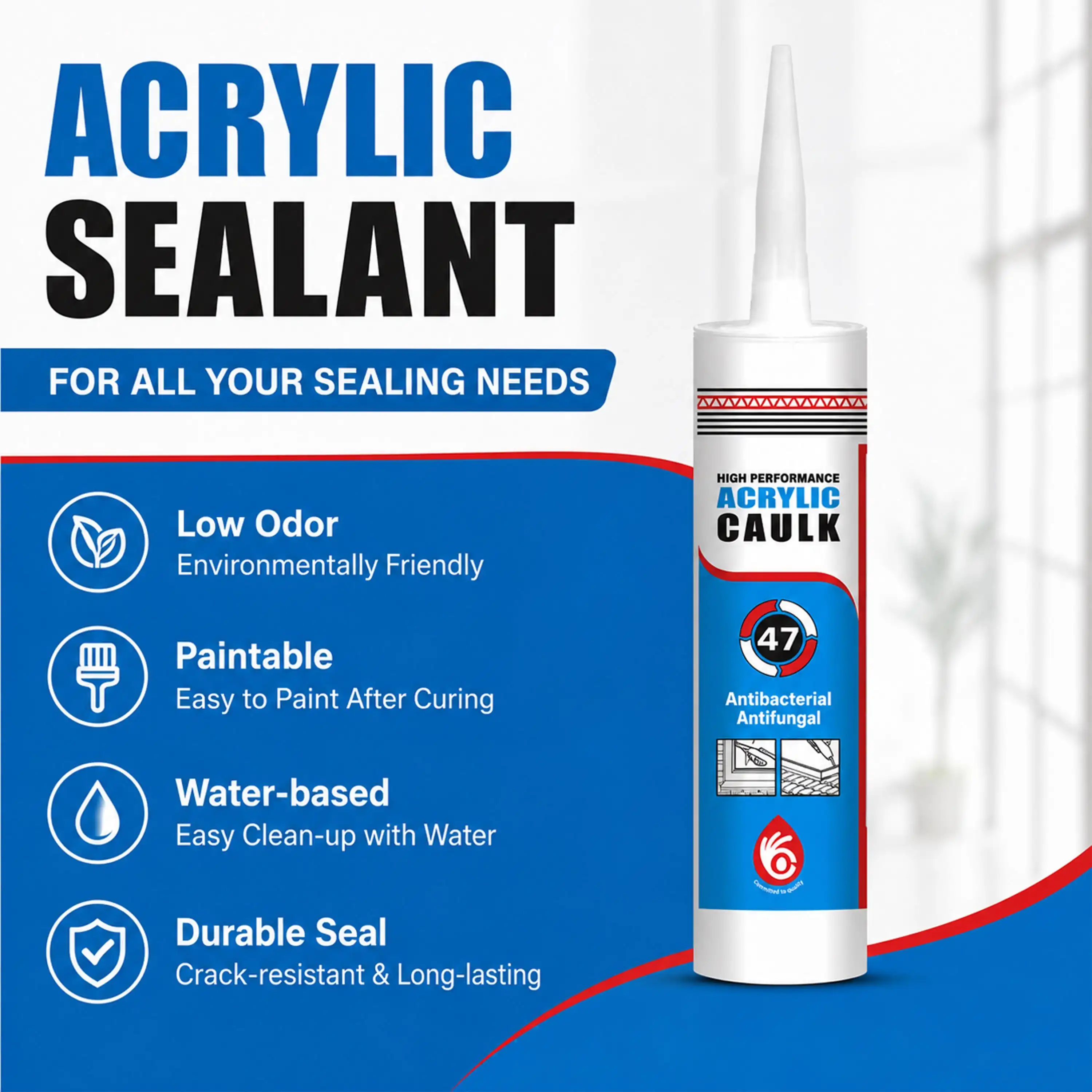
An acrylic sealant paintable type is better since you can paint on it. Because silicone has a low-energy surface, rubber paint beads up and comes off. If you coat the surface of acrylic after it dries, you can make the joint look like the wall. No more painting the trim or the drywall after that.
There are a lot of clear or set color silicones on the market. It might leave a shiny line on a flat wall. Plus plastic is easy to work with and wipe clean. If a joint is going to stay wet and unfinished, how it looks is not as important as how well it works. Still, I believe you should paint a small piece of scrap wood first as a test run before you begin the real job.
Because they can move, the two items are not the same. A lot of acrylic latex sealants say that joints can move up to 7.5%. The range for most ASTM C920 silicones is at least 25%. It's important to have that gap where windows expand in the summer, where different types of materials meet, and where big expansion joints are.
Stretchy acrylic can still work well with gaps in frames, drywall, trim, and masonry because the joints don't move around much. When setting up a wide extension joint, I wouldn't do it right away. First, measure the change you want to see. Then, pick a greater-rated product. If you stretch a sealant too far, it will tear or stop sticking together.
Something isn't waterproof just because it doesn't let water in. Being near water all the time can make acrylic soft over time. It can handle splashes and getting wet in dry rooms. It can handle baths, sinks, glass, and frames that get wet better than vinyl and UV light. Since water-based acrylic doesn't smell bad and is simple to clean up with water, it's good for places where people live.
VOC rules are also important in the US. Rule 1168 from the South Coast AQMD tells sealants in that area how much VOC they can have. Don't just assume that each seller is following the rules; ask them for VOC paperwork that fits the market you want to reach.
There is a link between latex glue and acrylic sealant paintable type because they are both water-based and can be painted. Simple rubber glue can leave a dip when it dries because it shrinks more and costs less. Professional grade or flexible acrylic sealant sticks to more surfaces and stays in shape better most of the time.
For small holes in a rental room, simple rubber might work. A better acrylic makes it less likely that a client will call you back for finish carpentry work in their home. Look at the data sheet because the name of the product doesn't tell you much about how it shrinks and sticks.
It's easier to move polyurethane sealer around than acrylic sealant, but it sticks better. That's why builders use it outside, with concrete, and in factories. Many polyurethanes can be painted on, but check the data sheet to be sure. What you get in return is a stronger smell, more work to clean up, and a shorter tooling window.
Sunlight can also change some recipes if the joint isn't covered. Polyurethane should be used where there is a lot of play and wear. Use plastic if the job is inside and just needs to look good. It's better to put on the right sealant for the job than to pick the best one for every part.
Based on what the project needs, this is how I set up the choices. Acrylic is the same color, doesn't smell bad, and has the same internal trim point. Silicone probably forms in damp places, on glass, and in strong sunlight. When there is a lot of movement or heavy touch outside, polyurethane or a high-quality rubber should be used.
Paint stores that also sell sealer often pick paintable acrylic because it matches the wall color well. OEM buyers should add the needs for packaging and labels to the list. With this simple sort, teams don't have to pay too much for help that a joint never needs. They also don't buy too little where a joint moves.
The acrylic sealant paintable type will stick well once the joint is clean. Get rid of any grease, dirt, peeling paint, or old sealant. After that, let any wet spots dry. First, use support material to fill in very deep holes. This is because beds that are thicker shrink more when water leaves them. Next, choose the size of the pack.
The gun can work with both a regular caulking gun and a 300-ml drum. A 600-ml sausage pack can be opened with a sausage-pack gun, which is good for big groups. Know what kind of gun you want before you place your order. It takes time to get the wrong gun to the spot. Masking tape should be used around the edges to get clean lines.
Cut the tip to the width of the joint. After that, hold it straight up. As you push a continuous bead, make sure there are no holes or air pockets that show. Smooth it out with a damp finger or tool while it's still wet. After that, take off the tape while the glue is still soft. Full cure is not the same as surface dry. In thirty minutes, our product is dry on the outside, but not on the inside. Paint only on the data sheet after the paint-over time is up. Early coats can crack and get wet.
Many things go wrong because of a short list of mistakes. Painters crack, blister, or change the color of the joint when they cover it too early. Acrylic is used in joints that get wet often or move around a lot. Some people put it on top of dust or uneven ground. Some people only think about color or price and not the pack size, gun type, how to store it, or how long it will last. Make sure you know when it goes bad before you use it.
Our glue can be used for a year. First, make sure the joint is clean. Then, figure out how long it will take to paint over it, how much movement you can expect, and make sure you have the right gun. Making this two-minute check will save you time, effort, and trouble when you don't need to.
An acrylic sealant paintable type is mostly used inside of businesses and homes. It can be used on baseboards, skirting boards, door and wall trim, cracks in concrete or masonry that aren't structural, and wood that goes from door to wall. This is what it's used for in buildings that process light goods.
Silicone or polyurethane should be used outside to keep the weather out. If there are interior expansion joints or other places that move a lot, you should check them out before you buy. You should get an engineer to look at the building if a crack keeps getting bigger. You can't see a crack in the wall or base because of the sealer.
Don't think about price or color first; think about the substrate, the design of the joints, how they move, and how much exposure they get. Then, see how stiff they are, how much they can move, how long they can stretch, how hard they are on the Shore, how much they shrink, how well they stick, how long it takes to fix, and if they need a primer. Ask for VOC papers and look at the temperature range and how the material responds to freezing and thawing.
Most sealers have a vertical sag of 3 mm or less, but our one-part acrylic sealer has no sag at all. It pushes out 163 ml/min, which is faster than the average of 80 ml/min or more. Most things dry in three hours or less, but this takes thirty minutes. It has a tensile strength of 0.64 MPa at 23 °C and doesn't fail to stick together. You can get packs with 300 ml or 600 ml sausages in white, black, gray, or any other color you want.
Ingredients, packaging, color, MOQ, lead time, shelf life, carton configuration, pricing terms, and how to handle complaints are some of the most important things that contractors, distributors, and OEM clients should all check. If you want to choose a provider, you should look at more than just price per unit. You should also look at batch consistency, international experience, quality control, and expert support.
Since its start in 2013, Shandong Jiaobao New Material Co., Ltd. has been making things for more than 13 years. Both ISO and CE have approved our products. We ship by land or sea, and we can do OEM/ODM work. Your order will be sent out in one to two weeks. If the quality goes down during the shelf life, we will either give you a refund or send you a new one.

You can fix things with acrylic sealant paintable type and silicone, but they do it in different ways. Interior parts that benefit from an acrylic sealant include baseboards, trim, drywall, and plaster. It works well in wet places, near glass, in direct sunlight, and on joints that move around a lot. For tough jobs outside or in factories, polyurethane works well. Rubber glue can be used with acrylic, but it tends to shrink more.
Make sure the joints are clean, use the right size pack, and don't check to see if the surface is dry. Instead, wait until the paint-over time is up. Most people mess up when they paint too early or use acrylic in places that are always wet. When someone buys something, they should think about the substrate, how it moves, how wet it is, paint, documents, and how reliable the supplier is. Another thing they should do is test a small area first.
How long it takes to dry depends on the mix, the temperature, the humidity, the size of the joints, and the flow of air. Just because something is dry on the outside doesn't mean it's fully cured. Read the product data sheet to find out how long you can paint over the acrylic sealant paintable type. If you want to make a unique finish, do a test run first.
Regular silicone doesn't always work with regular architectural paint, so I don't think you should rely on it. Pick acrylic if you need to paint the joint.
For most jobs and caulking guns, a 300 ml cartridge is enough. A 600 ml sausage pack and a sausage-pack gun are good for big jobs.
Acrylic that is normally used works well in safe places. Most of the time, polyurethane or silicone is safer for joints that get wet or move around a lot. Check out the info sheet first.
Are you looking for an acrylic sealant paintable type manufacturer? You can email dorashen@cnjiaobao.com to get in touch with Jiaobao. Please tell them what kind of surface you want, what color you want, what size pack you need (300 ml or 600 ml), and how much you need each month. We offer samples, technical datasheets, OEM/ODM packaging, project quotes, and have a one- to two-week lead time. The goods we sell will last for twelve months. Go to shandongjiaobao.com to find out more.

1. ASTM C920 Standard Specification for Elastomeric Joint Sealants, ASTM International, 2018
2. ASTM C834 Standard Specification for Latex Sealants, ASTM International, 2017
3. ASTM C1193 Standard Guide for Use of Joint Sealants, ASTM International, 2016
4. ASTM C1521 Standard Practice for Evaluating Adhesion of Installed Weatherproofing Sealant Joints, ASTM International, 2019
5. ISO 11600 Building Construction: Jointing Products, Classification and Requirements for Sealants, International Organization for Standardization, 2002
6. Rule 1168 Adhesive and Sealant Applications, South Coast Air Quality Management District, 2017

November 16,2023
Enterprise Name
The sealant has very strong adhesion and performs well even on glass and aluminum. After curing, it remains flexible and shows no cracking. Perfect for our facade projects.
November 16,2023
Enterprise Name
Stable quality across batches. Our customers especially like the smooth application and consistent extrusion. It helps reduce installation time on site.
November 16,2023
Enterprise Name
I used it for bathroom sealing. Excellent waterproof performance and no mold issues so far. It's been holding up very well in humid conditions.
November 16,2023
Enterprise Name
The neutral silicone works well on sensitive materials without corrosion. Very suitable for industrial applications requiring stable performance.