November 16,2023
Enterprise Name
The sealant has very strong adhesion and performs well even on glass and aluminum. After curing, it remains flexible and shows no cracking. Perfect for our facade projects.
Nov 6, 2026
If you're sourcing a reliable acetoxy cure sealant for door and window gap sealing, this guide cuts through the noise. GP acetic silicone sealant for construction is a one-component, moisture-curing product that tacks dry in just 15 minutes, bonds strongly to glass, aluminum, and ceramic tiles, and remains flexible across extreme temperatures. Whether you're a building materials distributor, an e-commerce seller, or an overseas brand importer seeking OEM production, this 2026 buyer guide walks you through composition, comparison, selection criteria, application steps, and real-world performance data.
GP acetic silicone sealant is an RTV (Room Temperature Vulcanizing) silicone that is made with an acetoxy hardening method and comes in a single part. When it comes in touch with water in the air, it gives off acetic acid, which smells like vinegar for a short time, and cross-links into a silicone rubber that is forever flexible. The product from Jiaobao looks like a smooth, thixotropic paste that doesn't sag when put on vertical joints.
Jiaobao's acidic sealer has a bond strength of 1.5 MPa, a tack-free time of 15 minutes, a Shore A hardness of 18, and a tensile stretch rate of over 300%. From -40°C to +150°C, it works reliably. These numbers are in line with ASTM C920 Class 25 and ISO 11600 G-20HM standards, which are two of the most commonly used guidelines for buying glass around the world.
Once the sealing sets, the acetic acid will no longer give off any gas. For best results, use GP acetic silicone sealant for construction in well-ventilated areas and keep it away from alkaline surfaces like concrete, cement, and mortar, as the acidity in these materials will break down the adhesion. Keep it below 27°C and out of strong sunlight. The food can be kept for 12 months after it was made.
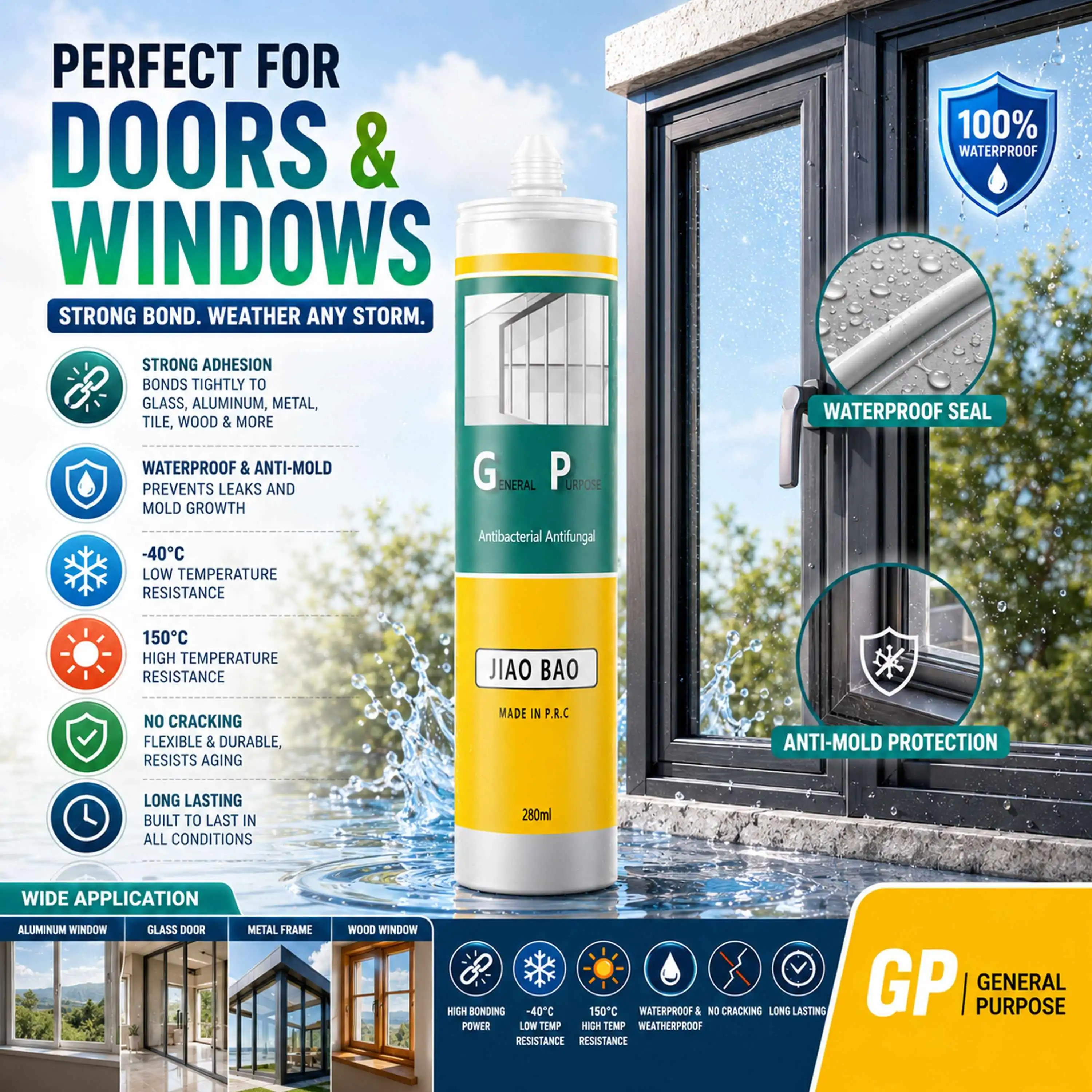
Because it doesn't give off acid when it cures, neutral cure silicone is safe for concrete, stone, and copper. It does, however, heal more slowly and cost more per dose. GP acetic silicone sticks to non-porous surfaces like glass, anodized aluminum, and glazed tiles stronger and faster. It also costs less per cartridge, which means that distributors can make more money when they buy a lot of it.
Polyurethane seals can be painted on and work well on porous brick joints. However, they break down when exposed to UV light for a long time and need a primer on many surfaces. Acetoxy silicone can stand up to UV light, ozone, and water without needing to be primed on metal or glass. This makes it the usual choice for shop glazing and home window frames that need to last for a long time.
Acrylic sealants are cheap and can be painted, but they aren't very flexible—they usually only stretch about 20%, while silicone can stretch over 300%. Acrylic joints break after two to three years in places where temperatures change a lot. Acetoxy silicone works much better than acrylic in any situation that needs long-lasting moving support.
Before you buy a lot of something, you should ask suppliers for the following test results: extrusion rate (ASTM C1183), slump resistance (ASTM C639), adhesion-in-peel results (ASTM C794), and volatile/shrinkage content. When a product cures, it should shrink by less than 5%. If it shrinks by more than that, it means that cheap plasticizers or chemicals were used, which shortens the seal's life.
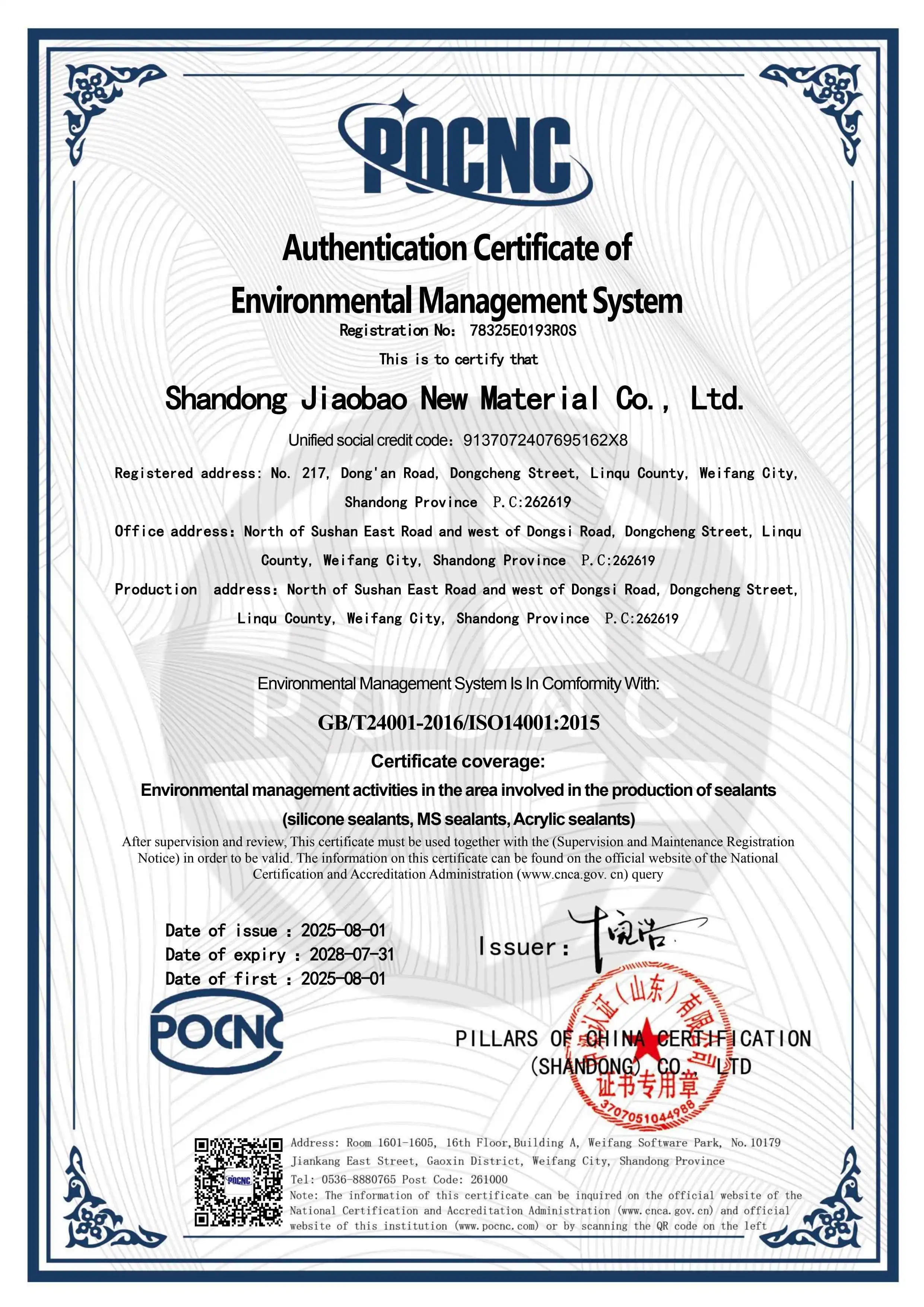
ISO and CE approvals are important for getting goods through customs in the EU and many other trade markets. Before you take a sample, ask for proof. Check to see if the plant can consistently make good batches by asking for quality control reports from at least three production runs. For more than 13 years, Jiaobao has kept its quality control process stable and makes sure that all of its export orders have the right paperwork.
People can order Jiaobao's GP acetic silicone sealant for construction in white, black, gray, or any other color they want. It comes in 300 ml tubes or 600 ml sausage packs. Distributors who deal with mixed goods will find it easier to handle their working capital when they can combine colors in a single package. OEM buyers can ask for private-label packages with logos and labels in their own language, but this usually adds one to two weeks to the wait time.
Use isopropyl alcohol or a special cleaner to get rid of all the oil, dust, old sealant residue, and loose particles that are on the substrates. Before you start, the surface must be completely dry; any water under the bead will quickly break the bond. For a clean, professional look, put masking tape along the sides of the joints. The best temperature for an application is between 5°C and 40°C.
Use a regular caulking gun and put the cartridge in it. Cut the tip at a 45-degree angle to fit the joint width, and then draw the gun along the joint while applying steady, even pressure. Within three to five minutes of putting it on, use a wet finger or spoon to make sure the bead makes full touch with both joint faces. Since you only have 15 minutes of tack-free time, work in manageable chunks.
At 23°C and 50% relative humidity, the full cure depth reaches about 2–3 mm in 24 hours. If you put it on a wet surface or when it's below 5°C, it won't stick and the curing process will stop. If the product shrinks a lot after drying, it probably has a lot of filler or solvent in it. To reduce shrinkage after curing, switch to a silicone polymer formula that is almost 100% silicone. Jiaobao makes this kind of formula.
In Vietnam, a company that brings in building supplies bought a test container of Jiaobao's GP acetic silicone sealant for construction to use on aluminum-framed windows in an apartment building. After 18 months of being exposed to tropical humidity and UV light, there were no cracks in the joints and no delamination from the metal frames. These results were in line with the product's stated service range.
An online store that sells building supplies said that Jiaobao's 300 ml white cartridge worked well for bathroom window sealing according to customer reviews. Buyers liked how quickly it dried and how there were no shrinkage gaps. The seller pointed out that uniform color matching across batches cut down on returns compared to the last provider.
Regional building materials events in 2024 and 2025 showed a rise in the purchase of non-standard sealant colors like beige, champagne, and dark brown to match modern window frame finishes. With brand-building distributors, it's clear that manufacturers who offer short-run color customization without high MOQ fees have a big advantage.
There are four things you need to think about when choosing an acetoxy silicone sealant: how well it sticks to the surface you want to seal, how fast it cures compared to the time you have to finish the project, how consistent the batches are from your supplier, and the total cost per sealed meter. Jiaobao's GP acetic silicone sealant for construction meets all four requirements. It has full ISO/CE documentation for export markets, a production lead time of one to two weeks, and different packaging options. When comparing quotes, use this guide as a check list, and always ask for a real sample before agreeing to a large order.
No. The acetic acid released during curing reacts with alkaline substrates like concrete, cement, and mortar, causing poor adhesion and potential substrate damage. For masonry or stone, choose a neutral cure silicone sealant instead.
The odor comes from the acetoxy curing mechanism. Acetic acid is released as the sealant reacts with moisture in the air. The smell disappears completely once the product has fully cured.
No. Standard silicone rubber does not accept paint after curing. Complete any painting before applying the sealant, or select a modified polymer sealant if painting over the joint is required.
Shrinkage beyond 5% indicates high solvent or plasticizer content — a sign of a low-grade formulation. A quality acetoxy silicone should be near-100% silicone polymer to hold joint volume after curing.
Yes. The service temperature range extends from −40°C to +150°C, making it suitable for cold-climate window sealing as long as you apply it above 5°C during installation.
Jiaobao has been making things for more than 13 years, is ISO/CE-certified, and can get your order of GP acetic silicone sealant for construction to you in one to two weeks. We can help both wholesale distributors and importers from other countries, whether they need standard cartridges, sausage packs, or full OEM packaging with their own brand. You can get samples and a factory price list right now by emailing our team at dorashen@cnjiaobao.com.
1. ASTM International. ASTM C920: Standard Specification for Elastomeric Joint Sealants. 2022.
2. ISO. ISO 11600: Building Construction — Jointing Products — Classification and Requirements for Sealants. 2022.
3. Petrie, E. M. Handbook of Adhesives and Sealants. McGraw-Hill, 2nd ed., 2007.
4. Construction Sealants Market — Global Forecast to 2028. MarketsandMarkets Research, 2023.
5. Wolf, A. T. "Durability of Silicone Sealants in Glazing Applications." International Journal of Adhesion and Adhesives, 2019.
6. ASTM C1183: Standard Test Method for Extrusion Rate of Elastomeric Sealants. ASTM International, 2020.
November 16,2023
Enterprise Name
The sealant has very strong adhesion and performs well even on glass and aluminum. After curing, it remains flexible and shows no cracking. Perfect for our facade projects.
November 16,2023
Enterprise Name
Stable quality across batches. Our customers especially like the smooth application and consistent extrusion. It helps reduce installation time on site.
November 16,2023
Enterprise Name
I used it for bathroom sealing. Excellent waterproof performance and no mold issues so far. It's been holding up very well in humid conditions.
November 16,2023
Enterprise Name
The neutral silicone works well on sensitive materials without corrosion. Very suitable for industrial applications requiring stable performance.