november 16,2023
Vállalat neve
A tömítőanyag nagyon erős tapadású, és még üvegen és alumíniumon is jól teljesít. Kikeményedés után rugalmas marad és nem reped. Tökéletes homlokzati projektjeinkhez.
2. november 2026.
To get a durable akril tömítőanyag dekoratív hézagtömítés, start by matching the product to the junction. If the connection is a dry interior joint with little movement such as baseboards, cut, door frames and wall-to-ceiling lines, use a water-based, one-part sealer. Then verify five points: adhesion, mobility, shrinkage, paintability and drying speed. Before you purchase in bulk, try a sample on your own substrates, using your own paint. Lastly, check over the supplier’s certificates, packaging, along with lead time. I'll guide you through each step below so that you keep your completed lines smooth and clean.
Acrylic sealant works well in dry interior seams where look is more important than movement. It is used mostly on baseboards, crown moulding, window casings, the door frames, drywall seams and wall to ceiling lines. These joints are small, have little structural movement and are frequently hidden by a layer of paint.
It fills the gap with a water-based acrylic paste that tools into a smooth bead and blends into the neighbouring surface. To a designer of interiors, the way wood trim meets a drywall wall can make or break a space, making it appear completed or hurried. Our single component RTV acrylic sealer is great for covering gaps and seams around through windows and doors.
Before you choose a cartridge, check the joint and figure out how much it moves. Wide gaps require more material and thick beads evaporate slowly and may shrink significantly. Joints between dissimilar materials, such wood and plaster, move with humidity and temperature. ISO 11600 defines building sealants by kind and movement capabilities, with plastic classifications for low-movement joints. ASTM C1193 provides guidelines on joint design and sealant application. acrylic fits tiny stable joints If you have a joint that expands and shuts substantially over the year, an extra elastic chemical typically functions better.
Acrylic isn't always the greatest option. Acrylic is not intended for persistent water exposure, thus you should not use it in continuously wet places such as baths, tub surrounds and backsplashes. The outside façades are exposed to rain, sun and more temperature changes. Glazing and joints that expand also need more movement capacity. In these circumstances, a silicone or other product rated over the service state is a preferable option. Jiaobao produces neutral and acetic silicones and we can guide you to the correct material rather than trying to put acrylic in the incorrect joint. If you get it right at this point you will eliminate most callbacks later.
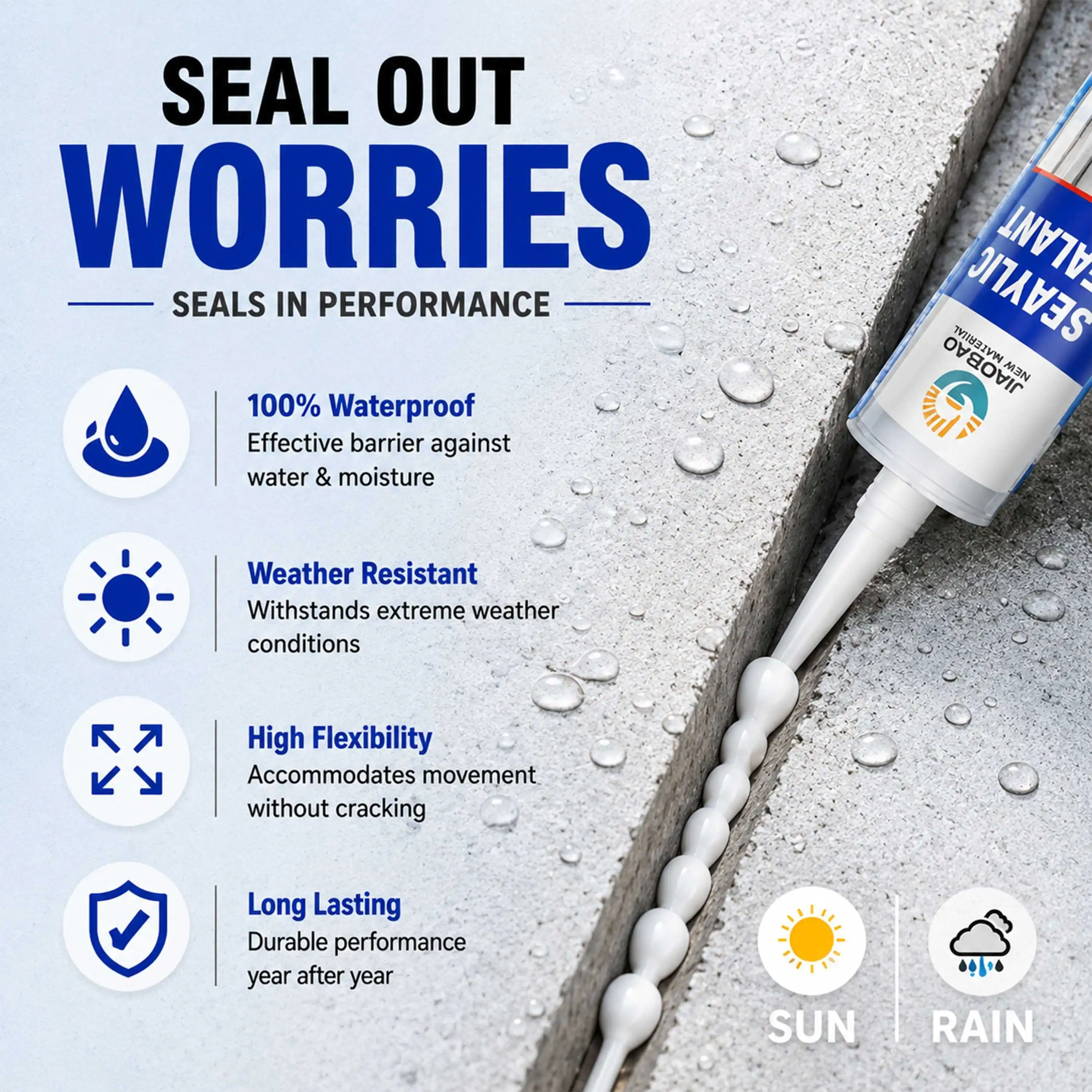
Start with motion and stickiness, since these determine whether the bead remains put. A stiff sealant will break if it's too stiff for its joint. A sealant that bonds inadequately will peel off the edge. This guidance applies to akril tömítőanyag dekoratív hézagtömítés. See the technical data sheet regarding movement capacity and the surfaces to which it will adhere, such as plaster, cement, gypsum based board, wood, MDF and painted trim.
ASTM C1521 covers the evaluation of adhesion in put in sealant joints. A site mock-up with a hand pull test delivers an early warning. In the adhesion test, our sealant shows no damage and obtains 0.64 MPa tension strength at 23℃. These numbers offer a starting point to feed your own trial that you may measure.
Shrinkage silently destroys beautiful joints. As the water exits the acrylic sealant, the bead forfeits volume and a thick bead might create a shallow groove or a hairline fissure. That groove picks up the light, showing under new paint. Check shrinkage values on data sheets, maintain beads within the manufacturers depth restrictions, and tool the finish smooth before it peels. Then examine the cured finish over pinholes, bubbles and colour changes. A consistent surface is a big deal for designers since customers will immediately pick up on a rough line. See a sample, not a catalogue illustration, to judge the finish.
Compatibility and drying time are two of a kind, since paint is what most interior projects finish up with. Acrylic sealants are usually paintable after they have skinned over and dried. It is always a good idea to paint a test joint to assure there is no cracking, colour change or poor adherence. Drying speed also dictates your timeline, since you can not complete a wet bead. Our sealant dries to touch in 0.5 hours as opposed to a conventional limit of a period of three hours or less. Thick beads and humid interiors still take longer to cure so give additional time before applying a standard topcoat and follow the paint maker’s recommendations.
The word caulk covers many chemistries, so it says little about performance. Always ask what the product is made from. Acrylic gives a smooth, paintable surface and cleans up with water while wet, which suits dry interior trim. Silicone resists moisture and handles more movement, but paint usually does not hold well on it, so it fits bathrooms and weather-exposed joints. ASTM C834 sets requirements for latex sealants, and ASTM C920 covers elastomeric joint sealants such as silicones. Each standard points to a different job. Match the label to the standard, and the standard to the joint, rather than shopping on price alone.
Here are the figures for our one-part RTV acrylic sealant, a water-based paste, so you can compare them against other data sheets. This product is our akril tömítőanyag dekoratív hézagtömítés.
| Ingatlanok | Érték: | Standard |
|---|---|---|
| típus | One-part RTV acrylic, paste form | - |
| Színek | White, black, grey; custom colors available | - |
| kötet | 300ml, 600ml | - |
| Csomagolás | Sausage and cartridge | - |
| Sag (upright) | 0 mm | ≤3 mm |
| Sag (parallel) | Nincs deformáció | - |
| Skin dry time | 0.5 óra | ≤3 óra |
| Extrudálási sebesség | 163 ml / perc | ≥80 ml/perc |
| Tensile strength (23℃) | 0.64 MPa | 0.4-0.6 MPa |
| Tapadás | Nincs pusztítás | - |
| Szavatossági idő | 12 hónap | Megfelelően tárolva |
ISO 7390 is a common method for measuring sag. Zero upright sag means the bead holds its shape on vertical joints, and the extrusion rate means the paste flows steadily on long runs.
Decorative work either succeeds or fails with colour matching. “We have white, black and grey and we can do custom colours so a joint will go well with dark trim, a translucent wall or a feature panel. Most painted walls are white, and if you're leaving the joint unpainted, ask for a unique tint. The volumes are 300ml and 600ml and are packaged in bottles or sausages. Cartridges are good for modest fit outs or hand guns, Sausage packs are good for bigger crews that desire less reloading. Shelf life is twelve months if kept correctly, therefore keep the stock in a dry area, away from freezing conditions.
Most failures are due to poor preparation. Check the joint and see if it is sturdy and within the limitations for width and depth. Remove dust, grease, loose paint and moisture. The sealant will adhere best to clean, dry, a noise surfaces. In ASTM C1193, surface preparation is considered as part of good joint sealing. For high-visibility trim, mask each edge with painters tape for a clean line. For larger gaps, add a supporting material to keep the bead shallow and shrink less. Test a new substrate, such as plated board or polymeric trim, on a concealed corner first.
Cut nozzle to suit joint, then run continuous bead so air is not trapped. Wet your finger or smoothing tool and run it over the bead before the surface dries off. Pull the tape whilst the beads is still pliable. Allow sealant to dry thoroughly before painting. Allow additional cure time for robust beads or in wet areas. After painting, check the line for pinholes, shrinking, uneven edges or lifting. Fix minor flaws immediately, since they are faster to fix than to explain to a customer.
Product faults are rarer than installation errors. Sealant adherence is reduced by dust, grease, dampness, or peeling paint. Moving joints break when using hard products. Curing and shrinkage are longer with thick beads. Paint applied prematurely might wrinkle or change colour. Unless approved, interior acrylic including our akril tömítőanyag dekoratív hézagtömítés in damp, outdoor, or high-movement environments fails early. When stored and transported, our water-based product must be kept from freezing. No expense to avoid these blunders saves labour, material, and reputation.
Buyers weigh various things. Contractors and designers want simple extrusion, smooth tooling, fast skin development, uniform colour, and standard gun compatibility. Shelf life, packaging toughness, popular sizes, paperwork, and storage concern distributors and importers. Procurement teams evaluate technical quality, delivery time, order minimums, batch uniformity, and project cost. OEMs need packaging, colour, sample, and artwork approval. We tailor orders to these demands with 300ml and 600ml alternatives, 12-month shelf life, and OEM/ODM assistance.
Check the technical data sheet for skin time, curing, movement, shrinkage, application the temperature, and shelf life. Testing samples on actual substrates and painting. For bigger or export orders, verify batch testing, filling exacting, packing, certifications, export documentation, and complaint management. Over 13 years of production expertise and a reliable quality control system distinguish Shandong Jiaobao New Materials, launched in 2013. Shipped by water or land, our items are ISO and CE certified, and manufacture takes 1–2 weeks. We refund or replace quality issues within the shelf life.
Use this brief list before every buy. The joint should be dry, internal, and low-movement. Test substrate adhesion and paint compatibility. Examine shrinkage, skin time, and extrusion. Approve a finish and colour sample bead. Check cartridge / sausage format, amount, lead length, and documents. Finally, evaluate labour, rework, delivery, and warrant risk, not just unit pricing. A somewhat more expensive sealant that avoids callbacks may minimise project expenses.
Válasszon egy akril tömítőanyag dekoratív hézagtömítés based on the junction. Acrylic works for dry, inside, low-movement gaps around trim, door frames, window trim, and wall-to-ceiling lines, while silicone or another rated substance is best for wet, exterior, high-movement connections. Movement capability, adhesion, shrinking, paintability, and drying time decide the finish, and ISO 11600, ASTM C834 and ASTM C1193 let purchasers compare. Proper preparation, tooling, and curing time for painting avoid most errors. A good purchase selection includes sample testing on actual substrates, supplier capabilities, and project cost.
Yes, acrylic sealants are generally paintable once they skin and dry. Test your paint on a sample joint first, and wait for full drying before the topcoat.
No. Acrylic suits dry interior joints with low movement. For wet areas or weather-exposed joints, choose silicone or another product rated for that service.
Our sealant reaches skin dry in 0.5 hours. Full cure depends on bead thickness, temperature, and humidity.
Yes. We support OEM/ODM production, custom colors, and sample requests. Email us to discuss your requirements.
Looking for an acrylic sealant decorative joint seal manufacturer? Jiaobao offers white, black, grey, and custom colors in 300ml and 600ml sausage or cartridge packs, with ISO and CE certifications, OEM/ODM support, and a 1–2 week production lead time. Email dorashen@cnjiaobao.com to request samples, technical data, or a bulk quotation. You can also visit shandongjiaobao.com fül alatt találsz.
1. ASTM C834 Standard Specification for Latex Sealants, ASTM International, 2017.
2. ASTM C920 Standard Specification for Elastomeric Joint Sealants, ASTM International, 2018.
3. ASTM C1193 Standard Guide for Use of Joint Sealants, ASTM International, 2016.
4. ASTM C1521 Standard Practice for Evaluating Adhesion of Installed Weatherproofing Sealant Joints, ASTM International, 2019.
5. ISO 11600 Building Construction — Jointing Products — Classification and Requirements for Sealants, International Organization for Standardization, 2002.
6. ISO 7390 Building Construction — Jointing Products — Determination of Resistance to Flow (Sag) of Sealants, International Organization for Standardization, 2002.
november 16,2023
Vállalat neve
A tömítőanyag nagyon erős tapadású, és még üvegen és alumíniumon is jól teljesít. Kikeményedés után rugalmas marad és nem reped. Tökéletes homlokzati projektjeinkhez.
november 16,2023
Vállalat neve
Stabil minőség a gyártási tételeken keresztül. Ügyfeleink különösen kedvelik a sima felvitelt és az egyenletes extrudálást. Ez segít csökkenteni a helyszíni telepítési időt.
november 16,2023
Vállalat neve
Fürdőszobai tömítésre használtam. Kiváló vízálló teljesítmény és eddig nem volt penészesedési probléma. Nagyon jól bírja a párás körülményeket.
november 16,2023
Vállalat neve
A semleges szilikon jól működik érzékeny anyagokon korrózió nélkül. Kiválóan alkalmas stabil teljesítményt igénylő ipari alkalmazásokhoz.