نوفمبر 16,2023
اسم المؤسسة
يتميز هذا المانع للتسرب بقوة التصاق عالية جدًا، ويؤدي وظيفته بكفاءة حتى على الزجاج والألمنيوم. بعد التصلب، يبقى مرنًا ولا يتشقق. إنه مثالي لمشاريع واجهات المباني لدينا.
سبتمبر 28، 2026
تطبيق نوع قابل للطلاء بمادة مانعة للتسرب أكريليكية correctly makes the difference between a seamless wall finish and a visible, patchy joint that ruins an entire room. The process involves surface preparation, precise application, controlled drying, and properly timed paint coating. When you follow each phase deliberately, the sealant integrates invisibly beneath latex or emulsion paint, leaving zero color discrepancy. Whether you manage large-scale interior fit-outs or source construction auxiliaries for distribution, mastering this application sequence protects your project quality and eliminates costly rework.
Paintable acrylic sealer is a plasto-elastic mixture that is water-based and made from acrylic acid resin. Silicone seals can't really do this because they have low surface energy, but this material's chemical structure makes a surface that is hydrophilic and easily bonds with latex and water-based paints.
Silicone seals are more flexible and resistant to weather, but paint doesn't stick to their hardened surface when scuffed hard. Polyurethane sealants have more volatile organic compounds (VOCs) and take longer to cure. Because acrylic-based sealants dry by evaporating water instead of chemical cross-linking, the time they need to be tack-free drops to about 10 to 30 minutes. Because the skin forms quickly, painting crews can move on to the coating stage during the same shift. This is a real benefit that silicone or polyurethane joints can't offer in terms of internal finishing schedules.
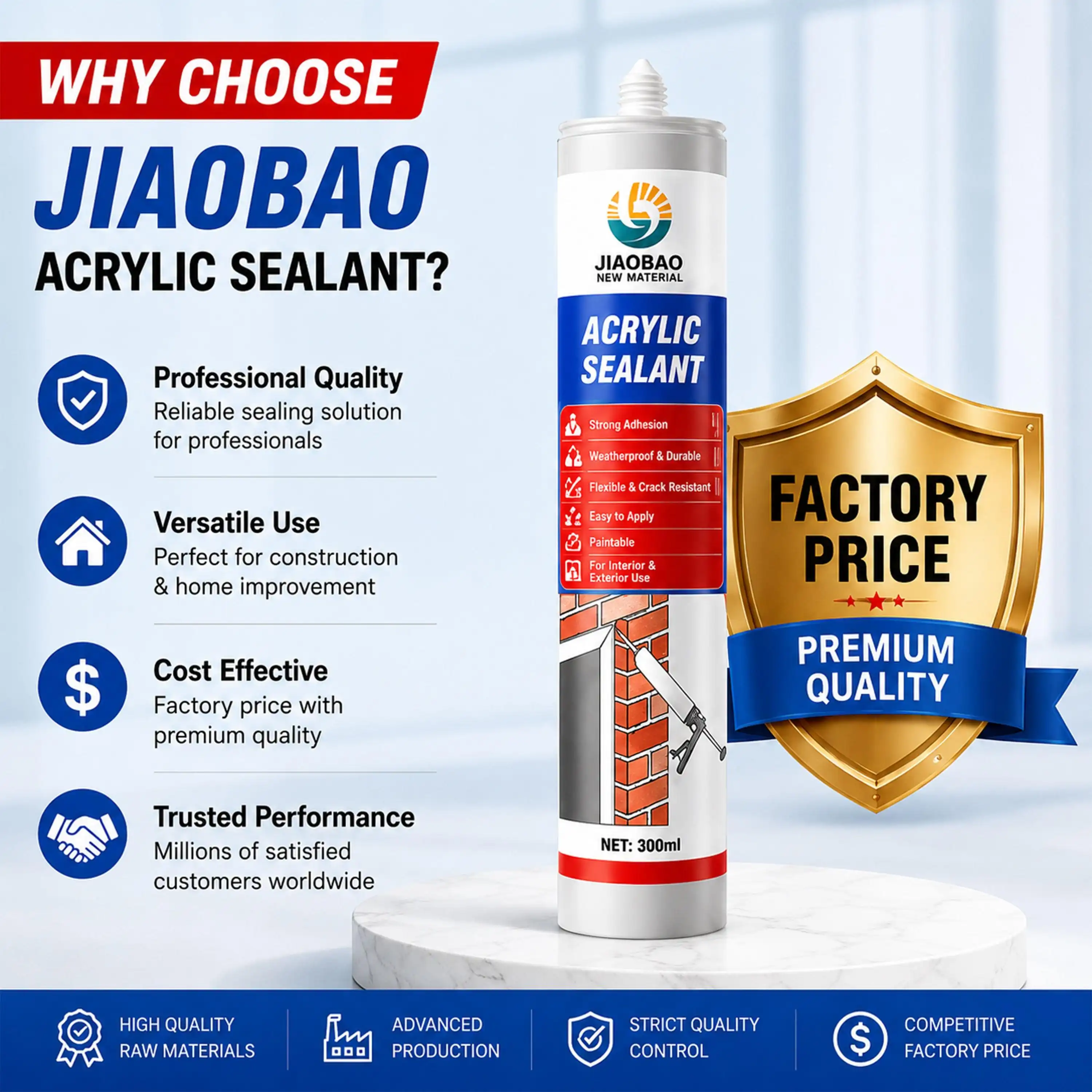
The one-component RTV acrylic sealant from Jiaobao has a surface dry time of 0.5 hours, while the industry standard is 3 hours. It also has a tensile strength of 0.64 MPa at 23°C and an extrusion rate of 163 ml/min, which is more than double the minimum standard of 80 ml/min. On vertical joints, the sag degree is 0 mm, which makes sure that the bead stays in shape and doesn't fall flat before the skin forms. Having more solids than the industry standard reduces volumetric shrinking during curing, which stops the curved joint profile that hides shadow lines under paint.
A lot of the success of sealants depends on how well the surface is prepared. In post-project audits, adhesion problems are often found to have started at this stage instead of in the program itself.
Paintable acrylic sealants stick well to drywall (gypsum board), wood moldings, primed metal, concrete, masonry, and paintable metal. To load the cartridge gun, clean the joint substrate of any dust, oil residue, loose paint, and water. On smooth surfaces, a clean, dry cloth and a light coat of rubbing alcohol are all that's needed. مادة مانعة للتسرب أكريليك قابلة للطلاء should not be confused with silicone products; do not get silicone on the substrate—even small amounts can stop acrylic from sticking and cause "fisheye" paint flaws later on.
The temperature where the application is used should not go above or below 5°C (41°F–104°F). When relative humidity is above 85%, water evaporates more slowly, so the surface dries longer than the recommended 0.5-hour window. Ideal uses are indoors, in climate-controlled areas. If you work in a place with a lot of humidity or in the winter, give the sealant more time to dry before applying the finish coat. Skipping this step is the most common way for paint to crack over newly applied sealant.
To get a truly unnoticeable joint, each step must be done in a methodical way. The steps below are standard professional finishing methods and are in line with Jiaobao's formulation's technical features.
These steps work the same way for all interior projects, like skirting boards, door and window architraves, gypsum ceiling joints, and cornice connections. The 163 ml/min production rate makes sure that the beads flow smoothly and evenly, even when running for long periods of time. This is important for big home or business projects.
Once the application steps are done, look at the joint line with a raking light before painting. At this point, while the مادة مانعة للتسرب أكريليك قابلة للطلاء is still workable, any holes or thin spots should be fixed.
After completing the application sequence, inspect the joint line under raking light before painting. Any pinholes or thin spots should be addressed at this stage while the sealant remains workable.
Some site factors or substrate variables can make things harder, even if the right product is used. By noticing these problems early on, they can be fixed before they get too bad and cost a lot to fix.
Cracking paint over a sealant joint is almost always caused by coating too soon. The sealant still has some wetness inside it that hasn't fully evaporated, and the topcoat traps it as a vapor barrier. Instead of being fully elastic, acrylic sealants are plasto-elastic, which means they can bend up to about 12.5%. Joints that move outside of this range, like those that join different materials with big differences in thermal expansion, will develop tiny splits at the sealant-substrate contact over time. This lets water in and causes the paint to peel off.
If you don't use an adhesion primer, standard acrylic sealants may not stick as well to dense, non-porous surfaces like anodized aluminum or glazed tile. It is common practice in B2B buying to do a peel adhesion test (per ASTM C794) on a sample panel before the whole job is done. The Jiaobao formulation doesn't fail to stick to any of the normal substrates that were tried, but it's still best to use a primer on thick, non-porous materials.
Regular inspections every 12 months, especially at the points where window frames and skirting meet in ways that change with the seasons, allow for timely touch-ups with مادة مانعة للتسرب أكريليك قابلة للطلاء before small gaps caused by shrinking turn into structural openings for air and wetness.
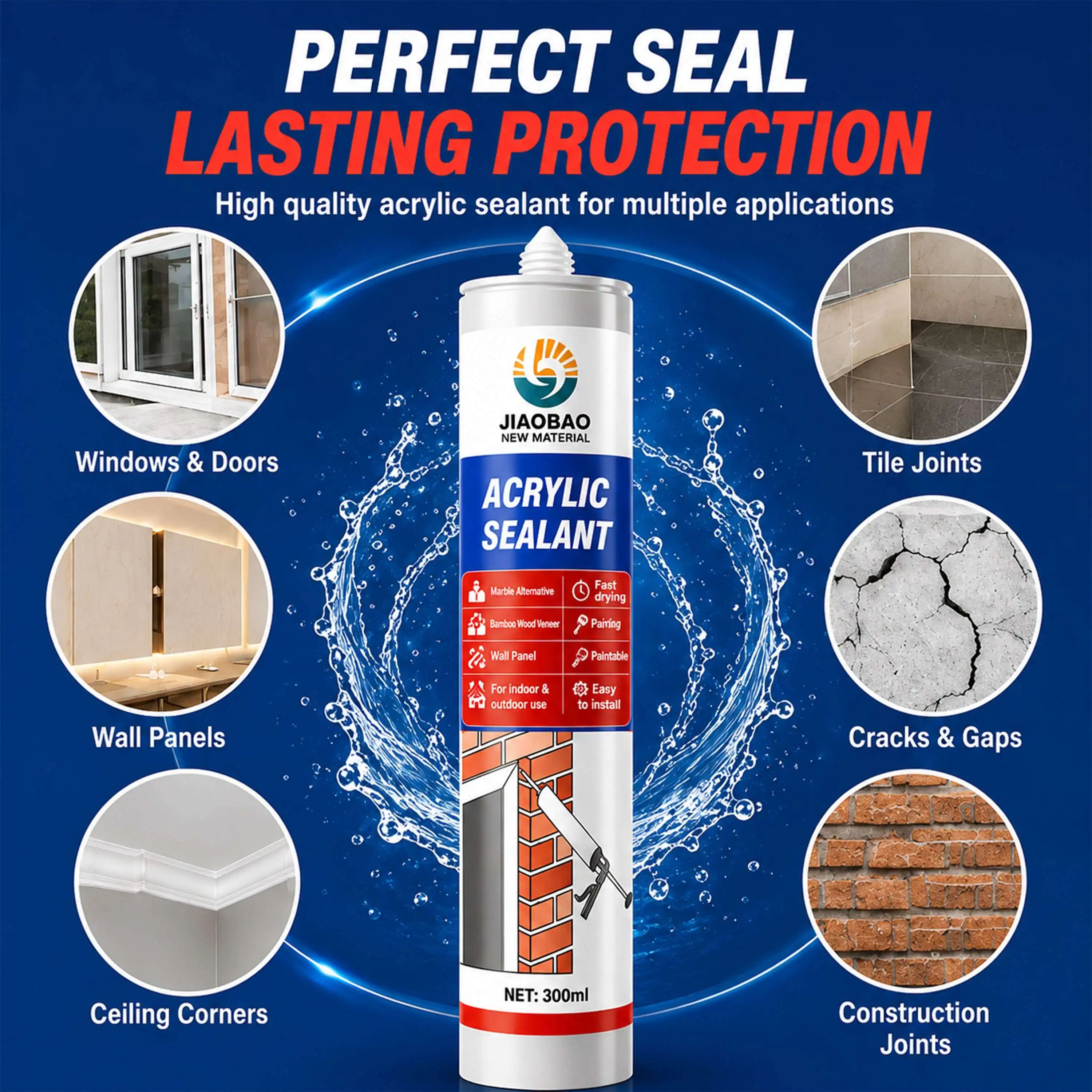
Five things that can be checked are used to decide what interior sealants to buy: data on paint compatibility, VOC compliance, tensile and elongation ratings, batch consistency records, and the reliability of lead times. Distributors who pair sealant lines with paint lines need proof that the sealants work with more than one brand of topcoat, not just one internal test result.
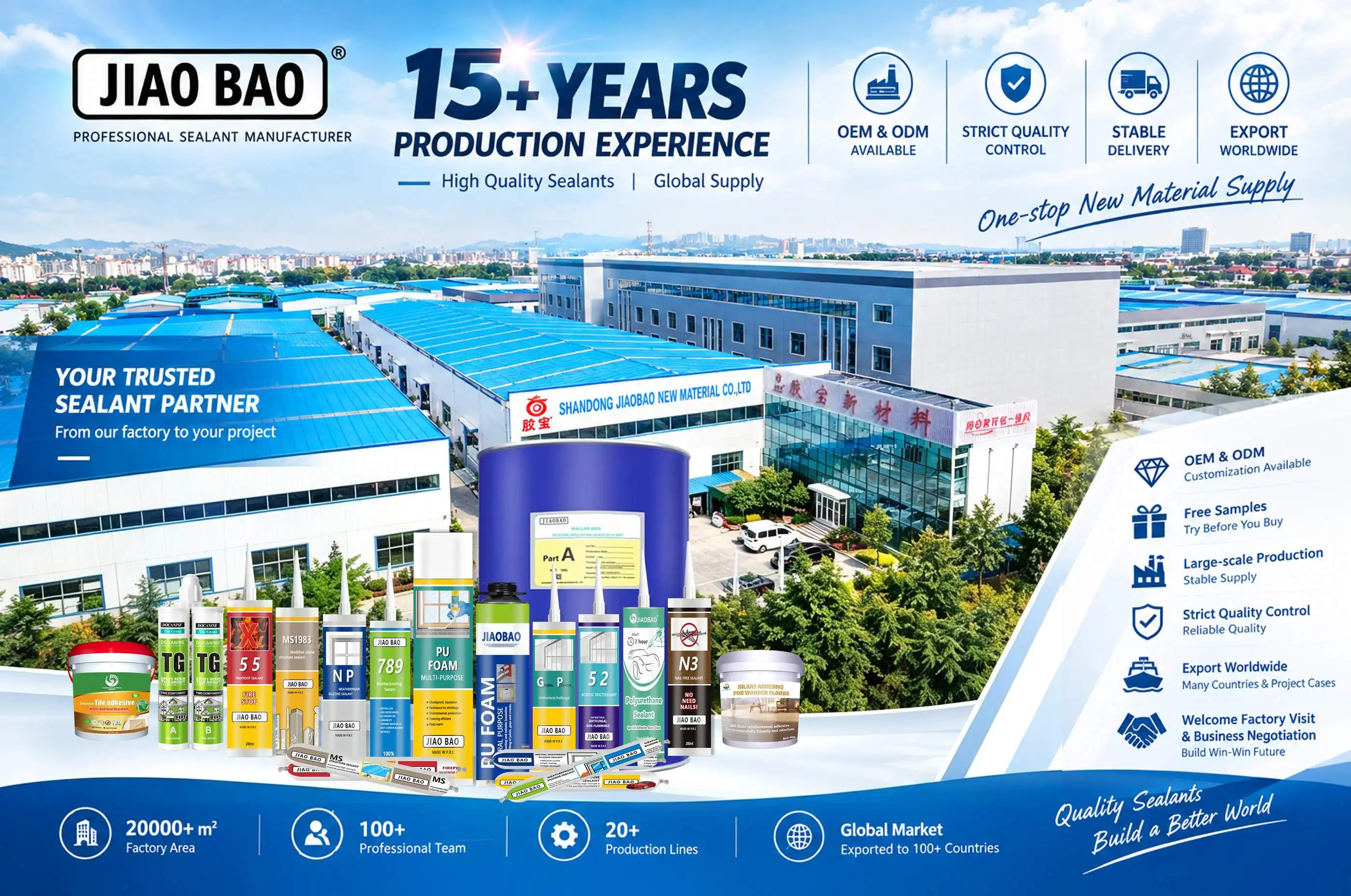
The Acrylic Sealant Paintable Type factory in Jiaobao has been making products for over 13 years. Certifications from ISO and CE back up the product line. It ships in one to two weeks after an order is confirmed and comes in 300 ml cartridges and 600 ml sausage packs in white, black, gray, or custom color choices. Private-label needs can be met by OEM and ODM programs that offer flexible minimum order amounts, full English TDS and SDS documentation, and custom packaging design for trade and retail outlets.
The right way to use paintable acrylic sealer starts with a clean base, then exact bead placement and quick tooling, and finally a paint coating window that is at the right time. The technical specs—0.5-hour surface dry time, 0 mm sag, and 0.64 MPa tensile strength—are only useful if the order of application doesn't mess up any of the curing stages. مادة مانعة للتسرب أكريليك قابلة للطلاء is better for procurement teams to find a product whose batch consistency is recorded and whose provider can quickly react to large orders. Getting these basics right cuts down on rework and saves both project margins and client happiness.
Allow at least 30 minutes for the surface to dry before spray treatment and at least 1 to 2 hours before brush application when the temperature and humidity inside are normal (23°C and 50%). If you paint too early, the topcoat will trap any remaining moisture, which will cause the paint film to crack as the sealant shrinks during the final cure.
Standard acrylic seals are made for use inside or outside in protected areas. Continuous contact to water and extreme changes in temperature are too much for most plastic types to handle. It's better to use a siliconized acrylic hybrid or a weatherproof sealant rated to ASTM C920 for window perimeter joints that are exposed to direct weather.
If the joint cracks after curing, it usually means that it moved outside of the sealant's elasticity range (±12.5%). Acrylics are plasto-elastic, which means they are both stretchy and plastic. High differences in thermal expansion between substrates, like metal trim against plasterboard, can put too much stress on the bond over time, making it impossible to repair.
If you keep it in a cool, dry place out of direct sunlight and freezing weather, it will last for 12 months from the date it was made. To make sure that water-based emulsions stay stable during cold-chain processes, they must pass the ASTM C731 freeze-thaw stability test.
Jiaobao has been making high-quality acrylic sealant for over 13 years and is ISO and CE-certified. This paintable sealant works well in both business and residential finishing jobs. As a reliable provider of Acrylic Sealant Paintable Type, we offer OEM/ODM options, wait times of one to two weeks, and expert support that is second to none. You can email our team at dorashen@cnjiaobao.com أو زيارة shandongjiaobao.com to ask for samples or talk about your sourcing needs.
1. ASTM C834: Standard Specification for Latex Sealants — ASTM International, 2020.
2. ASTM C920: Standard Specification for Elastomeric Joint Sealants — ASTM International, 2022.
3. ISO 11600: Building Construction — Jointing Products — Classification and Requirements for Sealants — International Organization for Standardization, 2022.
4. ASTM C794: Standard Test Method for Adhesion-in-Peel of Elastomeric Joint Sealants — ASTM International, 2018.
5. Construction Sealants and Adhesives, 4th Edition — Julian R. Panek & John Philip Cook, John Wiley & Sons, 2010.
6. Paint and Surface Coatings: Theory and Practice, 2nd Edition — R. Lambourne & T.A. Strivens, Woodhead Publishing, 1999.
نوفمبر 16,2023
اسم المؤسسة
يتميز هذا المانع للتسرب بقوة التصاق عالية جدًا، ويؤدي وظيفته بكفاءة حتى على الزجاج والألمنيوم. بعد التصلب، يبقى مرنًا ولا يتشقق. إنه مثالي لمشاريع واجهات المباني لدينا.
نوفمبر 16,2023
اسم المؤسسة
جودة ثابتة في جميع الدفعات. يُعجب عملاؤنا بشكل خاص بسهولة الاستخدام وثبات عملية البثق، مما يُساعد على تقليل وقت التركيب في الموقع.
نوفمبر 16,2023
اسم المؤسسة
استخدمته لعزل الحمام. يتميز بأداء ممتاز في مقاومة الماء، ولم أواجه أي مشاكل مع العفن حتى الآن. كما أنه يتحمل الرطوبة بشكل جيد للغاية.
نوفمبر 16,2023
اسم المؤسسة
يُعدّ السيليكون المحايد مناسبًا للاستخدام مع المواد الحساسة دون التسبب في التآكل. وهو مثالي للتطبيقات الصناعية التي تتطلب أداءً مستقرًا.
_1779347426672.webp)